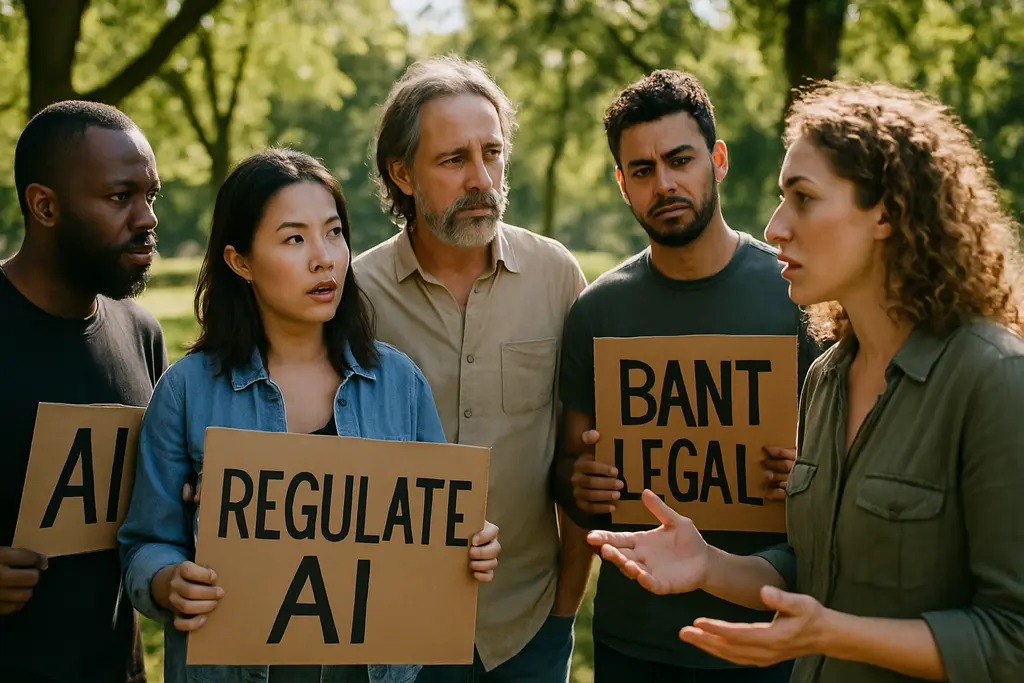
Congressional AI regulatory proposals became a practical organizing test in 2026, not just a policy debate among lawmakers, companies, and technical experts. The research record supplied for this case study shows advocacy groups responding to draft bills, possible federal preemption of state laws, data-center expansion, worker anxiety, and safety claims about advanced AI systems. The clearest pattern is not a single movement with one demand. It is a set of coalitions using letters, petitions, district-level pressure, public warnings, and coordinated protest to define what lawmakers should treat as acceptable AI regulation.
Because the proposals discussed here were draft, proposed, reported, or advocated as of October 22, 2026, this analysis does not describe them as enacted law. It focuses on how the policy process affected mobilization: who organized, what stories they told, which institutions they targeted, and where the evidence is still incomplete.
How Congressional AI regulatory proposals Changed Mobilization Signals
State Preemption Moved Groups From Issue Advocacy To Threat Assessment
One major trigger was the possibility that Congress could limit state authority over AI rules. The research notes state that on June 18, 2026, more than 130 civil society organizations, including SEIU, the Center for Biological Diversity, Common Cause, Consumer Federation of America, Public Citizen, and UltraViolet Action, submitted a letter urging congressional leaders to reject the Obernolte-Trahan draft bill. The stated concern was preemption: if Congress displaced state regulation too broadly, existing or future state privacy, civil-rights, and consumer protections could be weakened before federal protections were fully tested.
The research notes also record that on June 4, 2026, the ACLU criticized a draft bipartisan framework from Representatives Jay Obernolte and Lori Trahan, arguing that it would largely prohibit states from enforcing existing or new protections, including privacy and anti-discrimination laws. That sequence matters for movement strategy. Organizers were not only asking Congress to regulate AI. They were trying to prevent a federal bill from closing off state and local paths that activists had already used or expected to use.
Congressional AI regulatory proposals As A Coalition Test
On October 7, 2026, nearly 40 labor, progressive, faith, and AI safety groups, including Guardrails Action, sent a letter to Congress that set out demands for AI legislation and warned that any bill crossing their red lines would face “active, mobilized opposition,” according to Semafor. For organizers, Congressional AI regulatory proposals became a coalition test: could groups with different priorities agree on boundaries clear enough to pressure lawmakers?
The letter strategy used a familiar movement form. It named constituencies, described unacceptable outcomes, and signaled capacity for opposition. In digital advocacy, that kind of document can serve several audiences at once. It gives congressional staff a policy checklist, gives member organizations language for email and social campaigns, and gives reporters a way to describe a coalition without treating every group as identical. The risk is compression. A red-line letter can clarify demands, but it can also hide disagreement over priorities such as state authority, worker displacement, anti-discrimination enforcement, model safety, environmental impacts, and public procurement rules.
Evidence Of Grassroots Pressure Beyond The Letter
Petition Counts Became District Signals
The research notes state that on March 13, 2026, a coalition including ARI, Demand Progress, and Public Citizen launched a grassroots petition opposing a proposed freeze, or moratorium, on state and local AI laws. By that date, the petition had gathered more than 25,000 signatures, including more than 3,000 from congressional districts represented by the three AI Commission co-chairs: Representatives Josh Gottheimer, Valerie Foushee, and Ted Lieu.
That district-level detail is central. A national signature count can show breadth, but district counts are more useful to congressional offices because they connect a policy position to constituents. In movement terms, the petition translated an abstract institutional dispute into a local accountability claim: the people represented by lawmakers involved in AI policymaking were already watching the preemption question.
Meetings And Insider Witnesses Changed The Messenger
The Washington Post reported in September 2026 that dozens of current and former AI researchers had left their companies or spoken publicly after concerns about existential risk, and that safety-focused groups had reported many meetings with congressional offices; Encode AI said it had held about 150 separate meetings with members of Congress in the prior year, according to The Washington Post. That account does not prove that grassroots pressure caused any specific bill. It does show that safety advocates sought to move from online warning to institutional contact.
This messenger shift is significant. Traditional grassroots campaigns often rely on affected residents, workers, parents, patients, or consumers. AI safety advocacy added another figure: the technical insider who claims direct knowledge of systems under development. That can be persuasive in congressional settings, but it also raises a standard of proof. Public claims about catastrophic risk carry high stakes. Responsible advocacy needs to separate documented technical concerns, expert judgment, disputed forecasts, and speculative claims.
Infrastructure Protests Expanded The Frame
Data Centers Connected AI Policy To Place
The research notes state that on July 18, 2026, a coordinated effort by Humans First brought 142 protests across 42 states against rapid AI data-center expansion. The protests raised environmental, social, and transparency concerns. This was a different form of AI mobilization than the congressional letter or the safety meeting. It located AI politics in communities facing energy use, land-use questions, water concerns, local tax arrangements, or public-service strain.
That place-based frame matters because federal AI regulation can appear distant from residents who do not work in technology policy. Data centers give AI a local footprint. They also widen the coalition beyond digital rights and safety groups to include environmental advocates, local civic groups, and residents seeking more information from companies and public officials. For a broader public-interest frame on environment and society, the network also publishes Earth Times, which highlights diverse environmental and societal impacts.
Job Loss And Cross-Party Risk Became A Mobilizing Story
The research notes state that in an August 12, 2026 article, Representative Greg Casar, chair of the Democratic Progressive Caucus, described backlash against AI data centers as “tremors of a bigger political earthquake” and warned that job losses could drive greater voter pushback across party lines. The quote is best read as political interpretation, not a measured forecast. Still, it points to a narrative shift: AI regulation was no longer only about model safety or consumer privacy. It became linked to work, wages, local control, and community consent.
That shift connects with broader advocacy questions about public oversight. The site’s related analysis of AI Oversight Initiatives examines why campaign claims about AI need evidence, human control, and clear limits. The same caution applies here. Mobilization can speed public attention, but it cannot replace proof about job effects, infrastructure burdens, or the legal impact of draft statutory language.
What Organizers Learned About Message Discipline

Red Lines Worked Better Than Abstractions
Congressional AI regulatory proposals gave organizers a concrete target. Instead of asking supporters to respond to AI in general, groups framed mobilization around specific choices: whether Congress should preempt state law, whether companies should face stronger oversight, whether human control requirements should be written into law, and whether local communities should have more say over AI infrastructure.
- Letters signaled elite coalition alignment and gave lawmakers a written record of opposition.
- Petitions translated national concern into district-level pressure.
- Congressional meetings moved AI safety arguments into institutional settings.
- Protests made AI infrastructure visible as a local political issue.
The strongest strategic move was specificity. Groups did not simply say that AI was dangerous or that innovation needed support. They identified the policy mechanism they opposed or supported. In the preemption fight, that mechanism was the federal displacement of state authority. In the safety fight, it was oversight of advanced systems. In the infrastructure fight, it was the siting and governance of data centers.
Claims Still Need Guardrails
The evidence does not support a claim that grassroots groups alone shaped congressional action. Congressional offices also respond to committee priorities, party leadership, industry lobbying, agency capacity, state government pressure, campaign finance concerns, and public opinion. The April 2026 survey noted in the research file, finding strong support among K Street leaders for federal handling of AI regulation, suggests that elite policy actors were also pressing for federal frameworks.
That is why causal language should stay careful. The confirmed pattern is that advocacy groups treated AI proposals as mobilizing opportunities and pressure points. It is less certain which parts of that advocacy changed bill text, committee agendas, or member positions. A defensible case study can say that mobilization intensified around preemption, safety, and infrastructure. It should not say that mobilization alone produced the reported legislative proposals.
Congressional AI regulatory proposals And Grassroots Mobilization
The case shows that Congressional AI regulatory proposals turned AI governance into a multi-front organizing campaign by October 22, 2026. Labor, faith, progressive, safety, civil-rights, consumer, environmental, and local groups did not all use the same story. Some emphasized state authority and anti-discrimination law. Others emphasized existential risk, worker displacement, data-center impacts, or public transparency.
The shared lesson is institutional: draft federal language can mobilize people before a bill becomes law. The practical lesson is strategic: movements gain traction when they connect national proposals to concrete harms, named decision-makers, district-level pressure, and verifiable demands. The unresolved question is legislative. As of the research record used here, the key items were proposed, reported, criticized, or demanded; they were not presented as enacted federal law. Any later assessment should start with the exact bill text, committee action, votes, and final statutory language rather than campaign claims alone.