
Categories
Digital Campaign Best Practices

Katie Zacharia Becomes White House Press Secretary: What Changes In Trump’s Media Strategy?

Katie Zacharia’s appointment as White House press secretary marks a significant transition in President Donald Trump’s communications operation just weeks before the November 3, 2026, midterm elections. The former conservative television commentator and Trump Media & Technology Group adviser officially began her new role on October 12, replacing Karoline Leavitt, and delivered her first White House press briefing the following morning.

The growing fragmentation of political media reflects a broader transformation in how Americans consume information, exchange opinions, and evaluate public figures. Online communities increasingly influence conversations that once depended primarily on television networks and newspapers, with specialized platforms such as sports betting discussion forums illustrating how audiences gather around shared interests to debate developments and compare perspectives. Although these communities focus on different subjects, their participatory structure offers a useful comparison for understanding Donald Trump’s direct-to-audience communication strategy and the challenges Katie Zacharia faces in reaching an increasingly decentralized media landscape.

The appointment raises an important question about the administration’s media strategy: will Zacharia introduce a different approach to communicating government policy, or will she reinforce Trump’s existing preference for direct political messaging, sympathetic media outlets and tightly controlled public appearances?

Her first briefing on October 13 provided an early indication. Speaking inside the James S. Brady Press Briefing Room in Washington, D.C., Zacharia emphasized the president’s political priorities, defended his administration’s record and promised to continue expanding access for newer media organizations.

However, the appearance lasted approximately 14 minutes and included questions from only three news outlets. That limited exchange prompted scrutiny of how the new press secretary intends to balance political advocacy with the White House’s responsibility to answer questions from the broader press corps.

The official White House announcement described her debut positively, while independent reporting highlighted the limited questioning and the challenges of her first appearance.

The White House

+1

For political communication analysts, Zacharia’s arrival offers a timely case study in how presidential administrations manage their public image, communicate policy priorities and navigate an increasingly fragmented American media environment.

Who Is Katie Zacharia, Trump’s New White House Press Secretary?

Katie Zacharia became the 37th White House press secretary following Trump’s announcement of her appointment on October 9, 2026.

She succeeded Karoline Leavitt, who left the position on August 27. Leavitt had become one of the most recognizable public faces of the administration through her frequent appearances in the briefing room and confrontational exchanges with journalists.

Zacharia brings a different professional background to the position.

Before joining the White House, she worked as a communications adviser to Trump Media & Technology Group, the parent company of Truth Social. She also appeared as a conservative political commentator on Fox News and Newsmax and briefly served in a communications role at the Department of Homeland Security.

Her experience places her at the intersection of political commentary, digital media and government communications.

Unlike a traditional press secretary whose career develops primarily through institutional public relations or campaign press operations, Zacharia entered the position with substantial experience communicating political viewpoints to television audiences.

That distinction matters because the responsibilities of a television commentator and a White House press secretary are not identical.

A commentator can concentrate on persuading an audience or interpreting events through a political perspective. A government spokesperson must also explain official decisions, clarify policy details and respond to questions that may challenge the administration’s preferred narrative.

The Washington Post’s October 12 report documented Zacharia’s previous media and communications roles and the transition from Leavitt.

The Washington Post

Her background may make her comfortable defending the administration on television, but success in the briefing room will require an additional set of skills: responding accurately under pressure, explaining complicated policy decisions and maintaining credibility beyond the president’s political supporters.

Katie Zacharia’s First White House Briefing Reveals An Early Communication Pattern

Zacharia’s inaugural briefing on October 13 was one of the first opportunities for journalists to evaluate her approach to the position.

The session lasted approximately 14 minutes, including prepared remarks and a short question-and-answer period.

She began by thanking Trump for appointing her and outlining what she described as the administration’s achievements.

Her opening remarks emphasized economic policy, energy, immigration and the president’s campaign activities ahead of the midterm elections.

Zacharia also discussed Trump’s upcoming political travel, including planned appearances in Georgia, Kentucky and Florida.

The structure of the briefing was notable.

According to Associated Press coverage of her debut, she took questions from Breitbart, Fox News and the Daily Mail before ending the session.

apnews.com

Those outlets have different editorial operations, but all three have audiences that include substantial conservative readership or viewership.

The decision to take only three questions does not establish how Zacharia will conduct future briefings. Nevertheless, it illustrates the degree of control a press secretary can exercise over which subjects receive attention.

A press briefing serves several purposes simultaneously.

It allows an administration to explain its policies, provides journalists with opportunities to request clarification and creates a public record of government statements.

When the question-and-answer portion is brief, the balance shifts toward prepared communication rather than sustained examination.

That distinction is particularly important during an election season, when government announcements and political campaign messages can overlap.

The White House praised Zacharia’s performance, and Trump also expressed approval. Other observers questioned whether the short session demonstrated sufficient preparation for the demands of the position.

Those competing assessments underscore a central tension in presidential communications: an appearance can be politically effective for supporters while leaving journalists seeking more substantive answers.

From Karoline Leavitt To Katie Zacharia: Continuity And Change

The transition from Leavitt to Zacharia represents a change in personnel, but the available evidence does not yet establish a fundamental transformation in White House media strategy.

Leavitt’s tenure was associated with assertive defenses of Trump, direct challenges to critical reporting and an emphasis on communicating with media organizations beyond the traditional White House press corps.

Zacharia has already signaled support for continuing that approach.

During her first briefing, she praised Leavitt’s work and expressed support for retaining the New Media Seat, an initiative intended to provide opportunities for digital creators and other nontraditional media participants.

The administration has presented this policy as an effort to broaden media access.

Supporters of such initiatives argue that traditional news organizations should not have exclusive influence over the questions asked at White House briefings.

Digital publishers, independent journalists and online commentators can reach audiences that do not regularly consume conventional television or newspaper coverage.

However, broader access does not automatically guarantee broader scrutiny.

The effectiveness of any media-access policy depends on whether participants are able to ask substantive questions, challenge official claims and seek follow-up answers.

The White House’s October 13 statement confirmed Zacharia’s intention to maintain and potentially expand the New Media Seat.

The White House

The distinction between media diversity and viewpoint diversity will therefore become an important measure of her tenure.

A briefing room may include more types of publishers without necessarily exposing the administration to a wider range of difficult questions.

Conversely, a well-managed expansion could give legitimate independent reporters opportunities that previously were difficult to obtain.

Zacharia’s challenge is to demonstrate that the policy improves public access to information rather than simply strengthening the administration’s preferred communication channels.

Trump’s Direct-To-Audience Strategy Could Become Even More Important

One of the defining characteristics of Trump’s political communication has been his willingness to communicate directly with supporters rather than relying exclusively on traditional news organizations.

Truth Social, campaign rallies, televised interviews and short-form videos allow the president to distribute messages without waiting for journalists to interpret them.

Zacharia’s previous association with Trump Media & Technology Group is relevant in this context.

Her professional experience suggests familiarity with the digital platforms and political audiences that form an important part of the president’s communication ecosystem.

However, that background does not necessarily mean she will introduce new digital strategies.

The administration already uses social media extensively, and Trump remains a highly visible political communicator who frequently sets the news agenda through his own statements.

Zacharia’s contribution may therefore involve reinforcing messages across different platforms rather than developing a separate public identity.

The distinction is important.
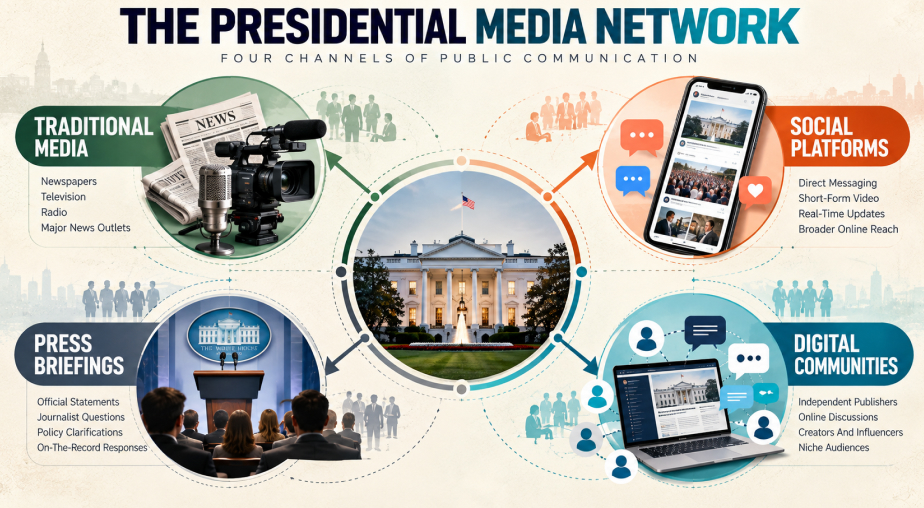
How Trump's Media Strategy Reaches Different Audiences

In a conventional communications structure, the press secretary may serve as the administration’s primary public interpreter. In Trump’s political operation, the president often delivers major announcements himself, leaving spokespersons to explain, defend or amplify those statements afterward.

The White House’s official video archive illustrates its emphasis on distributing presidential appearances, short videos and press briefings through its own channels.

The White House

This approach gives the administration greater control over presentation and timing.

It also creates challenges for independent verification because official clips may omit the broader context that journalists seek through follow-up questions.

For Zacharia, effective communication will depend partly on whether she can supplement the president’s direct messaging with detailed, reliable explanations of government policy.

White House Press Access Becomes A Major Test For Zacharia

Zacharia assumes the position during an ongoing legal dispute involving access to the White House.

CNN, MS NOW and Politico challenged the administration after their journalists’ credentials were revoked in September 2026.

The news organizations argued that the restrictions constituted retaliation for critical coverage and violated constitutional protections.

The administration defended its authority to manage access to White House facilities and disputed the outlets’ characterization of its actions.

On October 13, U.S. District Judge Timothy Kelly granted a preliminary injunction preventing the administration from enforcing the credential revocations while litigation continues.

The decision did not resolve the entire case or guarantee access to every presidential event, including certain restricted press-pool assignments.

Nevertheless, it represented an important legal development concerning the relationship between the executive branch and independent journalism.

According to CBS News’ coverage of the court ruling, Kelly concluded that the restrictions likely violated constitutional protections under the First and Fifth Amendments.

CBS News

The dispute presents Zacharia with a difficult institutional challenge.

As White House press secretary, she must represent the president’s positions while managing daily interactions with journalists whose reporting the administration may strongly oppose.

The legal controversy also raises questions about how access decisions influence public perceptions of transparency.

Government officials have legitimate responsibilities to organize briefings, manage security and establish procedures for media participation.

At the same time, restrictions based on unfavorable coverage can undermine the principle that journalists should be able to scrutinize government decisions independently.

Zacharia’s approach to these issues will be an important indicator of whether the administration intends to improve relations with the broader press corps or maintain a more confrontational structure.

Political Communication And Government Accountability During The 2026 Midterms

The timing of Zacharia’s appointment adds another dimension to her responsibilities.

The United States is approaching the November 3 midterm elections, and Trump has been actively campaigning for Republican candidates.

During her first briefing, Zacharia highlighted the president’s political travel and emphasized the administration’s economic and immigration messages.

Those themes are central to the Republican Party’s campaign narrative.

However, communicating government policy and promoting electoral candidates are distinct activities.

A White House press secretary is expected to explain the administration’s actions, including policy decisions that may influence voters’ opinions.

Political messaging becomes more complicated when official communications closely resemble campaign promotion.

For journalists, the challenge is determining whether government statements provide independently verifiable information or primarily advance electoral narratives.

For the administration, the challenge is maintaining a coherent message while responding to legitimate questions about policy outcomes.

Zacharia’s debut suggested that she intends to place substantial emphasis on reinforcing the president’s political priorities.

The October 13 briefing transcript documents the subjects she discussed and the relatively limited time devoted to reporters’ questions.

Roll Call

The next several weeks will offer a clearer picture of how she handles the distinction between policy explanation and campaign-oriented communication.

The quality of that distinction matters because public confidence depends not only on whether government officials communicate frequently, but also on whether their statements are accurate, contextualized and open to scrutiny.

What Katie Zacharia Must Demonstrate In Her First Weeks

Zacharia’s initial appearance provides only a limited basis for judging her long-term performance.

The first briefing attracted attention because of its short duration, prepared presentation and restricted questioning.

Those characteristics may reflect an early adjustment period rather than a permanent operating model.

Her performance should therefore be evaluated over multiple briefings rather than through a single appearance.

Several indicators will help determine whether her appointment produces meaningful changes in White House communication:

  • Briefing frequency and accessibility: Whether regular sessions provide meaningful opportunities for questions from a broad range of news organizations.
  • Policy knowledge and accuracy: Whether Zacharia can explain complex government decisions with sufficient detail and correct inaccurate statements when necessary.
  • Response to difficult questions: Whether she engages substantively with critical reporting rather than relying primarily on prepared political messages.
  • Digital media strategy: Whether expanded access for independent creators contributes to greater transparency and more informative public communication.

These measures matter more than the immediate reaction to her first appearance.

A press secretary’s effectiveness cannot be assessed solely through television presentation, social media engagement or approval from political supporters.

The position also carries an institutional responsibility to provide information about the federal government’s actions.

That responsibility becomes particularly important when policies affect economic conditions, immigration enforcement, international relations and other matters of substantial public interest.

Zacharia’s ability to combine political message discipline with substantive public explanations will shape her credibility.

Behind The Questions: A Journalist Prepares For A White House Briefing

What Zacharia’s Appointment Reveals About The Future Of Presidential Media Relations

Katie Zacharia’s arrival reflects the continued importance of political loyalty, media familiarity and direct communication in Trump’s White House.

Her background in conservative commentary and Trump-affiliated media makes her a recognizable representative of the administration’s existing communication culture.

Her first briefing reinforced several established priorities: promoting the president’s record, emphasizing political messaging and supporting greater participation by nontraditional media organizations.

At the same time, the short question-and-answer period and the ongoing legal dispute over press access demonstrate the unresolved tensions surrounding the administration’s relationship with independent journalism.

It is too early to conclude that Zacharia will substantially transform Trump’s media strategy.

The more immediate possibility is continuity, with a new spokesperson responsible for defending and explaining an established communication approach.

Whether that approach evolves will depend on her subsequent briefings, her handling of difficult policy questions and the administration’s decisions concerning media access.

The broader significance extends beyond one appointment.

Presidential communication now operates across official government channels, partisan media, independent journalism, digital platforms and direct-to-audience political messaging.

Each channel influences how citizens encounter government information and how competing interpretations of public policy develop.

Zacharia’s tenure will help illustrate whether a modern White House press secretary can operate effectively within that fragmented environment while preserving the accountability expected of an official government spokesperson.

The coming weeks will reveal whether her role becomes primarily an extension of Trump’s political messaging operation or develops into a more substantive channel for explaining the administration’s decisions to the American public.


Categories
Digital Campaign Best Practices

Screen Time Regulations After HHS Symposium

Screen time regulations should be read carefully after the HHS Live Real Life Symposium held on September 1, 2026, in Washington, D.C. Based on the research record provided, the federal activity described here includes a Surgeon Generals Advisory and Toolkit released on May 20, 2026, a public-health campaign, continuing education for clinicians, and Healthy People 2030 objective refinements that had a public comment period ending on July 16, 2026. Those are significant government signals, but they are not all binding legal mandates. For digital campaign teams, that distinction affects claims, consent practices, youth targeting, and the way advocacy messages describe risk.

What Screen Time Regulations Actually Changed

Screen Time Regulations Are Not One Legal Category

The phrase can obscure the legal status of different federal actions. HHS reported on May 20, 2026 that it had released a Surgeon Generals Advisory and Toolkit warning that children spend more time on screens than sleeping, exercising, or engaging face to face with family and friends; the same release cited national estimates that adolescents average 7 to 9 hours per day on entertainment screens, excluding school work HHS announcement. An advisory can influence schools, health systems, nonprofits, platforms, and lawmakers. It does not operate in the same way as a statute, court order, or final agency rule.

That difference matters for ethical marketing. A campaign can accurately say that HHS has issued advisory materials and public-health messaging. It should not imply that every recommendation has become a national legal limit unless a statute, regulation, or enforceable policy says so. The safer practice is to identify the issuing office, date, document type, audience, and any stated next step.

What The September 1 Symposium Added

The September 1, 2026 Live Real Life Symposium, according to the research record supplied for this article, brought together experts from technology, medicine, education, government, and advocacy to discuss harms of screen use in children and healthier childhood development. HHS also introduced a childrens book, The Magic Tablet, as a storytelling tool for Live Real Life principles, with a printable version expected to be distributed broadly. Healthcare providers were also told they could earn free continuing education credits through the American College of Preventive Medicine for completing the Advisory and Toolkit materials.

For campaign managers, the communications lesson is practical. The symposium framed screen use as a public-health concern that reaches parents, clinicians, schools, technology firms, and policymakers. That broad audience creates opportunities for coalition work, but it also increases the risk of overclaiming. A message aimed at parents should not sound like clinical advice unless it rests on medical authority. A message aimed at schools should not present voluntary guidance as a compulsory classroom rule.

Public Comment And The Healthy People 2030 Signal

Refined Objectives Are Policy Signals

Healthy People 2030 sought public input in 2026 on proposed new objectives and refinements to existing screen-time objectives. The notice identified PA-13, focused on increasing the proportion of children ages 2 to 5 who get no more than 1 hour of screen time per day, and PA-R02, focused on increasing the portion of parents who follow American Academy of Pediatrics recommendations on limiting screen time for ages 6 to 17; the public comment period closed on July 16, 2026 Healthy People 2030 notice.

That step did not, by itself, create a new private compliance duty for advocacy organizations. It did create a documented federal process for refining public-health benchmarks. Campaigns that cite those objectives should state whether they are discussing a target, a proposed refinement, a recommendation, or a legal requirement. Those categories are often collapsed in social media posts, but they carry different meanings for readers and different risks for the organization publishing the claim.

Age Bands Require Separate Messaging

The research record points to distinct age groups: children ages 2 to 5, children and adolescents ages 6 to 17, and adolescents considered separately in national entertainment-screen estimates. A campaign that uses one broad warning for all children may be easier to distribute, but it can blur the source material. Age-specific language is more defensible because the cited objectives and estimates do not all apply to the same population.

Digital advocacy teams should also avoid converting public-health benchmarks into shaming language directed at parents or children. Ethical messaging can identify risk without implying that every family faces the same resources, schedules, school demands, disability considerations, or access to safe outdoor space. The evidence in the research record supports concern; it does not support one-size-fits-all blame.

Screen Time Regulations In Youth Campaign Design

For campaign teams, screen time regulations should be treated as both a policy issue and a youth-protection issue. Campaigns about childrens online behavior often collect email addresses, survey answers, school affiliations, parent names, or age signals. That creates privacy, consent, data retention, and targeting questions separate from the screen-time message itself. A related analysis of youth privacy laws discusses why advocacy organizations must review consent and data practices when youth audiences are involved. As part of this network of information resources, The Parative Project serves as a collaboration space lacking sensationalism and promoting well-informed practices.

Several practical controls follow from that risk profile. Campaign materials should identify the source of a claim, separate health guidance from legal requirements, and avoid implying that HHS has endorsed a private platform, product, pledge, or school program unless that endorsement is confirmed. Paid ads should be especially cautious if they use fear-based language, images of children, or calls for parents to disclose family habits.

  • Use explicit dates for federal actions, such as May 20, 2026 for the Advisory and Toolkit and September 1, 2026 for the symposium.
  • Label document types accurately: advisory, toolkit, campaign, proposed objective, comment period, or enforceable rule.
  • Do not target children with persuasive health claims without reviewing consent, age-screening, and data-minimization duties.
  • Keep clinical, educational, and policy claims separate unless the same source supports all three.

Using screen time regulations as a campaign theme can be lawful and constructive, but precision is the compliance control. A short social post may need less detail than a policy brief, yet it still should not erase the difference between a public-health objective and a binding legal command. That is especially true when messages are boosted through ad tools that can reach minors or parents based on inferred family status.

Evidence Claims And Ethical Persuasion

Research charts and campaign drafts compared during an editorial review

Risk Framing Should Match The Record

The research record supplied for this article includes studies and government data suggesting links among heavy screen use, mental health concerns, physical activity, bedtime regularity, and sleep duration. Some of those materials are not among the permitted source links for this page, so they are not independently cited here. The cautious communications approach is to treat such findings as evidence of association unless the cited study design supports stronger causal language.

That difference is not a technicality. A campaign that says heavy screen use is linked with higher reported risks is making a more defensible claim than one that says screens directly caused a particular condition in a child. Public-health advocacy can still be persuasive without overstating certainty. In fact, careful language may increase trust with parents, clinicians, and policymakers who expect evidence to be described in proportion to what it shows.

Disparity Claims Need Careful Context

The research record also notes disparities in meeting screen-time targets for young children. Campaigns may use disparity data to argue for better community support, but they should avoid language that stigmatizes racial, ethnic, or income groups. A lawful and ethical message can point to unequal conditions while asking what institutions, services, school policies, platform practices, or neighborhood resources may reduce harmful exposure.

Organizations working across related public-interest sites, including The Parative Project, should apply the same sourcing discipline when translating policy material for different audiences. A parent-facing explainer, an educator toolkit, and a policymaker memo can share a factual base, but each should disclose its purpose and avoid presenting advocacy preferences as settled law.

Screen Time Regulations And Responsible Advocacy

The main compliance lesson from the HHS symposium is that public-health communication now sits close to digital campaign governance. Screen time regulations, used as a shorthand for the mix of advisories, objectives, educational tools, and possible future rules, should be handled with clear labels and dated references. As of October 12, 2026, the confirmed record described here shows federal concern, public engagement through Healthy People 2030, and campaign activity through Live Real Life. It does not support treating every HHS recommendation as an enforceable national rule.

For advocacy teams, the safer path is disciplined transparency: name the institution, name the document, give the date, state whether the item is advisory or binding, and protect youth data while promoting the message. That approach does not weaken a campaign. It makes the campaign easier to defend when parents, schools, journalists, regulators, or opposing advocates ask what was actually confirmed.

Categories
Digital Campaign Best Practices

Youth Privacy Laws and Digital Advocacy Rules

Youth privacy laws now affect the basic design of digital advocacy campaigns that involve children, teens, parents, schools, or youth-focused platforms. Since the amended U.S. Children’s Online Privacy Protection Act Rule became effective on June 23, 2025, and most covered organizations faced a compliance date of April 22, 2026, campaign teams have had to treat age, consent, targeting, retention, and deletion as front-end planning issues rather than back-office policy language.

Why Youth Privacy Laws Change Campaign Design

The confirmed federal baseline is no longer limited to a narrow view of names, addresses, and contact details. The amended COPPA Rule expanded what counts as personal information to include biometric identifiers and government-issued identifiers, addressed “mixed audience” sites, and strengthened confidentiality, security, retention, and deletion requirements, as stated in the Federal Register rule. For advocacy campaigns, that matters because youth outreach often relies on sign-up forms, petitions, surveys, event pages, text alerts, and social-media audiences.

A campaign that asks young people to join a cause may not see itself as operating like a commercial children’s service. Still, the legal risk can arise from the data flow: what is collected, why it is collected, who receives it, how long it is stored, and whether a child or parent receives a valid choice. The safest campaign architecture starts with the minimum data needed to communicate the advocacy message and avoids using youth data for secondary purposes that were not disclosed clearly.

Youth Privacy Laws And Audience Segmentation

Audience segmentation has become a legal and ethical pressure point. Many campaign tools let organizers build audiences by age, interests, school-related signals, location, lookalike modeling, or prior engagement. Under youth privacy laws, those features should not be used casually for minors. If the campaign cannot confirm that a data source, platform setting, or ad product is suitable for children or teens, the safer course is to exclude youth from targeted advertising and use broader contextual communication instead.

This does not mean youth civic participation must stop. It means campaign teams should separate civic engagement from surveillance-heavy marketing. A youth advocacy page can provide public information, plain-language issue explainers, and parent-facing consent routes without collecting sensitive identifiers or building persistent behavioral profiles.

Consent, Targeting, And Data Retention

The Federal Trade Commission’s January 2025 announcement confirmed changes to COPPA that require opt-in parental consent for targeted advertising to children under 13, place stricter limits on retention of children’s data, and increase transparency for Safe Harbor programs, according to the FTC announcement. For digital advocacy teams, this creates a direct challenge: many campaign platforms were built to optimize persuasion through data, while youth privacy rules ask whether that data should have been collected or shared at all.

Consent should not be treated as a one-time banner or a buried checkbox. If a campaign is directed to children under 13, or has actual knowledge that it is collecting data from them, parental consent must be addressed before practices such as targeted advertising or certain third-party disclosures. For teens, the legal analysis may depend on state law, proposed federal rules, platform design, and the campaign’s knowledge of the user’s age. That uncertainty calls for restraint rather than aggressive data use.

Consent Records Without Excess Collection

Campaigns need records showing that consent was obtained, but they should avoid solving one privacy problem by creating another. A careful system records the fact, scope, and date of consent without storing unnecessary documents, biometric data, or sensitive family information. Retention rules should set short, purpose-based periods for youth data, with deletion steps that can be verified.

For example, a campaign petition aimed at parents and teens should ask whether it truly needs a full date of birth, school name, precise location, phone number, and demographic profile. In many cases, an age band, state, and email address may be enough. If the campaign goal is legislative education, a high-friction data request can be both legally risky and harmful to trust.

State And International Signals For Campaign Teams

The research record for this topic shows that state and international measures have continued to expand beyond the federal COPPA framework. In 2025, state-level activity included laws addressing age verification, social-media rules, targeted advertising to minors, default privacy settings, and parental controls. Colorado’s HB 24-1136 took effect on August 2, 2026, according to the supplied research, and was described as requiring reasonable age verification, express parental consent for minors under 18 creating social-media accounts, limits on data collection and use for minors, and efforts to reduce exposure to harmful materials.

At the federal legislative level, S. 836, known as COPPA 2.0 in the research notes, was ordered reported by the Senate Committee on Commerce on June 25, 2025. A separate House draft of the Kids Internet and Digital Safety Act was introduced on June 22, 2026. Those measures were not described in the research as enacted federal law as of October 8, 2026, so campaign teams should not treat them as binding federal obligations. They are still useful signals of where lawmakers have been focusing: teen privacy, knowledge standards, data limits, and platform duties.

The European Union’s reported April 29, 2026 recommendation on age verification points in a similar direction: age assurance should reduce risk to minors without forcing unnecessary disclosure of identity. For those interested in public-interest reporting and related policy areas, EarthTimes is a related site in the same network. The common lesson here is not that every jurisdiction has adopted the same rule. Rather, it reflects that youth data practices are being judged against a higher standard of necessity, proportionality, and safety.

What Is Confirmed And What Is Still Unresolved

Confirmed obligations include the amended COPPA Rule’s effective date, the April 22, 2026 compliance date for most covered organizations, updated personal-information definitions, and the FTC’s consent and retention changes. Less settled are the final shape of proposed federal teen privacy legislation, the full enforcement pattern under newer state laws, and the technical standard regulators will accept for age assurance in different settings.

This distinction should shape campaign language. A campaign may say that federal children’s privacy rules changed and that compliance deadlines have passed. It should be more cautious with claims that a pending bill “requires” a practice unless the bill has been enacted and is in force. Related analysis of kids online safety campaigns makes the same point: advocacy messages can be forceful without overstating what the law already requires.

Operational Controls For Youth Advocacy

A campaign team discusses data access and vendor responsibilities

Digital advocacy groups should translate privacy law into campaign operations. A privacy policy alone will not control a vendor pixel, an ad audience, a volunteer spreadsheet, or an export from a petition platform. The operational question is whether each team member and vendor can explain what youth data is collected, where it moves, and when it is deleted.

  • Run a youth data inventory before launch, including forms, cookies, pixels, CRM fields, ad accounts, analytics tools, and volunteer access.
  • Use contextual content before behavioral targeting when a campaign may reach minors.
  • Separate parent-facing consent flows from youth-facing education materials.
  • Set deletion dates for youth records and test whether deletion works across vendors.
  • Review state requirements before campaigns are launched in specific jurisdictions.
  • Document decisions so legal, communications, and organizing teams can show why a low-data approach was chosen.

These controls also support ethical marketing. Advocacy campaigns often ask supporters to act quickly, share personal stories, or recruit peers. Youth participants may not understand how data can move through ad systems and analytics tools. A campaign that reduces collection, avoids pressure tactics, and explains choices in plain language is more likely to respect the young person’s autonomy and the parent’s role where consent is required.

Youth Privacy Laws And Ethical Advocacy

The practical rule for campaigns is simple to state but hard to administer: do not collect youth data merely because a platform makes collection easy. Youth privacy laws now reward restrained design, clear consent, limited retention, and verified vendor controls. They also make exaggerated campaign claims more dangerous, especially where a group speaks about children’s safety while using opaque tracking or poorly governed data sharing.

For advocacy leaders, the better standard is defensible necessity. If a data field, ad segment, third-party transfer, or retention period cannot be explained in relation to a specific campaign purpose, it should be removed or narrowed. Legal compliance is the floor. Ethical youth advocacy requires a higher level of care: invite participation, protect privacy, and avoid building campaign power from data practices that young people and families would not reasonably expect.

Categories
Digital Campaign Best Practices

Youth Social Media Safety After Meta Deal

Youth Social Media Safety campaigns gained a concrete policy reference point after the multistate Meta settlement announced on August 26, 2026. The agreement was announced by a bipartisan coalition of attorneys general representing most U.S. states, territories, and Washington, D.C. As of October 5, 2026, the confirmed settlement terms provide a clearer set of campaign demands than advocates often have in platform-accountability debates: time limits, night restrictions, default protections, reporting duties, and independent review.

The deal should not be treated as proof that every proposed child-safety measure works. It is a legal settlement, not a completed public-health evaluation. Still, it gives advocates a rare institutional record showing what state attorneys general, Meta, and oversight mechanisms accepted as enforceable platform obligations. That matters for campaign strategy because public pressure is stronger when it asks for specific design changes rather than general promises to “protect teens.”

Youth Social Media Safety Campaign Priorities

What The Settlement Confirms

State announcements described the Meta deal as a landmark settlement with required teen-safety changes. The Michigan attorney general’s office said the settlement includes “Productive Pauses” after 15, 60, and 90 minutes of continuous screen time, along with Night Mode restrictions blocking teen access to Facebook and Instagram between midnight and 6:00 a.m. and muting push notifications during school hours from 8:00 a.m. to 3:00 p.m. on weekdays during the school term Michigan AG announcement.

For Youth Social Media Safety campaigns, the lesson is that time-based safeguards are easier to explain when they are measurable. A demand for “less addictive design” may be morally clear, but it can be hard to enforce. A two-hour combined daily limit for teens on Facebook and Instagram, Productive Pauses at named intervals, and a defined overnight access block give parents, regulators, journalists, and advocates concrete benchmarks to track.

Youth Social Media Safety Evidence Standards

Campaigns should separate confirmed obligations from assumptions about outcomes. The settlement materials identify platform changes, payment structures, and oversight terms. They do not, by themselves, prove that teen mental health outcomes will improve by a specific amount. Advocates can argue that limits, pauses, and reduced notifications are reasonable harm-reduction tools, but they should avoid claiming results that have not yet been measured under the settlement.

The same caution applies to the settlement’s payment structure. The research record describes up to $18 billion in payments over 10 years, with roughly 70% going directly to participating states and the remaining share contingent on other platforms adopting comparable protections. That contingency matters. Campaign messages should not present conditional funds as guaranteed outcomes across the entire technology sector.

Design Defaults Advocates Can Defend

Defaults Beat Buried Settings

The settlement gives Youth Social Media Safety advocates a stronger basis for demanding default protections rather than opt-in tools. According to the research record, visible like and reaction counts and extreme makeup filters are blocked by default for users under 18, while cosmetic surgery filters had already been restricted. The teen experience is also shaped by a non-personalized feed option, with periodic reminders and parental ability to make that setting mandatory.

These details matter because campaign audiences often hear platform safety framed as a matter of personal responsibility. Parents may be told to find settings, teens may be told to self-regulate, and schools may be asked to manage distractions after harms appear. Defaults shift part of that burden back to product design. If a setting is protective enough to recommend to families, advocates can ask why it should not be the starting condition for minors.

Age Assurance Needs Clear Limits

The settlement also points toward stronger age assurance. The research record says Meta will use artificial intelligence to identify accounts that may be under 13 or accounts with inaccurate birthdates, so that teen-appropriate defaults apply even when an adult-aged birthdate was entered. This is a significant advocacy issue, but it calls for careful wording. Age assurance is not the same as perfect age verification, and automated classification can raise privacy, accuracy, and appeal-process questions.

A careful campaign should ask for age-appropriate defaults, explain why self-reported birthdates are weak, and press for transparency about correction processes. It should not imply that artificial intelligence can identify every underage user without errors. For a related organizing frame, readers tracking parallel U.S. policy coverage across the same network can find more analysis at The US Report, while still relying on official settlement documents and attorney general releases for campaign claims.

Accountability Claims That Need Boundaries

Advocacy team comparing compliance notes and platform reporting standards

Reporting Duties Are Campaign Infrastructure

The Pennsylvania attorney general’s office said the settlement includes protections related to harmful content, reporting, response obligations, and exposure to material involving self-harm, suicide, eating disorders, and bullying Pennsylvania AG release. For advocates, these are not only policy details. They are organizing tools. A campaign can ask whether teens can find reporting pathways, whether response standards are public enough to evaluate, and whether state officials receive usable compliance information.

The key is to keep claims bounded. A faster reporting channel does not automatically eliminate harmful exposure. Monitoring duties do not guarantee that every harmful post is removed before a young person sees it. Strong advocacy can still be precise: platforms should publish clear reporting routes, response standards, escalation rules, and data that allow outside reviewers to assess whether obligations are being met.

Independent Review Changes The Power Map

The settlement materials describe independent auditing for at least five years, along with expert consultation, internal research, and state-level assessments tied to exposure metrics for harmful or age-inappropriate content. That creates a different power map for campaigners. Instead of asking only for voluntary platform statements, advocates can ask public officials how compliance is being evaluated and whether audit findings are specific enough to guide policy corrections.

This does not mean every detail will become public. Settlements can include reporting channels, audit processes, and confidential business information. Campaigns should distinguish between oversight existing and full public transparency.

Youth Social Media Safety Campaign Practice

Turn Legal Terms Into Public Demands

For Youth Social Media Safety work, the best campaign practice is to translate settlement terms into checkable public demands. A campaign can ask for enforceable daily limits, interruption points after extended use, overnight access restrictions, school-hour notification limits, default limits on social comparison metrics, non-personalized feed options, age-appropriate defaults, accessible reporting, and independent compliance review.

These demands should be framed as design and governance issues, not as a claim that one settlement resolves youth risk online. The Meta deal applied to specific platforms and specific parties. Other platforms, including video and short-form services, were discussed in the research record only in relation to contingent protections if they adopt similar terms. Advocates should not state that those platforms are already bound by the same obligations unless a separate agreement or rule confirms it.

Build Campaigns Around Verification

The settlement offers a practical checklist for digital campaign teams. Messages should name the institution that announced the term, state the date of the agreement, identify which users are covered, and explain what remains unresolved. Partner outreach should include parents, school communities, pediatric and mental-health professionals, privacy advocates, and youth voices, but campaign materials should avoid presenting personal stories as if they prove system-wide effects.

  • Use exact time, notification, and reporting obligations where confirmed.
  • Label contingent provisions clearly, especially terms linked to action by other platforms.
  • Ask for independent audit findings that are specific enough to support public accountability.
  • Avoid promising measured health outcomes before post-settlement data exists.

The strongest advocacy lesson is procedural: make safety claims verifiable. A campaign that demands named defaults, auditable systems, and public response standards can be tested against records. That gives youth-safety advocacy more durability than outrage alone and helps public officials, families, and platform users see whether promised protections become operational practice.

Categories
Digital Campaign Best Practices

Digital Advocacy Campaigns After 2026 Rulings

Digital advocacy campaigns entered October 2026 with a different legal risk profile than they had at the start of the year. Several court decisions and reported policy shifts affected coordinated spending, voter data, youth-facing platform rules, political ad records, discounted ad rates, and AI-generated campaign material. The confirmed record does not support a single national rule for all digital outreach. It points instead to a practical need for tighter documentation, clearer internal approvals, and careful separation between what has been ruled, what has merely been reported, and what remains subject to further litigation.

That distinction matters for advocacy groups that work with volunteers, coalitions, vendors, and party-aligned entities. A court ruling that opens one path for spending does not erase disclosure duties, state transparency laws, platform policies, or privacy obligations. According to Earth Times, which is a related site in the same network, public-interest reporting can assist advocacy teams in comparing how policy communication varies across issue areas.

What 2026 Rulings Changed For Digital Advocacy Campaigns

Digital Advocacy Campaigns After Coordinated Spending Ruling

On June 30, 2026, the U.S. Supreme Court ruled 6-3 in National Republican Senatorial Committee v. FEC that federal limits on political party spending coordinated with candidates violated the First Amendment. The Federal Election Commission summarized the decision in its official update on the Supreme Court opinion. The confirmed effect is significant: federal party committees received greater room to coordinate spending with candidates. The ruling, however, did not remove the need to track money, content, approvals, and reporting duties.

For digital advocacy campaigns, the safest operational lesson is not simply that more coordination may be possible. It is that coordination now requires cleaner records because the volume and speed of digital production can obscure who approved a message, who paid for placement, and whether a communication was coordinated, independent, or issue-focused. A small volunteer team may draft posts, a vendor may place ads, and a party or candidate committee may review creative materials. If those steps are not recorded at the time they occur, later reporting can become unreliable.

Ad Rates, Budgets, And Eligibility Checks

The research record also described the Fourth Circuit’s August 25, 2026 decision striking down an FCC public notice that had extended the broadcast “lowest unit charge” candidate discount to political parties and joint fundraising committees. The court held that the guidance conflicted with the statutory language limiting the discount to legally qualified candidates. That ruling is specific to broadcast rate treatment, but its lesson reaches digital planning: a favorable agency interpretation may not survive judicial review.

Budget teams should distinguish confirmed discounts from assumed savings. That is especially relevant where advocacy planning blends broadcast, streaming, search, social, email, and peer-to-peer outreach. Rate eligibility, invoice language, and contract terms should be reviewed before spending plans are presented to boards, donors, volunteers, or coalition partners. A budget that depends on a legally uncertain discount can create program risk even when the message itself is lawful.

Data, Targeting, And Voter Eligibility Systems

Federal Database Use Remained Contested

Voter data became another high-risk area in 2026. On September 25, 2026, the Supreme Court temporarily allowed the Trump administration to use a revamped federal voter eligibility database while litigation continued, according to the Associated Press report on the voter eligibility database order. The word “temporarily” is central. The order changed what the administration could do for the time being; it did not settle every legal or operational question about accuracy, process, or future challenges.

The research record also described a June 22, 2026 ruling that blocked federal use of the Systematic Alien Verification for Entitlements system for citizenship checks, with concerns that upgraded use could wrongly remove legitimate voters from rolls. Taken together, the two developments show why advocacy organizations should avoid treating official-sounding data tools as error-free. A dataset may be government-associated and still require validation, correction channels, and limits on use.

For volunteer mobilization, this calls for plain rules. Volunteers should not be asked to make eligibility claims about individual voters based on unverified data. Lists used for outreach should be labeled by source, date, and permitted use. Where records appear inconsistent, campaigns should provide neutral information about official election offices rather than making accusations or discouraging participation. That is a civic integrity issue as much as a compliance issue.

Targeting Young Audiences Requires State-Specific Review

The 2026 research record pointed to divided treatment of state laws governing minors and social media. The Fifth Circuit’s July 24, 2026 decision in Computer & Communications Industry Association v. Paxton found parts of Texas H.B. 18 preempted by Section 230 in relation to monitoring, filtering, and targeted advertising to minors. The Sixth Circuit, by contrast, upheld Ohio’s parental consent law for users under 16 on June 18, 2026. A federal district court blocked Virginia’s one-hour daily limit and minor-status verification law on February 27, 2026, finding First Amendment problems.

These outcomes are not interchangeable. A youth outreach plan that is acceptable in one state may be restricted, uncertain, or vendor-dependent in another. Groups working with student volunteers, youth civic education, or family-focused issue campaigns should separate audience education from targeted persuasion, especially when platforms apply age gates or consent processes. The record supports caution, not a claim that all youth-facing campaign communication is either barred or fully open.

Disclosure, Archives, And AI Political Ads

Digital ad drafts and archive folders open on a campaign workspace

Political Ad Records Became A Public Accountability Issue

Washington State’s 2026 political ad disclosure litigation involving Meta reinforced a basic principle: platforms and advertisers may have recordkeeping duties that outlast the campaign cycle. The research record states that the Washington Supreme Court affirmed disclosure obligations under the Fair Campaign Practices Act for political ads hosted on Meta, including information related to 2019 requests. For campaign organizations, the lesson is direct. Ad archives, audience parameters, payer information, approval trails, and creative versions should not be treated as disposable operational files.

This is where internal structure matters. A campaign can publish lawful messages and still face avoidable problems if it cannot later show who bought an ad, what it said, who saw it, and which entity paid. For teams assessing related government messaging questions, this site’s analysis of digital campaign strategies during lawmaking offers a useful parallel on evidence, disclosure, and restraint.

AI Disclosure Should Not Wait For Uniform Rules

The research record also reported that, by late September 2026, experts had identified at least 164 political ads generated or enhanced with AI in the 2026 midterms, and that New York law required disclosure when AI was used in political communication even as many AI-based ads reportedly did not mention it. Because the cited research describes expert identification and reported gaps, campaigns should treat the number as a reported count rather than a permanent national tally.

The best practice is still clear: label AI involvement before a statute, platform rule, or press inquiry forces the issue. That does not mean every spelling correction or formatting aid needs the same treatment as synthetic audio, manipulated video, or generated imagery. It does mean campaigns should define categories internally, keep records of tools used, and disclose material AI use where it could affect a reasonable viewer’s understanding of the message.

  • Record who approved coordinated content, who paid, and which entity controlled placement.
  • Verify eligibility before claiming candidate-only ad rates or other pricing benefits.
  • Label voter data by source, date, limits on use, and known accuracy concerns.
  • Keep political ad files, creative versions, audience criteria, and vendor records.
  • Use consent-aware procedures for youth-facing outreach where state law or platform rules require them.
  • Disclose material AI use in political messages, especially synthetic media or altered candidate depictions.

Digital Advocacy Campaigns Compliance Practice In 2026

The central lesson from these 2026 decisions is that digital advocacy campaigns need compliance systems that match the speed of online persuasion. That does not require fear-based decision-making. It requires disciplined files, accurate labels, and clear responsibility. Confirmed rulings should be separated from pending challenges. Temporary orders should be treated as temporary. State-specific obligations should not be generalized into national rules without review.

For volunteer mobilization, the ethical standard is practical: do not ask volunteers to carry legal uncertainty into the field without guardrails. Give them approved scripts, escalation channels, and neutral language for voter information. Keep data claims narrow. Avoid overstating what a court decided. Where the law is unsettled, say so. That approach protects the public conversation and helps campaigns remain credible when legal rules shift faster than the message calendar.

Categories
Digital Campaign Best Practices

AI Regulation Practices For Digital Campaigns

AI regulation practices have moved from general ethics statements toward date-specific legal duties, voluntary standards, and public documentation. For corporations, advocacy teams, and campaign staff using artificial intelligence in outreach, the main task is no longer to issue broad promises about responsible use. It is to connect each AI system, vendor claim, audience-facing message, and internal workflow to a defined legal or standards source. The European Union’s Regulation (EU) 2024/1689, known as the AI Act, entered into force on August 1, 2024, and many provisions became fully applicable on August 2, 2026, according to the European Commission’s AI Act framework.

That shift affects public communication as much as engineering. A campaign may use AI for email segmentation, donor research, volunteer support, ad testing, chatbot responses, or issue monitoring. Each use can raise different duties depending on risk level, geography, sector, and audience. Industry calls for oversight may shape debate, but they are not law unless adopted by a competent institution. Campaign leaders should therefore separate confirmed legal obligations from proposed standards, public statements by executives, and voluntary codes.

AI Regulation Practices After The EU AI Act

The EU AI Act gives organizations a risk-based structure that is now central to international planning. The research record identifies four categories: unacceptable risk, high risk, limited transparency risk, and minimal or no risk. Obligations increase as risk rises. For campaign organizations, the most relevant lesson is that not every AI tool should be governed the same way, but every tool should be classified before use.

AI Regulation Practices Start With Risk Mapping

Good AI regulation practices begin with a written inventory. That inventory should identify the tool, provider, purpose, data inputs, user group, deployment region, and human reviewer. It should also state whether the system is used for public persuasion, internal administration, employment decisions, education, biometrics, migration support, customer service, or product functions. The point is not paperwork for its own sake. The point is to know which systems could fall into high-risk or transparency categories before they reach the public.

For digital campaign teams, risk mapping should include “shadow AI,” meaning tools used by staff outside formal procurement. A volunteer coordinator might summarize field reports with an unapproved model. A communications team might test messages in a third-party tool without checking data retention terms. A policy unit might upload sensitive stakeholder notes into a system that was never reviewed by legal or security teams. These uses may look small, but they can create compliance and trust problems if no one can later reconstruct what happened.

Phased Dates Change Campaign Claims

The timing of legal duties matters. The research record states that EU rules for high-risk systems in sensitive areas such as biometrics, education, employment, and migration take effect from December 2, 2027. AI systems embedded in certain products, including toys and lifts, face obligations from August 2, 2028. Those dates should shape public claims. A company should not say that a future obligation is already in force, and it should not imply that a voluntary framework carries the same status as a binding regulation.

Campaign messaging often compresses detail into short posts, ads, or talking points. That habit can create legal and reputational risk in AI policy. AI regulation practices should require review language for public statements: enacted, applicable, proposed, draft, voluntary, or under consultation. This discipline helps prevent overclaiming while still allowing organizations to explain their preparation.

Documentation Standards And Public Trust

Documentation is becoming a public accountability issue, not only an internal compliance task. Providers and deployers increasingly need to show what an AI system is intended to do, what data it uses, what limits are known, who supervises it, and how incidents are escalated. In advocacy settings, these records can also help answer stakeholder questions when a campaign uses automated outreach or AI-assisted content review.

NIST Drafts Put Records In The Public Conversation

In the United States, the National Institute of Standards and Technology has continued work on AI standards. The research record states that July 2026 NIST drafts on public-facing AI documentation sought stakeholder comment by mid-September 2026; as of September 28, 2026, that comment window had already passed. NIST’s AI standards work remains relevant for organizations that want a credible reference point while U.S. federal and state rules develop.

The practical lesson is simple: if a system affects the public, the organization should be able to explain it in plain language. Public-facing documentation does not require disclosure of every security detail or trade secret. It should, however, avoid vague assurance. A credible notice can identify the purpose of the AI use, the human contact point, the kinds of data involved, and the process for challenge or correction where applicable.

Inventories Reduce Shadow Use

An AI inventory should be updated on a fixed schedule and after major workflow changes. The list should cover licensed enterprise tools, open-source models, vendor products with embedded AI, experimental pilots, and unsanctioned tools discovered through surveys or security reviews. Without that record, a legal team may be asked to defend systems it never approved, and a communications team may be asked to explain outputs it cannot trace.

Documentation also supports outreach accuracy. If a campaign says it uses AI only for internal drafting, but staff deploy an AI chatbot in public direct messages, the claim becomes unreliable. If a company says humans review all AI-generated recommendations, records should show who reviewed them and when. These are operational issues, but they are also trust signals.

Accountability Across Legal And Outreach Teams

Legal and communications staff discussing an AI workflow approval process

AI governance cannot sit only with engineers. Legal, compliance, security, policy, communications, product, and field teams all see different risks. A model that looks low risk in a technical review may create concerns in employment, consumer protection, accessibility, privacy, or political communication. Cross-functional review helps identify those conflicts before public deployment.

Senior Ownership Should Be Visible

Senior management should assign responsibility for AI governance before a crisis. That does not mean every board member or executive needs to approve every prompt or workflow. It means there should be a clear chain of accountability for risk classification, vendor approval, incident response, documentation, and public claims. If a system fails or produces harmful output, staff should know who can pause it, who informs affected parties, and who speaks for the organization.

For advocacy and corporate affairs teams, escalation rules are especially important. AI tools can produce inaccurate summaries, unverified claims, biased classifications, or misleading public responses. A campaign should have a pause process for high-risk uses, especially when AI output touches legal rights, health, employment, minors, financial decisions, or protected personal data.

Sector Rules Still Apply

AI-specific rules do not replace sector laws. Healthcare, financial services, employment, education, product safety, data protection, and consumer protection rules may still govern a system even when an AI statute is not yet fully applicable. Campaign staff should avoid treating AI policy as a separate file. The better approach is to map each use case against existing laws first, then add AI-specific requirements on top.

This is also where advocacy strategy and compliance meet. Public campaigns often cite industry calls for stronger oversight, independent evaluations, or government-backed model review. Those statements can be useful in policy debate, but they should be labeled accurately. A chief executive’s call for a watchdog is not the same as an enacted statute. A voluntary safety pledge is not the same as a regulator’s order. For a broader perspective on AI policy coverage and related topics, a related site in the same network provides additional insights for U.S. public affairs readers.

AI Regulation Practices For Campaign Teams

For digital campaigns, AI regulation practices should be built into message approval, vendor selection, staff training, and incident planning. The same team that reviews factual claims in a public campaign should also verify whether AI-related compliance claims are accurate. A statement that a system is “safe,” “audited,” or “compliant” should be tied to a specific audit, standard, law, or internal control. If the evidence is incomplete, the statement should say less.

A workable operating model includes a small number of controls. First, keep a live AI register. Second, classify each use by risk and jurisdiction. Third, document human oversight and appeal channels where the system affects people. Fourth, review vendor terms for data use, retention, security, and model training. Fifth, create a public communication rule that separates enacted law from proposals, drafts, and industry advocacy. For wider policy coverage in the same network, a related site in the same network offers a useful reference point for U.S. public affairs readers.

The strongest campaign posture is cautious, specific, and verifiable. Organizations do not need to claim that every legal question is settled. They do need to show that AI systems are known, assigned, documented, reviewed, and described accurately. That practice protects audiences, helps staff make better decisions, and gives regulators, journalists, and civil society a clearer record to evaluate.

Categories
Digital Campaign Best Practices

Brazil’s Influencer Disclosure Guidance: Where Public Information Meets Paid Content

A social-media creator explaining a public service can be an independent commentator or a commissioned messenger. Brazil’s Secretariat of Social Communication, known as Secom, addresses that distinction in its requirements for digital creators seeking participation in federal government advertising. Its guidance, updated on July 1, 2026, calls for clear advertising identification and applies the principle that public advertising must serve educational, informational, or social-guidance purposes rather than personal promotion of officials.

For readers following political communication, the practical issue is how to recognize the relationship behind a message without confusing disclosure with proof. A visible advertising label explains something about the publication’s origin. It does not establish that every claim is accurate, that a public program achieved its stated results, or that the speaker represents an independent assessment.

Where The Government Advertising Guidance Applies

Secom’s requirements for digital content producers concern creators seeking registration in Midiacad and potential selection for advertising by institutions within the federal executive’s government communication system, Sicom. The guidance references Decree No. 6,555 of September 8, 2008, and prohibits names, symbols, or images that amount to personal promotion of public authorities or employees.

That scope matters. Requirements attached to commissioned government advertising are not interchangeable with the standards used to assess independent journalism, personal commentary, or an organization’s voluntary explanation of a public issue.

Consider a hypothetical creator discussing access to a government service. An independently produced explanation and a paid campaign could contain similar practical information. Their funding and approval arrangements would still be different. Readers need that distinction before assessing the message’s independence.

The analysis then moves beyond the creator’s personality. Which institution commissioned the work? What information was supplied? Which statements describe service procedures, and which make broader claims about policy outcomes? Those questions identify what needs verification without assuming misconduct.

Why Disclosure Placement Matters

Secom’s separate advertising identification guidance says identification should appear on the advertisement’s first screen and be immediately visible, without requiring the viewer to search for further information. It addresses mobile access, temporary posts, video descriptions, and livestreams. During live advertising, identification should be repeated periodically so that people joining at different moments can recognize the relationship among creator, advertiser, and agency.

The communication problem is easier to see through a hypothetical example. A viewer joins a livestream halfway through an explanation of a public initiative. A disclosure delivered only at the opening provides no context to that viewer. Repetition makes the commissioning relationship visible at more than one entry point.

Placement and wording perform different functions. Placement determines whether someone encounters the disclosure. Wording determines whether that person can interpret it.

Neither function requires viewers to reject the message. The purpose is to give them information about its origin before they decide what weight to place on it. Sponsorship and accuracy remain separate questions.

What Registration Can—and Cannot—Establish

Midiacad is Secom’s national registration system for advertising distribution agents. It holds registration, commercial, and business information used by contracted advertising agencies. Secom explains that an active registration is only one requirement for participation in Sicom campaigns; other conditions depend on the medium and type of provider. Access to the system is restricted to specified registered representatives, contracted agency users, and public officials.

Registration is an administrative fact, not an assessment of every statement a creator publishes. The existence of a registration cannot, by itself, demonstrate that a particular post was commissioned, that a contract covered it, or that its claims were independently checked.

For public scrutiny, each document answers a different question. A registration identifies an eligible participant. A contract can identify commissioned work. A delivery record can show what was produced. Evidence about public-service results addresses whether the underlying program achieved an outcome.

Treating those documents as interchangeable creates avoidable confusion. An administrative relationship may explain why content appeared, but it does not settle the accuracy of the content or the effectiveness of the policy being described.

Public Advertising Has a Distribution Dimension

Transparency concerns extend beyond the creator speaking on screen. Secom’s digital advertising risk framework describes Normative Instruction No. 4 of February 23, 2024, which establishes measures for Sicom institutions concerning internet advertising placements. Secom presents the framework as an effort to reduce institutional risks and prevent public advertising from monetizing online services or content that violate Brazilian law.

That stated objective is not evidence that every placement is reviewed successfully or that prohibited monetization has been eliminated. Assessing implementation would require records of placements, identified problems, responses, and subsequent checks.

This introduces a distinction between the message and its distribution. A factually accurate advertisement might raise separate questions about where it appeared. A placement on an established platform does not establish that every statement in the advertisement is correct.

For journalists and civic organizations, the analytical task is to identify the relevant evidence at each stage. Content accuracy, contractual delivery, and distribution controls are related subjects, but they require different records.

Product Questions and Regulatory Questions Need Different Sources

The same source distinction is useful outside government communication. A reader asking Does BetAnything have an online casino? is seeking information about a commercial product. That question is separate from whether an operator holds authorization in a particular jurisdiction or whether the publisher has a commercial relationship with the business.

A product review, an advertising disclosure, and an official authorization record are different types of evidence. One cannot automatically substitute for another.

Applied to civic information, a creator’s explanation can help a reader identify a question to investigate. It cannot replace the document establishing the relevant public-service conditions or the evidence supporting a claim about results.

This distinction avoids two equally unhelpful shortcuts: accepting a message solely on the speaker’s reputation, or dismissing it solely on the existence of payment. The more useful inquiry examines the commissioning relationship and the factual claim separately.

Election-Period Restrictions Remain a Separate Issue

Standing advertising requirements do not remove restrictions that apply during an election period. On July 2, 2026, Brazil’s Administrative Council for Economic Defense, Cade, announced adjustments to its institutional communication for the electoral period. The agency said its website would retain technical information, operational data, and mandatory transparency material, with changes to its social-media activity intended to avoid institutional advertising. Its announcement cited electoral legislation and Secom guidance.

Cade’s communication adjustment notice illustrates why an advertising label is not a complete compliance test. Identifying commissioned content and determining whether an institution may publish that content at a particular time are separate matters.

It is equally important not to generalize one agency’s operational choices into a claim that every public communication channel must close. The notice describes Cade’s response. Broader claims require the applicable rules and the circumstances of the publication being examined.

What a Verifiable Public Message Leaves Behind

A useful way to assess a hypothetical public-information video is to trace it backward. The viewer sees a statement about a service. The supporting agency page explains the service conditions. The commissioning record identifies who paid for the video. The disclosure makes that relationship visible within the content itself.

Each element addresses a different uncertainty. None removes the need for the others.

The remaining accountability question is not whether a creator sounds persuasive. It is whether the audience can distinguish a commissioned message from independent commentary, locate the evidence behind factual claims, and identify where corrections belong. That approach leaves readers free to assess the information without treating either government sponsorship or online popularity as a verdict on its credibility.

Categories
Digital Campaign Best Practices

Flock Policy Changes and Surveillance Practice

Flock Policy Changes announced on August 13, 2026, changed the public debate over automated license-plate reader systems from a general privacy dispute into a test of enforceable safeguards. As of September 14, 2026, the confirmed record supports a cautious reading: Flock Safety said it would shorten default data retention, require case-number ties for searches, activate audit assistance, and narrow some interagency sharing. What remains unresolved is whether those changes will reduce misuse in practice, satisfy local oversight bodies, or restore community trust where deployments have already drawn objections.

The issue matters for digital campaign teams because surveillance policy is now being debated through public records requests, council meetings, campus governance, local news, social media clips, and volunteer-led petitions. Advocacy work in this area can easily overstate what is known. Ethical campaign practice requires separating confirmed policy changes from claims about motives, crime effects, or future enforcement that have not been independently shown.

What Flock Policy Changes Confirmed

Flock Policy Changes And Data Retention

Flock Safety announced on August 13, 2026, that it would reduce its default retention period for license-plate scans from 30 days to 7 days, require every search to be tied to a criminal case number, activate “Audit Assistance” to flag abnormal activity, and restrict interagency data sharing based on investigation types, according to the reported changes. The company also allowed longer retention only with elected-official oversight in line with case-number evidence, as described in the research record.

The main effect of Flock Policy Changes is procedural. Shorter default retention reduces the routine availability window for plate-scan data. A case-number requirement creates a documented connection between a search and an identified investigation. Audit assistance, if consistently applied, gives administrators a tool for spotting activity that appears unusual. None of these controls, by itself, proves that improper searches will stop. They do create clearer points where agencies, elected officials, journalists, and residents can ask whether policy and practice match.

Audit Flags And Case Numbers

Before the August 2026 changes, the research notes state that Flock’s audit-assistance feature was used by about one-third of its roughly 7,000 law enforcement agency customers, rather than being mandatory. That detail is significant because a safety feature that exists but is not used across most customer agencies has limited public value. Moving from optional adoption toward activation across the platform shifts the burden from local preference to system design, though the strength of that shift depends on implementation and follow-up.

The case-number requirement also changes the evidentiary trail. For advocates, the relevant question is not only whether an officer typed a number into a field. It is whether the agency can later show that the number was valid, that the search matched the stated investigation type, and that supervisors reviewed abnormal patterns. Campaign messaging should be careful here. The confirmed change is the requirement; the unconfirmed outcome is whether every agency will apply it consistently.

Evidence Of Institutional Response

Campus Removal As A Trust Signal

Public institutions did not all wait to see how the new rules would operate. On September 11, 2026, the University of Minnesota removed a recently installed Flock Safety camera on the West Bank campus, citing community trust and privacy concerns, according to Axios reporting. That decision is a confirmed example of an institution responding to surveillance concerns after installation, not merely debating a future purchase.

The campus example shows why policy revisions by a vendor may not settle local disputes. A university, city, or county may still decide that the presence of a camera system raises governance questions that cannot be answered by a company announcement. Those questions may include who approved installation, what consultation occurred, how data access is monitored, and whether affected communities had a meaningful chance to respond before the system went live.

Backlash And Contract Decisions

The research record also states that in 2026 more than 50 agencies or jurisdictions cancelled, suspended, or rejected Flock contracts amid privacy and surveillance concerns. Because each local decision may rest on different facts, advocates should avoid treating that number as proof of a uniform national judgment. It is better read as evidence that license-plate reader governance has moved from a technical procurement question into public accountability forums.

Flock Safety has claimed that its cameras record 20 billion plate scans per month and help law enforcement investigate around 1 million crimes per year. Those are company claims reported in the research record, not independent findings in this article. Campaign teams should identify them as company-stated figures and pair them with the civil-liberties questions raised by broad data collection, retention periods, access logs, and interagency sharing.

Why Flock Policy Changes Matter For Campaigners

Ethical Messaging For Privacy Advocacy

For advocacy teams, Flock Policy Changes create both an opening and a responsibility. The opening is clear: when a company changes default retention, audit settings, and search requirements after criticism, public pressure has at least prompted a documented policy response. The responsibility is equally clear: campaign materials should not imply that a policy change proves prior illegality, nor should they claim that revised settings have failed before evidence exists.

A disciplined campaign can ask sharper questions without overstating the record. Volunteers can request written policies, meeting minutes, retention settings, audit procedures, and sharing agreements. They can compare a vendor’s public announcement with the actual terms adopted by a city, police department, school, campus, or homeowners association. Related analysis on privacy advocacy tools offers a useful companion frame for organizations assessing how technical systems affect public oversight.

Volunteer Mobilization Without Exaggeration

High-trust mobilization depends on accuracy. Volunteers should be trained to say what is known, what is reported, and what remains open. That approach is slower than outrage-driven posting, but it is safer for communities that need credible records in council chambers, campus meetings, and public comment periods. Campaigners can organize around the following evidence-centered practices:

  • Use explicit dates for policy announcements, removals, votes, and contract deadlines.
  • Separate vendor claims from agency records and independent reporting.
  • Ask for audit logs and retention settings rather than assuming they match public statements.
  • Avoid naming private individuals unless a reliable public record supports the reference.

For readers exploring connections in civic governance, The Parative Project provides a related site in the same network. This link is important because it illustrates how similar civic engagement skills apply broadly across digital accountability campaigns, from verifying sources to organizing volunteer initiatives.

Unresolved Questions For Surveillance Practice

Oversight checklist beside maps and camera placement notes

Policy Design Versus Measured Outcomes

The most difficult question is whether policy design will produce measurable changes in behavior. A shorter retention default may reduce access to older scans, but it does not answer how often data is queried during the 7-day window. A case-number field may deter casual searches, but it does not show whether supervisors review the link between the case and the plate lookup. Audit assistance may flag abnormal activity, but the public still needs to know who receives alerts, what actions follow, and whether findings become visible to oversight bodies.

That gap between design and outcome is where many surveillance debates stall. Vendors can point to settings. Agencies can point to public-safety goals. Residents can point to privacy risks and documented misuse allegations involving license-plate reader tools. Each claim may be relevant, but none replaces local verification. Advocacy teams should press for written procedures and after-action records rather than relying only on broad assurances.

What Oversight Bodies Can Ask

Oversight bodies have a concrete set of questions available to them. They can ask whether local retention remains at 7 days or has been extended with elected-official oversight. They can ask whether every search requires a valid criminal case number and whether false or incomplete entries are reviewed. They can ask how abnormal activity is defined, how interagency sharing is limited by investigation type, and how residents can learn whether those limits are honored.

These questions do not require a prior conclusion that every use is improper. They also do not require accepting broad surveillance as harmless. They put the burden where it belongs: on documented authority, clear policy, and verifiable practice. For campaigners, that stance is both ethically sound and more durable than claims that cannot be checked.

Flock Safety Surveillance Practices After Public Backlash

A Cautious Assessment As Of September 14, 2026

Flock Policy Changes should be treated as a meaningful but incomplete response to public backlash. The confirmed changes alter retention, search documentation, audit activity, and sharing rules. The confirmed institutional response includes at least one public removal decision at the University of Minnesota on September 11, 2026. The unresolved issues include consistency of enforcement, public access to audit results, the practical effect of case-number requirements, and whether local communities view revised settings as enough.

For digital campaign best practice, the lesson is not to declare victory or failure too soon. The stronger approach is to keep attention on records: contracts, retention settings, approval votes, agency policies, audit reports, and public explanations. Surveillance systems operate through data flows that are difficult for ordinary residents to see. Advocacy work can make those flows more accountable, but only if it treats evidence as the center of the campaign rather than as a supporting prop for a predetermined message.

Categories
Digital Campaign Best Practices

Social Media Mobilization After Addiction Rulings

Social media mobilization has entered a more legally sensitive phase after a series of 2026 developments in U.S. social media addiction litigation. The confirmed record does not establish final liability across the full group of cases, and campaigners should avoid saying that courts have proven all alleged harms. What has changed is narrower but still significant: some lawsuits survived early platform defenses, a major state settlement was reported, and youth safety claims moved closer to the center of public advocacy strategy.

For advocacy groups, school-community coalitions, and public-interest marketers, the lesson is not to copy litigation language into campaign copy without review. Legal claims, public education, fundraising appeals, and mobilizing messages serve different functions. Ethical campaigning should separate what a court ruled, what a company agreed to settle, what plaintiffs alleged, and what remains unresolved.

Why Social Media Mobilization Changed In August 2026

Social Media Mobilization Claims Need Precision

On August 10, 2026, the U.S. Court of Appeals for the 9th Circuit allowed thousands of lawsuits alleging that major social media platforms engineered addictive experiences harmful to minors to proceed past an early defense stage. The court rejected an attempt by platforms to use Section 230 of the Communications Decency Act to block the cases at that point, according to Axios reporting on the ruling. That ruling matters for advocacy, but its meaning should be stated carefully. It was not a final finding that every defendant caused every alleged injury.

The ruling does, however, give campaigners a firmer basis for discussing platform design as a legally contested issue rather than only a cultural or parental concern. Social media mobilization can now point to a federal appellate decision rejecting a threshold immunity argument in these cases. A responsible message might say that addiction-related design claims were allowed to proceed. A less careful message would say that the platforms were found liable by that decision. The first statement tracks the reported procedural posture; the second would overstate the record.

Section 230 Is Not A Campaign Slogan

Section 230 has often been discussed in public campaigns as a broad shield for platforms. The August 10 ruling, as reported, shows that courts may distinguish between claims about third-party content and claims about product design. For advocacy teams, that distinction can sharpen message framing. Campaigns focused on recommendation systems, age-related features, notifications, or other design choices should avoid general attacks on protected speech and instead identify the platform practices at issue.

This is also where digital campaign ethics and legal risk meet. A campaign can educate supporters about the difference between user-generated content and alleged design choices without implying that every platform feature is unlawful. The more a campaign names defendants, products, or alleged injuries, the more it should rely on sourced, reviewed language. Related discussion of social media advocacy after Meta’s settlement shows why youth reach and campaign measurement now require closer review.

Messaging Duties After Addiction Allegations

Settlements Are Not The Same As Trial Findings

On August 29, 2026, Meta agreed to a settlement worth up to $17.1 billion with 47 states in a case alleging that the company marketed addictive social media features to youth and misled users about risks; the settlement also incorporated new child-safety features, as CBS News reported. That is a major confirmed development. Still, campaign materials should describe it as a settlement of alleged conduct, not as a jury verdict on all allegations.

That difference is not semantic. A verdict, a consent judgment, a settlement, and a ruling on a motion each carry different legal meaning. Advocacy copy that blurs those categories may generate short-term attention but weaken credibility with journalists, policymakers, and potential coalition partners. Social media mobilization around youth safety is stronger when the audience can see exactly which institution acted, when it acted, and what the action did or did not decide.

Use Youth Stories Without Turning Them Into Proof

The research record includes youth mental-health allegations, school district involvement, and claims tied to platform design. Such accounts can be powerful in public education, but they should not be presented as proof of causation beyond what the legal record supports. Campaigns can say that plaintiffs alleged depression, anxiety, body dysmorphia, and other harms in addiction-related litigation where that is supported by the research notes. They should avoid implying that every young person’s mental-health challenge is legally attributable to one platform or feature.

Ethical youth-centered campaigns should also treat minors and families as participants, not content assets. Consent, privacy, image use, and trauma-aware editing standards are part of legal compliance and public trust. Where youth voices are used, campaigns should identify whether a story is personal testimony, litigation allegation, expert opinion, or verified court finding. Those labels help prevent emotional storytelling from becoming unsupported factual assertion.

Coalitions, Evidence, And Youth Safety

Community organizers comparing notes during a youth safety policy session

State And Local Actors Changed The Advocacy Map

The research notes state that state attorneys general, school districts, and individual plaintiffs have all been active in the litigation. That matters for campaign design because public pressure is no longer aimed only at federal legislation or platform self-regulation. State and local institutions have become visible actors in the record. The notes also report that the Columbus, Ohio school district’s board voted on September 8-9, 2026, to join litigation against social media companies including TikTok, Instagram, and YouTube.

For campaigners, local involvement creates both opportunity and discipline. A school-board campaign can connect parent concerns, district costs, and youth safety demands in a way that national messaging often cannot. Yet local campaigns should not suggest that joining a lawsuit guarantees recovery, reform, or a specific settlement amount. Mobilization language should describe the action taken, the defendants named, and the allegations made, while making clear that litigation outcomes remain unresolved unless the record says otherwise.

Evidence Standards Should Shape Content Calendars

Addiction-design claims depend on more than slogans. The research notes point to technical and psychological issues, platform data, internal documents, expert evidence, and design features as important parts of the litigation narrative. That should influence how advocacy teams plan content. A strong campaign calendar will not rely only on outrage posts. It should include explainers, court-date updates, document summaries, safety resources, and plain-language descriptions of what a ruling actually decided.

  • Label posts as allegation, ruling, settlement, report, or advocacy demand.
  • Keep a source file for dates, court actions, settlement terms, and named institutions.
  • Review youth stories for consent, privacy, and avoidable identification risks.
  • Do not claim that a pending case has produced findings it has not produced.
  • Separate fundraising appeals from factual litigation updates.

That kind of discipline may seem slower than viral messaging, but it reduces legal exposure and strengthens public credibility. Social media mobilization focused on platform accountability is most persuasive when supporters can repeat claims accurately. For readers seeking to compare related civic communication debates, CA Views offers another valuable perspective on public-interest digital coverage within the same network.

Social Media Mobilization After The Addiction Cases

Campaign Strategy Should Track The Procedural Record

The research notes identify MDL 3047, In re Social Media Adolescent Addiction/Personal Injury Products Liability Litigation, as the consolidated federal proceeding created in October 2022 in the Northern District of California. They also report that thousands of cases were pending in that multidistrict litigation as of mid-2026, and that certain bellwether-related activity continued into 2026 and 2027. Because some of those details come from the provided research rather than the high-authority source list available for this article, they should be treated as contextual reporting rather than expanded beyond the notes.

Campaigns can still use the MDL structure as an educational frame. Multidistrict litigation can help explain why many similar claims move through one federal process, why early rulings may affect strategy, and why bellwether cases can influence settlement pressure without deciding every claim. The key is to describe the structure without predicting outcomes. Litigation calendars can change, settlements can suspend trials, and appellate rulings can alter later strategy.

Practical Guardrails For Campaign Teams

The safest advocacy posture is specific, documented, and modest in legal claims. If a message says a court allowed claims to proceed, name the date and court. If a message cites a settlement, state that it was a settlement and identify the reported amount as “up to” the confirmed figure where that is how it was reported. If a post discusses youth mental health, avoid universal claims and direct readers to appropriate support resources where the campaign has authority to do so.

Social media mobilization after these cases should also account for platform policy changes. If platforms introduce child-safety features as part of settlement commitments or public responses, campaigns should assess the feature rather than assume success or failure. Claims about timers, age signals, design restrictions, or transparency tools should be tested against available documentation. Advocacy can press for stronger protections while still acknowledging confirmed reforms.

The core best practice is to match the strength of the message to the strength of the evidence. The 2026 addiction-lawsuit developments gave youth-safety advocates more material for public education, coalition building, and policy pressure. They did not remove the need for accuracy. Campaigners who distinguish allegations from rulings, settlements from verdicts, and design criticism from speech regulation will be better positioned to build trust as the remaining cases continue through the courts.

Categories
Digital Campaign Best Practices

Digital Equity Act Restoration Needs Evidence

Digital Equity Act Restoration is better treated as a test of evidence discipline than as a slogan. As of September 8, 2026, the record described in the research is mixed: the Digital Equity Act was enacted with major grant funding, federal programs were later canceled, recommended awards were withdrawn, and at least part of the legal and administrative path toward reinstatement remained unresolved. Campaigns that blur those stages risk overstating both harm and remedy.

For volunteer-led advocacy, the central question is not whether digital access matters. The available record supports that it does. The harder task is translating funding history, legal developments, and community needs into claims that lawmakers, agencies, journalists, and affected residents can check. That requires separating enacted law from obligated money, withdrawn recommendations from spent funds, and reported court developments from final program operations.

Digital Equity Act Restoration Requires Evidence

Digital Equity Act Restoration And Baseline Funding

The baseline is clear. The Digital Equity Act was funded at $2.75 billion under the Infrastructure Investment and Jobs Act of 2021. The funding structure included $60 million for State Planning Grants, $1.44 billion for State Capacity Grants, and $1.25 billion for the Competitive Grant Program, according to the National Telecommunications and Information Administration’s Digital Equity Act overview NTIA overview.

That breakdown matters because restoration claims can mean different things. A campaign may seek restored planning support, capacity grants, competitive awards, or all three. A message that simply says “restore the program” may be emotionally clear but operationally vague. Legislative offices often need to know which account, program, population, application pool, or agency action is at issue.

What Is Confirmed And What Is Unresolved

The cancellation record is also specific. On May 9, 2025, the State Planning, State Capacity, and Competitive Grant Programs under the Digital Equity Act were canceled by President Trump, who declared the Act unconstitutional because of grant provisions described as racial preferences. The Government Accountability Office later reported that 62 recommended but unobligated awards, totaling $579.6 million, were withdrawn after the termination GAO funding status report.

Those facts support a narrow claim: recommended awards were withdrawn before obligation. They do not, by themselves, prove that every intended service was operating, that every applicant would have received money, or that each withdrawn award had the same local effect. Evidence-based advocacy should avoid converting recommended award amounts into confirmed lost expenditures unless the record supports that step.

The research provided for this article also reports a June 2026 litigation development in NDIA v. Trump, Civil Action No. 25-cv-3606, involving the Competitive Grant Program and a severability issue tied to the covered population category of racial or ethnic minorities. Because the court materials are not cited here, campaigns should verify the docket and any agency implementation notice before presenting the reinstatement status as final. The same research states that, as of September 8, 2026, the Competitive Grant Program had not been fully reinstated and no specific timeline had been set for prior applications.

How Advocates Should Treat The Funding Record

Separate Enacted Funding From Available Funding

For advocates, Digital Equity Act Restoration should begin with a plain timeline. First, Congress enacted the funding structure through the 2021 infrastructure law. Second, the relevant programs were canceled on May 9, 2025. Third, GAO reported the withdrawal of 62 recommended but unobligated awards totaling $579.6 million. Fourth, the research notes describe partial legal movement around the Competitive Grant Program but no complete operational reinstatement as of September 8, 2026.

This sequence helps prevent a common campaign error: treating an authorization, appropriation, notice of funding opportunity, recommendation, obligation, and payment as if they were the same event. They are not. Each stage carries a different evidentiary weight. Volunteers who brief legislators should be trained to say where the money sat in the process and what document supports that description.

Avoid Claiming Full Reinstatement

If a restoration effort is still incomplete, the language should say so. A careful message might state that advocates are seeking restoration or implementation of grant programs after the May 2025 cancellation and withdrawal of recommended awards. A less careful message would say that restoration has already repaired the program or that all affected awards will return. The research does not support that broader claim.

This caution is not a retreat from advocacy. It is a credibility practice. Legislative staff, reporters, agency employees, and community partners are more likely to trust a campaign that states uncertainty directly. A related analysis on The Parative Project indicates that public pressure is stronger when claims are distinct in terms of law, funding, and implementation.

Evidence Practices For Volunteer Mobilization

Community volunteers discussing outreach materials in a library room

Use Local Stories After The Numbers

Digital inclusion campaigns often rely on personal accounts from residents who lack affordable access, devices, or digital skills. Those accounts can be ethically useful when they are voluntary, specific, and not used to imply a statistic that the campaign cannot prove. The better order is to begin with confirmed public records, then use local experience to explain what those records mean in daily life.

Volunteer teams should prepare short evidence cards for calls, meetings, canvasses, and testimony. Each card can include the date of the cancellation, the GAO-reported count and value of withdrawn recommended awards, and a short note on what remains unresolved. The purpose is not to script every word. It is to reduce accidental exaggeration when supporters are speaking under time pressure.

Protect People Represented By The Data

Digital access data often points to income, disability, age, language, geography, and race or ethnicity. Campaigns should treat those categories with care, especially after the legal dispute described in the research. Volunteers do not need to speculate about legal motives or constitutional doctrine to explain that communities still report barriers to access. They should focus on verified program facts, local service gaps, and the specific action requested from an institution.

Consent is part of evidence quality. If a resident shares a story about telehealth, school access, job applications, or public benefits, the campaign should explain where the story may appear and whether a name, image, location, or identifying detail will be used. Readers comparing civic communication practices across related projects may also find The Parative Project useful as a broader reference point.

Digital Equity Act Restoration And Volunteer Proof

A Practical Standard For Claims

The best standard for Digital Equity Act Restoration campaigns is simple: every public claim should be traceable to a document, a named institutional action, or a clearly labeled personal account. The $2.75 billion funding figure should point back to the original program structure. The May 9, 2025 cancellation should be described as a past action. The $579.6 million figure should be tied to withdrawn recommended but unobligated awards, not described as money already spent in communities.

That standard leaves room for strong advocacy. Organizations can argue that restoration is needed for workforce development, education, health access, civic participation, or local service delivery, but they should label those as policy arguments unless the evidence directly measures the outcome. They can ask Congress or agencies to restore programs, clarify timelines, or address prior applications, but they should not imply that unresolved steps have already occurred.

For legislative advocacy, the impact of Digital Equity Act Restoration will depend on what is actually reinstated, when agencies act, which applications or awards are recognized, and how future grant rules are written. Until those facts are confirmed, the ethical campaign posture is disciplined pressure: state the record, name the uncertainty, protect community voices, and ask for a specific institutional remedy.