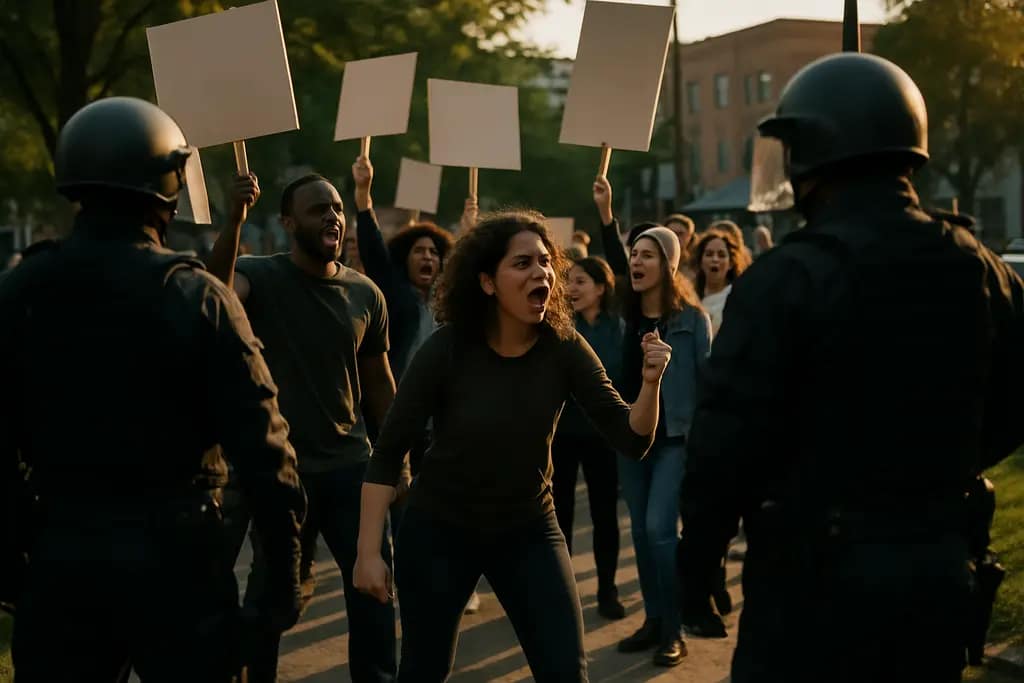
Clearview AI Surveillance became a central issue in Minnesota after public court records and reporting described federal monitoring of progressive organizations, unions, and activists during immigration-enforcement operations linked to Operation Metro Surge. The available record, as of September 14, 2026, supports several limited findings: federal agencies gathered identifying information, used facial recognition in at least some protest-related inquiries, and built dossiers that reportedly included people who were not charged with crimes. Other questions remain unresolved, including the full number of Clearview searches, the standards used to review possible matches, and how long related data was retained.
What Clearview AI Surveillance Shows In Minnesota
Clearview AI Surveillance And Photo Dossiers
The most specific public reporting says Homeland Security Investigations used Clearview AI facial recognition during Minnesota protest investigations to assemble photo dossiers. According to a Minnesota Reformer report, those files included protesters, with many people reportedly not charged with crimes. That distinction matters for social movements because surveillance can affect participation even when no prosecution follows.
The reported use of facial recognition fits a broader pattern described in the same public record: officials gathered vehicle information, addresses, employment details, family ties, and other identifiers. The record does not show, from the cited public material, that every person identified through these methods was accused of unlawful conduct. It does show that the investigation did not stop at people later named in indictments.
What The Public Record Does Not Yet Establish
There is still a gap between confirmed use and full operational scope. Public materials support that Clearview was used, but they do not provide a complete search log, error rate for the specific searches, internal review criteria, or a full account of how analysts treated false or uncertain matches. For campaign strategists and civil-society groups, that gap is not a minor detail. Facial recognition systems can return candidate images rather than proven identity, and any organizing response has to account for uncertainty rather than treating every reported match as a confirmed identification.
One risk in public debate is overstating what the documents prove. Another is understating the significance of a facial recognition tool being paired with undercover attendance, financial subpoenas, license plate data, and digital chat monitoring. Clearview AI Surveillance, as described in the Minnesota materials, was not an isolated software issue. It was one component in a wider information-gathering operation.
Operation Metro Surge And The Scale Of Federal Presence
Federal Deployment Figures In Court Records
Operation Metro Surge was described in federal litigation as involving more than 3,000 federal immigration agents deployed across Minnesota beginning in late 2025 and into early 2026, with some filings describing a peak of more than 4,000 agents. A federal memorandum opinion and order in case No. 0:26-cv-00778 dismissed cases and discussed the scale of the operation in the litigation record; the document is available through GovInfo.
The operations named in the research record include Operation Metro Surge, Operation Puppet Master, and Operation Whipple Shield. The research notes state that these initiatives began under the Trump administration and were tied to federal immigration enforcement. Public reporting connected them to progressive organizations, unions, and activists in Minnesota, including Sunrise Movement, SEIU, Communications Workers of America, Voices for Racial Justice, and other groups.
Charges, Allegations, And The Need For Careful Language
In June 2026, 15 people in Minnesota were federally indicted for allegedly conspiring to impede or injure federal officers during protests that responded to ICE enforcement. Those charges are allegations unless and until resolved in court. The available reporting ties the indictments to the broader surveillance operations, but it does not mean every person observed, searched, photographed, or entered into a dossier was accused of a crime.
That separation is essential for accurate public communication. A movement may be monitored because officials are investigating a protest event, but attendance at a meeting, presence in a chat, or appearance near a demonstration does not itself establish criminal conduct. Public-facing advocacy should avoid language that treats surveillance records as proof of wrongdoing by organizers or proof of unlawful conduct by the government beyond what courts or official documents have found.
How Surveillance Methods Reached Movement Infrastructure

Meetings, Chats, And Financial Records
The surveillance described in public materials reached beyond street protests. Reporting said undercover agents attended meetings in churches, libraries, schools, parks, and other public forums. One reported example was a Sunrise Movement meeting at the Minneapolis Public Library on January 31, 2026. The research record also says agents infiltrated Signal chats, sought financial records through administrative subpoenas, and collected personal details about activists and participants.
For organizers, the key lesson is structural: a campaign’s risk profile is not limited to public rallies. Planning meetings, fiscal sponsorship records, sign-in practices, transportation logistics, and member-to-member communication can all become part of an investigative file. A related local case file on Minneapolis ICE activism tracks similar concerns about federal attention during Operation Metro Surge.
- Confirmed in the research record: facial recognition use, undercover attendance, collection of identifying information, and subpoenas for financial records.
- Reported but still requiring document-by-document review: the full scope of searches, all affected individuals, and the standards used to assess matches.
- Unresolved in the cited public materials: how long all related data was stored and how many people not charged were entered into government files.
Digital Campaign Practice Under Scrutiny
Clearview AI Surveillance should prompt movements to separate security culture from panic. Good digital practice does not require secrecy around lawful organizing; it does require disciplined data handling. Groups can reduce unnecessary exposure by limiting collection of personal information, setting retention schedules for volunteer records, using access controls for planning materials, and explaining to participants how meeting notes, photos, and chat archives may be handled.
Coalitions also need a communications plan for surveillance disclosures. If records show monitoring of a group, the first public statement should distinguish what is documented, what is alleged, and what remains unknown. That approach protects credibility, especially when legal proceedings are active or when some individuals face criminal allegations. For comparative work on advocacy networks and civic communication, The Parative Project offers a connected reference within the same publishing network.
Clearview AI Surveillance And Minnesota Movements
Clearview AI Surveillance in Minnesota is best understood as a case study in how facial recognition can be folded into a wider government information operation. The confirmed and reported elements include immigration-enforcement deployments, protest-related indictments, undercover activity, chat infiltration, administrative subpoenas, and collection of identifying details. The Minnesota attorney general, Keith Ellison, publicly condemned the operations on August 14, 2026, calling the surveillance “appalling and alarming” and criticizing Operation Puppet Master and Project Whipple Shield as retaliation against First Amendment-protected protest.
That public response does not resolve the legal questions. Courts, agencies, and defense counsel remain the institutions positioned to test claims, evidence, and procedure. For social movements, the practical lesson is narrower but immediate: assume that public organizing may be observed, avoid collecting more participant data than necessary, verify claims before repeating them, and keep public messaging anchored to records rather than rumor. The Minnesota case shows why movement communication strategy now has to treat data governance, protest logistics, and public narrative as connected parts of the same organizing system.