
Categories
Digital Campaign Best Practices

Katie Zacharia Becomes White House Press Secretary: What Changes In Trump’s Media Strategy?

Katie Zacharia’s appointment as White House press secretary marks a significant transition in President Donald Trump’s communications operation just weeks before the November 3, 2026, midterm elections. The former conservative television commentator and Trump Media & Technology Group adviser officially began her new role on October 12, replacing Karoline Leavitt, and delivered her first White House press briefing the following morning.

The growing fragmentation of political media reflects a broader transformation in how Americans consume information, exchange opinions, and evaluate public figures. Online communities increasingly influence conversations that once depended primarily on television networks and newspapers, with specialized platforms such as sports betting discussion forums illustrating how audiences gather around shared interests to debate developments and compare perspectives. Although these communities focus on different subjects, their participatory structure offers a useful comparison for understanding Donald Trump’s direct-to-audience communication strategy and the challenges Katie Zacharia faces in reaching an increasingly decentralized media landscape.

The appointment raises an important question about the administration’s media strategy: will Zacharia introduce a different approach to communicating government policy, or will she reinforce Trump’s existing preference for direct political messaging, sympathetic media outlets and tightly controlled public appearances?

Her first briefing on October 13 provided an early indication. Speaking inside the James S. Brady Press Briefing Room in Washington, D.C., Zacharia emphasized the president’s political priorities, defended his administration’s record and promised to continue expanding access for newer media organizations.

However, the appearance lasted approximately 14 minutes and included questions from only three news outlets. That limited exchange prompted scrutiny of how the new press secretary intends to balance political advocacy with the White House’s responsibility to answer questions from the broader press corps.

The official White House announcement described her debut positively, while independent reporting highlighted the limited questioning and the challenges of her first appearance.

The White House

+1

For political communication analysts, Zacharia’s arrival offers a timely case study in how presidential administrations manage their public image, communicate policy priorities and navigate an increasingly fragmented American media environment.

Who Is Katie Zacharia, Trump’s New White House Press Secretary?

Katie Zacharia became the 37th White House press secretary following Trump’s announcement of her appointment on October 9, 2026.

She succeeded Karoline Leavitt, who left the position on August 27. Leavitt had become one of the most recognizable public faces of the administration through her frequent appearances in the briefing room and confrontational exchanges with journalists.

Zacharia brings a different professional background to the position.

Before joining the White House, she worked as a communications adviser to Trump Media & Technology Group, the parent company of Truth Social. She also appeared as a conservative political commentator on Fox News and Newsmax and briefly served in a communications role at the Department of Homeland Security.

Her experience places her at the intersection of political commentary, digital media and government communications.

Unlike a traditional press secretary whose career develops primarily through institutional public relations or campaign press operations, Zacharia entered the position with substantial experience communicating political viewpoints to television audiences.

That distinction matters because the responsibilities of a television commentator and a White House press secretary are not identical.

A commentator can concentrate on persuading an audience or interpreting events through a political perspective. A government spokesperson must also explain official decisions, clarify policy details and respond to questions that may challenge the administration’s preferred narrative.

The Washington Post’s October 12 report documented Zacharia’s previous media and communications roles and the transition from Leavitt.

The Washington Post

Her background may make her comfortable defending the administration on television, but success in the briefing room will require an additional set of skills: responding accurately under pressure, explaining complicated policy decisions and maintaining credibility beyond the president’s political supporters.

Katie Zacharia’s First White House Briefing Reveals An Early Communication Pattern

Zacharia’s inaugural briefing on October 13 was one of the first opportunities for journalists to evaluate her approach to the position.

The session lasted approximately 14 minutes, including prepared remarks and a short question-and-answer period.

She began by thanking Trump for appointing her and outlining what she described as the administration’s achievements.

Her opening remarks emphasized economic policy, energy, immigration and the president’s campaign activities ahead of the midterm elections.

Zacharia also discussed Trump’s upcoming political travel, including planned appearances in Georgia, Kentucky and Florida.

The structure of the briefing was notable.

According to Associated Press coverage of her debut, she took questions from Breitbart, Fox News and the Daily Mail before ending the session.

apnews.com

Those outlets have different editorial operations, but all three have audiences that include substantial conservative readership or viewership.

The decision to take only three questions does not establish how Zacharia will conduct future briefings. Nevertheless, it illustrates the degree of control a press secretary can exercise over which subjects receive attention.

A press briefing serves several purposes simultaneously.

It allows an administration to explain its policies, provides journalists with opportunities to request clarification and creates a public record of government statements.

When the question-and-answer portion is brief, the balance shifts toward prepared communication rather than sustained examination.

That distinction is particularly important during an election season, when government announcements and political campaign messages can overlap.

The White House praised Zacharia’s performance, and Trump also expressed approval. Other observers questioned whether the short session demonstrated sufficient preparation for the demands of the position.

Those competing assessments underscore a central tension in presidential communications: an appearance can be politically effective for supporters while leaving journalists seeking more substantive answers.

From Karoline Leavitt To Katie Zacharia: Continuity And Change

The transition from Leavitt to Zacharia represents a change in personnel, but the available evidence does not yet establish a fundamental transformation in White House media strategy.

Leavitt’s tenure was associated with assertive defenses of Trump, direct challenges to critical reporting and an emphasis on communicating with media organizations beyond the traditional White House press corps.

Zacharia has already signaled support for continuing that approach.

During her first briefing, she praised Leavitt’s work and expressed support for retaining the New Media Seat, an initiative intended to provide opportunities for digital creators and other nontraditional media participants.

The administration has presented this policy as an effort to broaden media access.

Supporters of such initiatives argue that traditional news organizations should not have exclusive influence over the questions asked at White House briefings.

Digital publishers, independent journalists and online commentators can reach audiences that do not regularly consume conventional television or newspaper coverage.

However, broader access does not automatically guarantee broader scrutiny.

The effectiveness of any media-access policy depends on whether participants are able to ask substantive questions, challenge official claims and seek follow-up answers.

The White House’s October 13 statement confirmed Zacharia’s intention to maintain and potentially expand the New Media Seat.

The White House

The distinction between media diversity and viewpoint diversity will therefore become an important measure of her tenure.

A briefing room may include more types of publishers without necessarily exposing the administration to a wider range of difficult questions.

Conversely, a well-managed expansion could give legitimate independent reporters opportunities that previously were difficult to obtain.

Zacharia’s challenge is to demonstrate that the policy improves public access to information rather than simply strengthening the administration’s preferred communication channels.

Trump’s Direct-To-Audience Strategy Could Become Even More Important

One of the defining characteristics of Trump’s political communication has been his willingness to communicate directly with supporters rather than relying exclusively on traditional news organizations.

Truth Social, campaign rallies, televised interviews and short-form videos allow the president to distribute messages without waiting for journalists to interpret them.

Zacharia’s previous association with Trump Media & Technology Group is relevant in this context.

Her professional experience suggests familiarity with the digital platforms and political audiences that form an important part of the president’s communication ecosystem.

However, that background does not necessarily mean she will introduce new digital strategies.

The administration already uses social media extensively, and Trump remains a highly visible political communicator who frequently sets the news agenda through his own statements.

Zacharia’s contribution may therefore involve reinforcing messages across different platforms rather than developing a separate public identity.

The distinction is important.
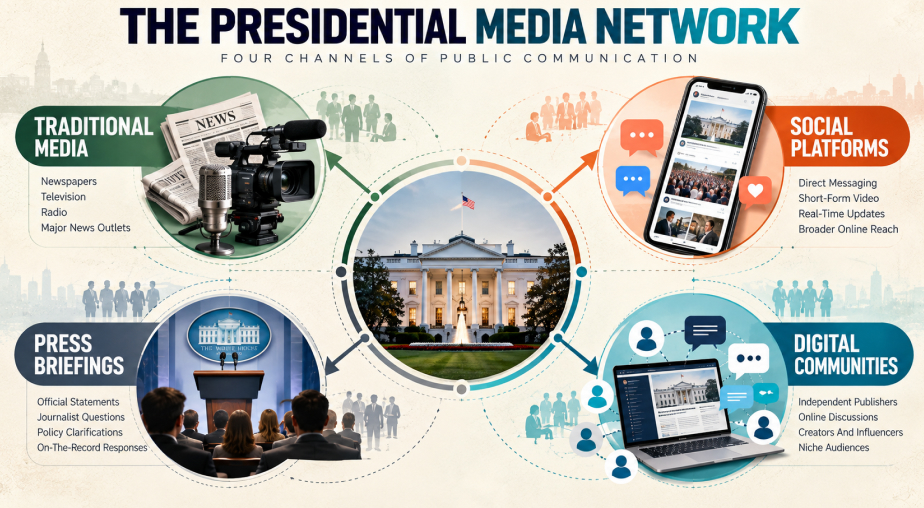
How Trump's Media Strategy Reaches Different Audiences

In a conventional communications structure, the press secretary may serve as the administration’s primary public interpreter. In Trump’s political operation, the president often delivers major announcements himself, leaving spokespersons to explain, defend or amplify those statements afterward.

The White House’s official video archive illustrates its emphasis on distributing presidential appearances, short videos and press briefings through its own channels.

The White House

This approach gives the administration greater control over presentation and timing.

It also creates challenges for independent verification because official clips may omit the broader context that journalists seek through follow-up questions.

For Zacharia, effective communication will depend partly on whether she can supplement the president’s direct messaging with detailed, reliable explanations of government policy.

White House Press Access Becomes A Major Test For Zacharia

Zacharia assumes the position during an ongoing legal dispute involving access to the White House.

CNN, MS NOW and Politico challenged the administration after their journalists’ credentials were revoked in September 2026.

The news organizations argued that the restrictions constituted retaliation for critical coverage and violated constitutional protections.

The administration defended its authority to manage access to White House facilities and disputed the outlets’ characterization of its actions.

On October 13, U.S. District Judge Timothy Kelly granted a preliminary injunction preventing the administration from enforcing the credential revocations while litigation continues.

The decision did not resolve the entire case or guarantee access to every presidential event, including certain restricted press-pool assignments.

Nevertheless, it represented an important legal development concerning the relationship between the executive branch and independent journalism.

According to CBS News’ coverage of the court ruling, Kelly concluded that the restrictions likely violated constitutional protections under the First and Fifth Amendments.

CBS News

The dispute presents Zacharia with a difficult institutional challenge.

As White House press secretary, she must represent the president’s positions while managing daily interactions with journalists whose reporting the administration may strongly oppose.

The legal controversy also raises questions about how access decisions influence public perceptions of transparency.

Government officials have legitimate responsibilities to organize briefings, manage security and establish procedures for media participation.

At the same time, restrictions based on unfavorable coverage can undermine the principle that journalists should be able to scrutinize government decisions independently.

Zacharia’s approach to these issues will be an important indicator of whether the administration intends to improve relations with the broader press corps or maintain a more confrontational structure.

Political Communication And Government Accountability During The 2026 Midterms

The timing of Zacharia’s appointment adds another dimension to her responsibilities.

The United States is approaching the November 3 midterm elections, and Trump has been actively campaigning for Republican candidates.

During her first briefing, Zacharia highlighted the president’s political travel and emphasized the administration’s economic and immigration messages.

Those themes are central to the Republican Party’s campaign narrative.

However, communicating government policy and promoting electoral candidates are distinct activities.

A White House press secretary is expected to explain the administration’s actions, including policy decisions that may influence voters’ opinions.

Political messaging becomes more complicated when official communications closely resemble campaign promotion.

For journalists, the challenge is determining whether government statements provide independently verifiable information or primarily advance electoral narratives.

For the administration, the challenge is maintaining a coherent message while responding to legitimate questions about policy outcomes.

Zacharia’s debut suggested that she intends to place substantial emphasis on reinforcing the president’s political priorities.

The October 13 briefing transcript documents the subjects she discussed and the relatively limited time devoted to reporters’ questions.

Roll Call

The next several weeks will offer a clearer picture of how she handles the distinction between policy explanation and campaign-oriented communication.

The quality of that distinction matters because public confidence depends not only on whether government officials communicate frequently, but also on whether their statements are accurate, contextualized and open to scrutiny.

What Katie Zacharia Must Demonstrate In Her First Weeks

Zacharia’s initial appearance provides only a limited basis for judging her long-term performance.

The first briefing attracted attention because of its short duration, prepared presentation and restricted questioning.

Those characteristics may reflect an early adjustment period rather than a permanent operating model.

Her performance should therefore be evaluated over multiple briefings rather than through a single appearance.

Several indicators will help determine whether her appointment produces meaningful changes in White House communication:

  • Briefing frequency and accessibility: Whether regular sessions provide meaningful opportunities for questions from a broad range of news organizations.
  • Policy knowledge and accuracy: Whether Zacharia can explain complex government decisions with sufficient detail and correct inaccurate statements when necessary.
  • Response to difficult questions: Whether she engages substantively with critical reporting rather than relying primarily on prepared political messages.
  • Digital media strategy: Whether expanded access for independent creators contributes to greater transparency and more informative public communication.

These measures matter more than the immediate reaction to her first appearance.

A press secretary’s effectiveness cannot be assessed solely through television presentation, social media engagement or approval from political supporters.

The position also carries an institutional responsibility to provide information about the federal government’s actions.

That responsibility becomes particularly important when policies affect economic conditions, immigration enforcement, international relations and other matters of substantial public interest.

Zacharia’s ability to combine political message discipline with substantive public explanations will shape her credibility.

Behind The Questions: A Journalist Prepares For A White House Briefing

What Zacharia’s Appointment Reveals About The Future Of Presidential Media Relations

Katie Zacharia’s arrival reflects the continued importance of political loyalty, media familiarity and direct communication in Trump’s White House.

Her background in conservative commentary and Trump-affiliated media makes her a recognizable representative of the administration’s existing communication culture.

Her first briefing reinforced several established priorities: promoting the president’s record, emphasizing political messaging and supporting greater participation by nontraditional media organizations.

At the same time, the short question-and-answer period and the ongoing legal dispute over press access demonstrate the unresolved tensions surrounding the administration’s relationship with independent journalism.

It is too early to conclude that Zacharia will substantially transform Trump’s media strategy.

The more immediate possibility is continuity, with a new spokesperson responsible for defending and explaining an established communication approach.

Whether that approach evolves will depend on her subsequent briefings, her handling of difficult policy questions and the administration’s decisions concerning media access.

The broader significance extends beyond one appointment.

Presidential communication now operates across official government channels, partisan media, independent journalism, digital platforms and direct-to-audience political messaging.

Each channel influences how citizens encounter government information and how competing interpretations of public policy develop.

Zacharia’s tenure will help illustrate whether a modern White House press secretary can operate effectively within that fragmented environment while preserving the accountability expected of an official government spokesperson.

The coming weeks will reveal whether her role becomes primarily an extension of Trump’s political messaging operation or develops into a more substantive channel for explaining the administration’s decisions to the American public.


Categories
Social Media Advocacy Strategies

Children’s Online Safety Advocacy After KIDS Act

Children’s Online Safety advocacy changed after the U.S. House passed the Kids Internet and Digital Safety Act, H.R. 7757, on June 29, 2026. As of October 13, 2026, the research provided confirms House passage, but it does not confirm Senate passage, presidential signature, or federal enactment. That status matters for advocates: campaign materials should describe the measure as House-passed unless a later official action is verified. According to EDUCAUSE Review, the bill would raise the COPPA “child” threshold from under 13 to under 14 and create a new teen category for ages 14 through 17 EDUCAUSE Review.

The strategic task is not only to support safer product design. It is to communicate the policy record accurately, avoid overstating legal duties, and translate technical provisions into clear asks for platforms, families, schools, and lawmakers. Advocacy teams working across social media should treat every post, explainer, and petition as part of a public evidence file. Claims about age thresholds, advertising limits, audits, and emerging technologies should match the bill text or a cited official document.

What Children’s Online Safety Advocates Can Say

House Passage Is Confirmed, Enactment Is Not

The strongest public message begins with status discipline. H.R. 7757 passed the House on June 29, 2026. The provided research does not establish that the bill became law by October 13, 2026. That means advocates should avoid language such as “the new federal law requires” unless they have checked a later official record. A more accurate formulation is: “The House-passed KIDS Act would require…” or “The amended bill proposes….”

This distinction is more than legal caution. Digital advocacy often spreads through short captions, graphics, and reposted summaries. Once a claim circulates, later corrections rarely travel at the same speed. A campaign that is precise about legislative status is more credible with journalists, parents, educators, platform policy teams, and congressional staff.

Children’s Online Safety Claims Need Clear Status Labels

Campaign teams should separate three categories in their public materials: confirmed House action, proposed platform obligations, and evidence that advocates want decision-makers to consider. A carousel post, video script, or email alert can use labels such as “House-passed provision,” “advocacy ask,” and “research claim.” This gives audiences a simple way to distinguish what an institution has done from what a campaign recommends.

For related coverage of U.S. public affairs and policy communication, readers can explore how different framing practices are compared at The US Report. Cross-reading is useful because online safety debates can move quickly from statutory text to broader claims about technology, parenting, and youth culture.

Platform Duties Advocates Should Track

Advertising And Default Settings

The KIDS Initiative one-page document describes several obligations that advocates are likely to use in campaign messaging. It says the proposal would prohibit targeted advertising to children and teens, require the most restrictive privacy and data security protections by default, and provide parents with tools and permissions tied to settings KIDS Initiative summary. These points are concrete enough for campaign checklists, but they still should be framed as provisions in the proposal unless enactment is later confirmed.

For social media strategy, the advertising provision is central. A campaign aimed at policymakers can ask whether platforms can prove that minors are excluded from targeted ad systems. A campaign aimed at parents can explain the difference between a privacy default and a setting that families must find and change themselves. A campaign aimed at platforms can press for plain-language notices, accessible controls, and public explanations of how age categories are applied.

Reporting, Audits, And Enforcement Signals

The same summary states that platforms would need reporting mechanisms for harms to minors and annual third-party audits to assess compliance with safety requirements. The research notes also refer to civil penalties and possible Federal Trade Commission involvement. Advocates should treat these as oversight mechanisms, not as proof that a violation occurred at any specific company.

That caution is especially relevant in social media posts naming firms or products. Advocacy can call for audits, reporting channels, and enforcement capacity without alleging misconduct that has not been established by a regulator, court, or formal audit. A careful post might say: “If enacted, the proposal would create audit and reporting expectations. Advocates should ask platforms how they would meet them.”

Social Media Campaign Practices For Careful Advocacy

Segment Audiences Without Targeting Minors

Advocacy teams often segment audiences so that parents, educators, clinicians, youth organizers, and lawmakers receive different messages. That practice should not slide into targeting minors with pressure campaigns or collecting unnecessary youth data. For Children’s Online Safety campaigns, a safer model is to target adults and institutions while inviting youth participation through consent-aware, privacy-protective channels.

Digital teams can build separate content tracks. Parents may need short explainers on default settings and parental tools. Schools may need discussion prompts and policy templates. Lawmakers may need bill-status graphics and oversight questions. Platforms may need public scorecards that focus on documented policies, not inferred motives. Related analysis of youth privacy rules shows why consent, retention, age signals, and ad targeting deserve separate treatment in campaign planning.

Use Evidence Without Overclaiming

The research notes cite studies and surveys on adolescent social media use, depressive symptoms, ADHD-related symptoms, generative AI use, household rules, and parental controls. Because the permitted sources for this article do not include those underlying study pages or survey reports, campaign teams should verify the original methodology before placing specific statistics in public ads or legislative testimony. That includes checking sample size, age range, dates, geography, survey wording, and whether the finding shows correlation rather than causation.

This is a practical credibility rule. A campaign can say that advocates are concerned about addictive patterns, AI tools, deepfake-style harms, disappearing messages, and design features that intensify social comparison if those concerns are tied to the legislative record. But it should not convert every research note into a sweeping claim about all young people. Precision protects the campaign from avoidable corrections and gives opponents fewer opportunities to challenge the message on evidentiary grounds.

How Advocacy Teams Can Use Digital Tools

Shared digital dashboard showing tasks, sources, and approval steps

Build Public Checklists From The Bill Text

Digital tools can make policy advocacy more transparent. A public checklist can track each proposed requirement: age category, targeted advertising, default privacy settings, parental tools, reporting channels, audits, AI safeguards, and restrictions on deceptive professional advice. Each item should include a status label, a source link, and the campaign’s specific ask.

  • Create a bill-status tracker that distinguishes House passage from enactment.
  • Use a content calendar that assigns each post to one audience: parent, school, youth group, lawmaker, or platform.
  • Maintain a claim bank so staff and volunteers reuse approved language.
  • Archive screenshots of campaign materials in case a correction or clarification is needed.
  • Review any youth participation form for data minimization and consent language.

These practices do not require expensive systems. A shared document, spreadsheet, version history, and approval queue can reduce errors. For larger coalitions, a collaborative knowledge base can prevent local chapters from publishing outdated statements after a vote, amendment, or committee action.

Make Youth Participation Verifiable And Safe

Youth-led participation is one of the strongest forms of advocacy in debates about platform design. It can also create privacy risks if campaigns collect stories, images, school names, health details, or platform-use histories without guardrails. Advocacy teams should ask young participants what design features they want reviewed, but they should avoid gathering more personal information than the campaign needs.

For social posts, this means using composite themes or anonymized examples unless a young person and the appropriate adult consent to public identification. For listening sessions, it means explaining who will see the notes and how long the campaign will retain them. For petitions, it means considering whether youth signatures are necessary or whether adult allies can carry the public-facing pressure.

Children’s Online Safety Advocacy After The KIDS Act

The Careful Path For Campaign Teams

The best advocacy after the House vote is specific, sourced, and modest in its claims. Campaigns can say that H.R. 7757 passed the House on June 29, 2026. They can explain that the proposal would expand privacy treatment for younger teens, create a teen category for ages 14 through 17, restrict targeted advertising to minors, call for restrictive defaults, support parental tools, and require reporting and audit mechanisms. They should not say those duties are binding federal law unless later enactment is confirmed through official records.

Children’s Online Safety work benefits when advocates pair moral urgency with procedural accuracy. The public needs to know what the House approved, what remains unresolved, and what platforms can do voluntarily while federal action is pending. Social media strategy should make that distinction visible in every post. That approach gives families clearer information, gives policymakers sharper feedback, and gives technology companies a fair set of safety questions they can answer in public.

Categories
Digital Tools and Platforms

Voter Citizenship Verification Digital Tools

Voter Citizenship Verification has become a test of how advocacy groups use digital tools without overstating what courts have decided. On September 25, 2026, the U.S. Supreme Court issued a stay in Department of Homeland Security v. League of Women Voters, Docket No. 26A308, allowing state election officials to use an expanded SAVE database that includes Social Security data to check citizenship status before the November 2026 midterms, as The Washington Post reported. For digital organizers, the ruling created a communications problem as much as a legal one: supporters need accurate timelines, clear limits, and outreach systems that do not turn uncertainty into alarm.

Why Voter Citizenship Verification Rulings Matter

A Stay Is Not A Merits Ruling

The September 25, 2026 Supreme Court action was a stay. That distinction matters for campaign language. A stay can change what the government may do while litigation proceeds, but it does not by itself settle every legal question raised by the underlying case. Advocacy teams using email, SMS, social posts, or supporter dashboards should avoid describing the order as a final ruling on every objection to expanded database use.

The research record also states that on June 22, 2026, U.S. District Judge Sparkle L. Sooknanan blocked recently introduced SAVE upgrades, citing a risk that aggregation of sensitive personal data could lead to voters being wrongly removed from rolls. After the Supreme Court stay on September 25, the operational position changed, but the privacy and accuracy concerns did not disappear as public issues. That is the kind of distinction a digital advocacy operation must preserve in its content library.

The Arizona Precedent Is A Different Kind Of Signal

Earlier proof-of-citizenship litigation gives organizers another reference point, but it should not be treated as identical to the 2026 SAVE dispute. On March 1, 2024, the U.S. District Court for the District of Arizona struck down provisions of HB-2492 that required birthplace and proof-of-citizenship information, finding that the provisions violated federal law for federal voter registration, according to the Justice Department. That precedent can inform public education, yet state laws, federal forms, database checks, and executive actions may raise different procedural questions.

For advocacy teams, Voter Citizenship Verification messaging should separate these strands. One post might explain what happened in Arizona in 2024. Another might explain what the Supreme Court allowed on September 25, 2026. A third might explain what remains contested. Keeping those records separate helps volunteers answer questions without making claims that exceed the cited decision.

How Digital Tools Can Support Careful Mobilization

Turn Court Dates Into Verifiable Content

Digital tools can amplify public education when they are tied to a disciplined source workflow. A campaign calendar should treat each court date, order, and statutory deadline as a separate entry with a citation, status label, and owner. Labels such as ruled, stayed, challenged, scheduled, blocked, and effective can reduce confusion for volunteers drafting posts or responding to direct messages.

That structure matters because voter-roll issues spread quickly through short-form platforms. A single unclear graphic can be copied into group chats, reused by partner pages, or quoted without context. A content-management system should preserve the original date, the jurisdiction, the institution, and a short statement of what is confirmed. If a claim rests on pending litigation, the public-facing version should say so.

Build A Source File Before The Message Calendar

A source file is a practical tool, not just an archive. It can include court orders, agency pages, official statements, public deadlines, and internal notes about what the organization will not claim. Earlier site coverage on voter verification outreach discussed how community groups can plan lawful outreach around voter-roll issues. The same principle applies here: digital speed should not outrun verification.

Teams that compare advocacy technology and civic communication practices across publications can also use related network resources such as peiknet.com as a reference point for broader digital-tool coverage. Still, any legal or election-related claim should trace back to an official record or a high-authority report, not to a repeated social media summary.

Risk Controls For Data Matching Campaigns

Secure data review screen used for civic outreach planning

Voter Citizenship Verification And Data Risk

A digital campaign around Voter Citizenship Verification should treat data matching as a risk topic, not only as a participation topic. The research record says SAVE began in 1986 as a system used by agencies to verify citizenship or immigration status for benefit programs, and that its use for voter registration checks expanded through later executive action. The 2026 dispute shows how a database built for one government function can become central to election administration debates.

Advocacy groups should be cautious about collecting personal documents, immigration history, Social Security-related information, or screenshots from voters unless they have a clear legal basis, secure storage, and trained staff. Public education can explain rights, deadlines, and where official help may be available. Individual case handling is different and may require qualified legal assistance.

Use Segmentation Without Overclaiming

Segmentation can make outreach more useful, but it can also produce unfair assumptions. A campaign might send different reminders to volunteers, local partners, donors, and voters seeking public information. It should not infer citizenship status, eligibility, or legal risk from names, language preference, neighborhood, or engagement history. Those inferences can damage trust and may expose organizations to avoidable legal and ethical problems.

  • Use status labels that distinguish confirmed rulings from pending lawsuits or scheduled effective dates.
  • Keep volunteer scripts short, sourced, and limited to public information.
  • Route individual registration problems to official election offices or qualified legal-support partners.
  • Audit social posts after major court orders so outdated guidance is corrected or removed.

These controls do not prevent every error, but they reduce the chance that a fast campaign spreads unsupported claims. They also help staff explain why a message changed after a new ruling, which is often essential for public trust.

Digital Advocacy After Voter Citizenship Verification Rulings

What Advocacy Teams Can Say With Confidence

Advocacy teams can say that court rulings and stays have changed the operating environment for citizenship checks tied to voter registration. They can say that the Supreme Court allowed expanded SAVE use on September 25, 2026 while litigation continued. They can say that the Arizona HB-2492 provisions were struck down in 2024 under federal voter-registration law. Those are narrower claims than many social posts prefer, but they are stronger because they can be checked.

Digital tools should support that discipline. A shared fact sheet, a version-controlled message bank, and a correction log can help organizers move quickly while keeping claims tied to source material. Social media teams can then focus on clear explanations rather than dramatic framing. Email teams can give supporters concrete dates and institutions. Volunteer managers can train people to say, when needed, that a question is unresolved.

What Should Remain Conditional

Claims about future removals from voter rolls, the effect of a pending lawsuit, or the accuracy of a specific database match should remain conditional unless an official record confirms them. The research record includes disputes over proof-of-citizenship rules, SAVE upgrades, and state-level verification regimes. Those disputes are not all the same, and digital campaigns should not collapse them into a single claim.

The strongest advocacy use of legal precedent is not repetition of slogans. It is the creation of public materials that show what happened, when it happened, which institution acted, and what remains open. In that sense, Voter Citizenship Verification is a civic technology test: the groups that earn trust will be those that pair mobilization with careful records, privacy limits, and clear correction practices.

Categories
Social Media Advocacy Strategies

Multi-Platform Social Media Strategy for Activists

A strong campaign does not post the same message everywhere. It cannot just hope the internet handles the rest. Each platform is different.

Twitter rewards quick replies and sharp debate. Facebook favors shares, discussion, and familiar community voices. Each platform has its own rhythm and audience.

I have found the best social strategy starts with one clear idea. Then, it changes how it is delivered. A question may spark conversation on Twitter.

A personal story often travels farther on Facebook. The message stays steady. But the packaging changes. Even Shakespeare knew that timing matters.

Emotion drives reach, too. Outrage can spread a demand. Awe can turn a local win into a shared moment.

Likes and shares are only signals, not proof of progress. This analysis of viral online movements shows why a powerful post needs a clear next step.

Examples include a petition, donation page, or community meeting. These actions push the movement forward, beyond just social media support.

Understanding platform ecosystems

Social platforms are more than digital noticeboards. They help civil society groups share information, organize volunteers, and move people toward action.

A local campaign can reach neighbors on Facebook, inform reporters on X, and build trust through organic social media.

Each channel plays a different role in the public square.

That mix creates the need for a clear Cross Platform Advocacy Strategy. A strong message may travel across several networks.

It should not look copied and pasted by a tired intern at 2 a.m. Each platform has its own audience habits, rules, and culture.

Understanding those differences makes cross platform campaigns sharper and more credible.

These platform ecosystems run on centralized business models. They collect searches, questions, statements, viewing habits, relationships, location signals, and political interests.

Algorithms use that data to rank content and shape attention.

The result is useful reach paired with a level of observation that would make George Orwell reach for a privacy policy.

For activists and grassroots groups, the same infrastructure can open doors or create serious risks.

Platforms can support rapid mobilization and access to vital information. They can expose people to surveillance, censorship, harassment, cyber violence, manipulation, and influence operations.

A campaign needs to treat reach as an asset, not a guarantee of safety.

Smart organizers map each platform before they invest time or money. They ask who controls access, what data the service gathers, how content is moderated, and which accounts face greater risk.

They keep contact lists and key resources beyond any single platform.

A resilient campaign can use social networks without allowing them to become the campaign’s only foundation.

Platform role Useful opportunity Primary risk Practical safeguard
Public discovery Reach new audiences through timely posts and searchable topics Algorithm changes can reduce visibility without warning Track results and maintain more than one public channel
Community organizing Coordinate volunteers, events, and local updates Harassment or exposure of participant details Limit personal data and use clear moderation rules
Political discussion Share evidence, statements, and rapid responses Manipulation, censorship, and coordinated influence campaigns Verify claims and document important posts offline
Direct communication Build lasting relationships with supporters Platform access can be suspended or restricted Offer trusted email, phone, or in-person contact options

Tailoring content for each platform

I treat each platform like a different room at the same civic dinner. Instagram and TikTok reward motion, emotion, and a clear next step. Reels, Stories, short videos, event clips, and shareable graphics turn protests or volunteer events into living records of public action.

Strong visual storytelling gives viewers a reason to pause. A direct call to action gives that pause a purpose. Advocacy groups guide people to a link sticker or profile link for sign-ups, donations, or event details.

No one needs another vague “learn more” floating in the digital fog.

Facebook works best as a neighborhood bulletin board with better targeting. Groups nurture discussion, Events organize attendance, and pinned posts keep sign-up details visible. Page tabs make email subscriptions easier to find, useful when an algorithm changes its mood.

LinkedIn calls for a sharper suit. Policy analysis, expert commentary, and professional networking reach business leaders, decision makers, and policy professionals. The tone stays human, yet the evidence must carry weight.

Snapchat creates urgency through disappearing content. Event-specific geofilters mark gatherings and make participation feel timely. A thoughtful social media strategy respects these differences instead of copying one message across every screen.

  • Instagram and TikTok: Use Reels, Stories, event footage, graphics, and direct calls to action.
  • Facebook: Build community with Groups, Events, pinned posts, and visible subscription tools.
  • LinkedIn: Share policy insight, professional analysis, and credible leadership voices.
  • Snapchat: Create immediacy with ephemeral posts and event-specific geofilters.

This approach makes digital advocacy feel less like a broadcast and more like a conversation for the people in the room.

Coordinating messaging across channels

A strong Cross Platform Advocacy Strategy keeps the cause clear without making every post sound the same. People use each platform in different ways. Treating Instagram, email, and text messages alike can make a campaign seem like a broken record.

Ben & Jerry’s shows how this balance works. Its United States and German Instagram accounts share an activist spirit and common values. But their posts look different.

The United States account often uses multi-image posts with lots of context. The German account prefers shorter posts with calls to visit external links via “links in bio.”

That contrast may reflect audience habits. One group prefers the full argument in one post. Another is more willing to click for details.

Effective digital advocacy coordination respects those habits while keeping the campaign’s main message clear.

Cross Platform Advocacy Strategy

Coordinated messaging works best when teams share a message map, key facts, tone, and a clear action goal. The format can change by channel.

A carousel can explain the issue. An email can add depth. A text alert can deliver a clear prompt before attention shifts elsewhere.

For a wider look at connected channel planning, explore cross-channel engagement principles. These practices help make advocacy communications feel unified without treating every audience the same.

Resource allocation and prioritization

Every campaign faces the question: where should the money go? Large digital ad budgets buy attention, but organic channels build trust.

A steady social presence gives supporters reasons to return before asking for a donation, vote, or volunteer shift.

For cross platform campaigns, assign each channel a clear job. Use social posts to start conversations and short videos to explain complex issues.

Email delivers direct calls to action. This approach stops one message from wearing many costumes and calling itself a strategy.

Organic advocacy turns casual interest into public support. Staff time should cover replies, community moderation, and useful updates, not just polished graphics.

These small exchanges strengthen relationships and show what supporters care about.

Build email list growth into the routine. Offer event reminders, issue briefings, or practical ways to help in exchange for sign-up.

Paid advertising has value when a message is proven and the audience is ready. Until then, use resources carefully to build strong community infrastructure.

Platform-specific best practices

Good platform best practices start with a simple question: what does this audience want here? Instagram rewards polished visuals, Stories, Reels, and quick explainers. TikTok favors short-form video, event footage, and a strong opening before the scroll wins again.

I build advocacy content around one clear action. A shareable graphic may explain a policy, while a link sticker or profile link guides people toward petitions, meetings, or volunteer forms. The format changes. The purpose stays steady to keep a social media strategy focused.

platform best practices for advocacy content

Facebook Groups suit supporters who want deeper discussion and regular updates. Facebook Events promote rallies, town halls, and neighborhood actions with useful details in one place. The platform feels more like a community bulletin board—if nobody pins a 900-word rant at midnight.

LinkedIn calls for a different approach. Posts can highlight policy analysis, professional expertise, research, and civic networks. Snapchat geofilters can give an event a local stamp, especially when attendees share moments from the same venue or city.

Cross channel engagement works best when each platform adds a new layer. Instagram shows the moment, Facebook organizes the gathering, LinkedIn explains policy, and Snapchat marks the place. One message travels farther when every channel gives it a distinct job.

Platform Strong formats Best use Practical cue
Instagram Stories, Reels, graphics, visual explainers Build attention and shareable context Use a link sticker for the next action
TikTok Short-form video and event footage Reach viewers through direct, lively storytelling Lead with the key point in the first seconds
Facebook Groups and Events Support discussion and organize gatherings Place dates, locations, and access details in clear view
LinkedIn Policy posts and expert commentary Reach professional and civic networks Connect analysis to public impact
Snapchat Geofilters and live event moments Increase visibility in a defined area Match the filter to the venue or campaign theme

Analytics and performance tracking

Good advocacy needs more than applause metrics. It requires proof that actions happen. Track posts that drive sign-ups, petition completions, and event RSVPs.

Also track volunteer work, donations, comments, and shares. Campaign analytics turn a busy feed into a useful tool for decisions.

Strong digital advocacy coordination links every channel to a clear goal. A post may get thousands of views but few sign-ups.

Another post may reach fewer people but fill an event. Which one deserves the next dollar? The answer is in behavior after the click.

Use conversion tracking to connect social activity with owned channels. Measure movement from Instagram, Facebook, TikTok, or email into petitions, meetings, or donation pages.

Test headlines, images, calls to action, and landing pages. High engagement with weak conversions often means the message or page needs fixing.

  • Engagement rose from 2.3% to 5.7%.
  • Conversion increased from 1.8% to 4.2%.
  • Audience growth moved from 200 to 850 people per week.
  • Average donations climbed from $42 to $67.

These shifts show why engagement should measure quality, not just volume. Data-driven advocacy produced 73% higher engagement and 2.4 times better conversions in one case.

It also led to a 45% cost reduction and an 89% stronger stakeholder buy-in. Numbers are powerful but need context, clean tracking, and fair comparison.

Segment results by campaign, audience, platform, and time. Watch for unusual spikes, patterns, and gaps between goals and benchmarks.

If posts perform best on Tuesday evenings, schedule important alerts then. If mental health content reaches parents but not young adults, adjust the message or audience.

Correlation suggests a lead but cannot prove cause. Teams can use Google Analytics, Action Network, or Phone2Action to monitor progress.

A live dashboard works like a car’s check-engine light. It flags problems before the campaign stalls.

For a practical guide to data-driven advocacy measurement, connect each metric to a SMART goal. Goals may include referrals, treatment wait times, satisfaction, or life outcomes.

Trust matters in measurement. Collect only needed data, get clear opt-in consent, protect records, and report full context.

Ask which alerts lead to meetings, which meetings produce policy commitments, and which stories get media pickup. These questions keep analytics tied to people, not just spreadsheets.

Managing multiple community conversations

Organic advocacy feels more like a busy town hall than a broadcast. Trust grows when organizers answer questions and share supporter stories.

Admitting when an issue is complex also builds trust. People easily spot polished slogans from afar.

Good community management gives each platform a clear role. Instagram may carry event photos. TikTok can share quick personal stories.

Cross-platform campaigns work best when messages feel connected, not copied by a machine with great Wi-Fi.

Invite supporters to explain why an issue matters. Ask them to share event photos, describe local needs, or join discussions.

This approach deepens supporter engagement because people add their experience, not just clicks.

Breaking news needs a calm response. Check facts and name what remains unknown.

Give people useful next steps too. Clear moderation protects online safety by limiting harassment and removing threats.

Moderation also keeps private details out of public posts.

  • Set response guidelines before a major event begins.
  • Route legal, safety, and media questions to trained staff.
  • Credit supporters when sharing their work or stories.
  • Record repeated questions to improve future outreach.

Integration with offline activism

A strong social media strategy should lead somewhere beyond the screen. Posts can guide supporters to phone banks, rallies, lobby days, community meetings, and virtual town halls. Attention matters, but action gives it a pulse.

Digital advocacy links online messages with local needs. Clear event details, simple RSVP forms, and timely reminders make joining easier. Organizers can also identify potential volunteers, donors, or long-term advocates through this.

Offline mobilization works best when invitations feel personal, not like another generic calendar alert. Share transportation, accessibility, safety details, and clear reasons to attend. Activist networks grow through these acts of trust, one meeting and conversation at a time.

Ben & Jerry’s showed how a brand can join the bridge between culture and action. During a U.S. demonstration initiative, they told followers, “We’ll be there and we are bringing the ice cream!” The message was playful, but the lesson was serious: digital outreach is powerful when it shows up in real life.

Categories
Social Media Advocacy Strategies

Social Media Advocacy After the Meta Settlement

The Meta settlement that took effect on August 27, 2026, changed the operating assumptions for social media advocacy aimed at young audiences. For environmental movements, the issue is not simply whether Facebook and Instagram remain useful channels. The more precise question is how youth safety rules, time limits, notification restrictions, and public concern about teen platform use should shape campaign timing, message testing, and evidence standards. There is not yet confirmed evidence that the settlement has changed climate-policy outcomes or environmental mobilization rates. What is supported is narrower: campaign teams now have to plan within a more restricted youth-access environment on Meta platforms, while still accounting for where teens and young adults spend attention online.

How Social Media Advocacy Changed After The Settlement

Social Media Advocacy Metrics For Youth Reach

The youth audience was large before the settlement, and the available survey data helps explain why platform rules matter to environmental groups. Pew Research Center reported that, in a fall 2025 survey, 61% of U.S. teens ages 13 to 17 said they used TikTok daily and 55% said they used Instagram daily; among those users, 21% said they used TikTok almost constantly and 12% said the same for Instagram. Pew also reported that 48% of teens in 2024 said social media had a mostly negative effect on people their age, up from 32% in 2022, and that 45% said they spent too much time on social media Pew teen platform data.

Those figures do not show how any specific environmental campaign performed. They do show why youth-facing climate groups should avoid assuming that high daily use means unlimited attention or positive receptivity. A teen who checks Instagram daily may still support restrictions, feel overloaded, or be less reachable during school hours and overnight periods if platform controls are active. For environmental organizations, social media advocacy now has to separate three measures that are often blended together: access to an audience, audience willingness to receive repeated messages, and verified action after exposure.

Platform Rules That Affect Campaign Cadence

The settlement was reported as a landmark agreement with states in litigation over teen social media addiction, with The Washington Post describing an $18 billion settlement on August 26, 2026 Washington Post settlement report. The research record for this article states that the agreement covered 47 U.S. states and included platform changes such as default two-hour-per-day limits for users under 18, muted notifications during school hours from 8 a.m. to 3 p.m., and blocking Facebook and Instagram use from midnight to 6 a.m.

If those terms operate as described, campaign calendars need adjustment. A youth climate group that previously posted reminders during the school day may see lower notification-driven response among under-18 users. Late-night posts, once used to catch high-engagement windows, may become less relevant for minors on Meta-owned apps. That does not mean environmental communication should abandon these platforms. It means organizers should treat time-of-day performance data collected before August 27, 2026, as a historical baseline rather than a reliable guide for post-settlement youth outreach.

Risks For Social Media Advocacy Design

Emotional Framing And Polarization

Environmental messaging often uses urgency, threat, and visible harm because climate and ecological issues involve real risks. The research base supplied for this article includes evidence that environmental nonprofit content tends to perform better when it uses strong emotional or threat-based framing, as measured by reactions, shares, or comments. It also includes a 2026 study of young adults in Germany finding that exposure to radical environmental influencers was associated with higher perceptions of environmental polarization and lower intentions for collective environmental action, with hate comments and greater environmental knowledge intensifying those effects.

That finding supports cautious social media advocacy rather than softer advocacy by default. Strong messages may attract attention, but attention is not the same as trust, persuasion, turnout, donations, or policy pressure. If a post generates anger while also convincing viewers that the issue is socially divisive or that participation will expose them to hostile exchanges, the campaign may win a platform metric and lose a movement metric. This distinction is especially relevant after the Meta settlement because youth safety debates place added scrutiny on how intense or conflict-driven content affects younger users.

Confirmed Engagement Is Not Confirmed Mobilization

The research record also cites a randomized controlled field trial by Extinction Rebellion involving more than 350,000 Facebook users in Birmingham, Oxford, and Cardiff. In that trial, exhortation messages paired with impact images showing environmental harm led to higher engagement with local climate-action event links than weaker request messaging. That is useful evidence for campaign testing, but it should not be overstated. Link engagement is not the same as event attendance, durable membership, or policy change. It is a signal that message force and image choice can affect the first step in a participation funnel.

For environmental groups, the practical lesson is to test high-urgency content against clear safeguards. Campaigns should track whether strong framing leads users to sign up, attend, contact officials, or share accurate resources. They should also monitor whether comments become hostile enough to deter participation. Post-settlement youth protections make that balance more visible: a campaign can be legally compliant and still design a message environment that discourages constructive action.

Advocacy Workflows For Climate Groups

Testing Message Intensity Without Overclaiming

A stronger workflow starts with the claim a campaign can support. If an environmental organization tests two versions of a post, it can say which version produced more link clicks, shares, comments, or sign-ups in that test. It should not claim that the stronger version caused broader climate action unless it measured that outcome. This matters because movements often face pressure to report wins from digital activity. Public credibility improves when campaign teams separate platform engagement from verified civic behavior.

The post-settlement period also calls for more careful segmentation. Under-18 users, college-age supporters, parents, educators, and local volunteers may need different timing and content. Gen Z and Millennial social media users were identified in the research record as more likely than older groups to engage with climate-action content, but that does not remove the need for age-appropriate design. Campaigns that ask teens to share, comment, attend, or pressure institutions should consider whether the request is clear, proportionate, and consistent with school-hour and overnight limits on Meta platforms.

Youth Protection As A Governance Constraint

The settlement reportedly directed attention and funding toward youth mental-health programs, digital literacy counseling, youth online safety design changes, age assurance, default private settings, and tighter controls around likes, notifications, and usage limits. Those measures are not environmental-policy tools by themselves. They are governance constraints on the communication systems that many environmental groups use to recruit and inform younger supporters.

State-level implementation will matter. Groups that track how settlement terms are applied can compare safety requirements with the practical needs of civic education and youth participation; a related analysis of Meta settlement tools explains how advocates can monitor terms and funding demands. For broader public-affairs coverage in the same network, The US Report, a related site, offers insights into ongoing policy discussions affecting digital communication strategies The US Report.

Measurement Rules For Post-Settlement Campaigns

Dashboard showing campaign sign-ups and engagement indicators

A Practical Evidence Checklist

Environmental campaign teams do not need to stop using Meta platforms. They do need measurement systems that reflect the new restrictions and the public debate around youth safety. A careful framework can help keep advocacy effective without treating minors as an unlimited attention pool.

  • Separate under-18 performance data from adult audience data when platform tools and privacy rules allow lawful, aggregated analysis.
  • Compare pre-August 27, 2026 benchmarks with post-settlement data before assuming a decline reflects weaker public concern.
  • Measure verified steps such as event registration, volunteer follow-up, public-comment submissions, or newsletter confirmation, not only reactions.
  • Track comment quality and moderation burden when using threat-based or high-urgency climate content.
  • Document which claims are supported by test data and which remain hypotheses for later campaign cycles.

The key operational shift is discipline. A campaign may still decide that urgent language is justified by the environmental facts it presents. It should then measure whether that language builds participation or simply attracts conflict. It should also account for time limits and muted notifications before judging whether a youth-focused message failed. Lower reach during school hours may reflect safety settings rather than reduced concern about climate or conservation.

Social Media Advocacy In Environmental Movements

Post-settlement environmental advocacy sits between two confirmed realities. First, young people have been heavy users of major social platforms, including Instagram and TikTok, based on Pew’s 2025 survey data. Second, Meta accepted major restrictions and funding obligations in a settlement that took effect on August 27, 2026, according to the research record provided for this analysis and contemporaneous reporting. What remains unresolved is how these changes will affect environmental organizing results over time.

The safest conclusion is also the most useful one for campaign planners: treat the Meta settlement as a change in communication conditions, not as proof that digital climate organizing has weakened or improved. Environmental movements should keep testing messages, but they should define success with care, protect young users from excessive pressure, and avoid presenting engagement metrics as civic impact without further evidence. That approach gives advocacy teams a stronger basis for public trust while preserving the organizing value of digital channels.

Categories
Digital Tools and Platforms

Meta Settlement Tools For State Youth Advocacy

The Meta settlement announced on August 26, 2026, gives state advocacy groups a concrete policy document to organize around, but it should not be treated as a substitute for broader youth online-safety law. The agreement, described by the New York attorney general as worth up to $17.1 billion, resolved claims brought by a coalition of 47 states, the District of Columbia, and territories alleging that Meta designed Facebook and Instagram in ways that harmed children and teens. The confirmed terms create practical openings for advocates: track compliance, press for public spending that reflects youth needs, and convert settlement standards into clearer state rules.

What The Meta Settlement Confirmed

Meta Settlement Terms State Groups Can Track

The New York attorney general’s August 26 announcement said the agreement requires several changes for minors, including a two-hour daily time limit, blocking access from midnight to 6 a.m., disabling school-hour notifications by default, and turning off like counts for teen posts. It also described an enhanced age-assurance framework intended to identify users under 13 and users ages 13 to 17 so that minor-specific restrictions apply to the right accounts. Those measures are to be in place within one year of court approval, which means advocacy groups should distinguish the announced agreement from the later approval and implementation steps. New York’s announcement is the clearest official reference point for those terms.

The Meta settlement also matters because it links platform design, youth mental health claims, and state enforcement capacity in a single public framework. For advocates, that makes the agreement more useful than a press release alone. It names design features, identifies default settings, and establishes a compliance timeline tied to court approval. Those details can be translated into monitoring questions that local coalitions, parent groups, youth councils, and public-health advocates can ask state officials to answer in regular intervals.

Why Court Approval And Implementation Dates Matter

Advocacy groups should be careful about timing. The agreement was announced on August 26, 2026; the research record supplied for this article says certain measures must be implemented within one year of court approval. That means the practical compliance clock depends on the court process. Groups can still prepare public dashboards and issue briefings now, but they should avoid telling communities that every protection is already active unless state officials or court records later confirm implementation.

This distinction is not procedural hair-splitting. Youth-safety campaigns often lose credibility when they collapse announced, approved, and implemented actions into one category. A cautious communications plan should separate four statuses: agreed terms, court approval, implementation by Meta, and independent confirmation that the settings work as described for minors.

Turn Meta Settlement Terms Into Public Checklists

Build A Feature-By-Feature Accountability Map

State advocacy groups can turn the confirmed terms into a checklist that is understandable to families, teachers, youth workers, and legislators. The list should not require technical expertise. It can ask whether daily time limits are present for covered teen accounts, whether overnight access blocks apply from midnight to 6 a.m., whether school-hour notifications are off by default, whether like counts are hidden for teen posts, and whether age-assurance systems are being applied to the under-13 and 13-to-17 groups described in the settlement materials.

A public checklist also helps prevent the debate from drifting into general claims about whether social media is good or bad for young people. The agreement is narrower: it concerns specific allegations, specific Meta platforms, and specific required changes. That scope matters. Advocacy groups can press for evidence on the named measures without claiming that the settlement resolves every risk tied to youth social media use.

  • Ask state attorneys general to publish plain-language implementation updates after court approval.
  • Request public explanations of how age-assurance categories are being evaluated without exposing children’s personal data.
  • Track whether default settings for teen accounts match the announced settlement terms.
  • Separate confirmed platform changes from proposals that may apply to other companies or later legislation.

Use Data Access Without Overclaiming Results

The Washington Post reported that the agreement included an independent organization with access to internal Meta data to monitor trends in teen app usage. For advocates, that is significant because external access to platform data has long been a central demand in online-safety debates. Still, access to data is not the same as proof that the settlement has improved youth well-being. It is a tool for measurement, not a result by itself. The Post’s report frames the monitoring body as part of the agreement’s broader oversight structure.

If state groups treat the Meta settlement as a measurement opportunity, they can ask better questions. What indicators will be reported? How often will public summaries be released? Will reporting distinguish younger children from older teens? Will usage trends be broken down in ways that are useful for public-health planning while still protecting privacy? Those are governance questions, not partisan questions, and they are appropriate for coalitions that include schools, clinicians, youth advocates, and civil-society organizations.

Connect Settlement Funds To Youth-Designed Services

Make Spending Transparent Before Programs Are Announced

The research record notes that state-specific funds are part of the agreement, including examples involving Kentucky and Massachusetts. Because funding levels and state plans can change through public budgeting and administrative processes, advocates should focus first on transparent decision-making. State groups can ask attorneys general, governors, legislatures, and public-health agencies to publish criteria for how settlement money will be directed, what agencies will control funds, and how youth-serving organizations can participate in planning.

That approach keeps the campaign grounded. Rather than assuming that settlement dollars will reach crisis intervention, mental-health support, after-school programs, or outdoor youth activities, advocacy groups can ask states to document the path from legal recovery to public service. They can also request that young people, including youth from underresourced areas, have structured input before funding priorities are finalized.

Guard Against A Narrow Technology Fix

The Meta settlement centers on platform design and youth protections, but state responses should not be limited to app settings. A child’s online experience is shaped by school schedules, family resources, mental-health access, peer networks, and community safety. The settlement can support a wider public-health strategy if states connect design reform to services that respond when a young person is already in distress.

For organizations comparing online-safety campaigns across policy areas, previous reports on youth digital advocacy offer insights into similar efforts at the state level. Those interested in broader digital policy discussions within this network can find additional civic communication resources at PeikNet, a related site in the same network.

Convert Settlement Standards Into Broader Policy

A legislative draft and notes on digital safety spread across a desk

Use The Terms As A Drafting Reference, Not A Template

State lawmakers and regulators may look to the agreement for policy language on default settings, teen privacy, addictive design claims, time limits, notifications, and age assurance. Advocacy groups can help by identifying which provisions are clear enough to discuss in legislation and which require more evidence or technical definition. The safest use is as a drafting reference: the settlement shows what one company accepted in one legal context, not what every platform is already legally required to do in every state.

This is where advocacy discipline matters. Groups should avoid presenting settlement terms as a universal federal standard. They can say the agreement creates a precedent for discussing safety-by-design duties and independent monitoring. They should not claim that it automatically binds TikTok, YouTube, or other services unless a separate law, settlement, or court order does so.

Preserve Speech, Privacy, And Due Process Questions

Online-safety advocacy can fail if it treats every policy tradeoff as settled. Age assurance can raise privacy questions. Default limits can raise questions about parental choice, youth autonomy, disability access, and emergency communication. Independent monitoring can raise questions about data protection and researcher access. Strong advocacy does not ignore those issues; it names them and asks public institutions to address them through clear procedures.

State groups can pair youth-protection goals with transparency demands. They can ask for privacy impact assessments, complaint channels, appeal processes for wrongly categorized accounts, and plain explanations of how minors’ data will be handled. That type of advocacy strengthens accountability because it presses platforms and governments to show how protections work in practice.

State Advocacy After The Meta Settlement

The Meta settlement gives state advocacy groups a rare combination of money, design commitments, age-assurance requirements, and outside monitoring. Its value will depend on whether public officials and civil-society groups keep the terms visible after the announcement cycle ends. The most useful next step is not a broad declaration of victory. It is a state-by-state accountability plan that tracks court approval, implementation dates, feature changes, monitoring reports, and public spending decisions.

For youth online protection, the agreement is best understood as a starting instrument. It can help advocates ask sharper questions of Meta, support demands for transparent use of settlement funds, and give lawmakers concrete language to consider for future policy. It does not resolve every concern about children and social media, and it does not remove the need for careful federal, state, and platform-level action. Its strongest contribution may be practical: it turns a long-running public dispute into terms that can be checked, debated, and tested against real outcomes for young people.

Categories
Case Studies: Social Movements

How Brazil’s Betting Regulation Is Redefining Digital Communication Responsibility

Brazil’s expansion of fixed-odds betting regulation has created a broader debate about digital communication, advertising responsibility, and how audiences evaluate commercial information online. The issue is no longer limited to betting operators. Regulators are increasingly examining the full communication chain behind promotional messages, including publishers, influencers, affiliates, platforms, and the systems that distribute advertising to users.

The discussion has become especially relevant as audiences encounter reviews, rankings, comparison pages, and promotional content that may combine information with commercial incentives. A page presenting BetAnything user reviews can illustrate a wider communication challenge: users often need to understand the difference between editorial analysis, advertising partnerships, consumer opinions, and official regulatory status before making decisions.

For a political communication audience, Brazil’s betting rules offer a case study in how governments attempt to create clearer boundaries between persuasion and public information in digital spaces.

Why Betting Advertising Became A Communication Policy Issue

Brazil’s Law No. 14,790/2023 created the federal framework for fixed-odds betting regulation and established government oversight through the Secretariat of Prizes and Betting at the Ministry of Finance. The policy response came after years of rapid online betting growth, increased advertising exposure, and public debate about consumer protection.

The regulatory discussion is closely connected to communication because advertising messages shape how people interpret risk, legitimacy, and trust. A commercial message may emphasize convenience, entertainment, or brand recognition, but regulators have focused on whether audiences receive enough information about potential financial risks and the legal status of operators.

The Ministry of Finance has required authorized operators to follow advertising standards, including responsible gambling warnings and restrictions against messages that present betting as a solution to financial difficulties or a substitute for employment. These rules show how public policy can move beyond regulating a product and begin addressing how that product is presented to society.

How Digital Platforms Changed The Responsibility Debate

Traditional advertising models usually involved clear relationships between a company, a publisher, and an audience. Digital communication has created more complex distribution networks. A promotional message can move through social media accounts, affiliate websites, video creators, search platforms, and recommendation systems before reaching a user.

That structure creates questions about responsibility. If an advertisement is misleading, unclear, or connected to an unauthorized operator, regulators must determine which participants contributed to spreading the message and what obligations they had before publication.

Brazil’s approach reflects a wider international discussion about digital accountability. Governments in different regions have examined how online platforms distribute political advertising, financial promotions, health claims, and other commercial messages. The common issue is whether audiences can identify who created a message, who benefits from it, and what verification process occurred before it reached them.

Why Transparency Matters For Online Reviews And Recommendations

Consumer reviews have become an important part of online decision-making. Many users search for comparisons, rankings, and opinions before choosing services. The challenge is that digital content can combine independent commentary with commercial relationships.

A transparent communication environment depends on clear disclosures, accurate descriptions, and separation between verified information and promotional claims. This applies to betting content, technology reviews, financial comparisons, and many other online categories.

Regulatory attention toward affiliates reflects this concern. Affiliate marketing can provide useful information for consumers, but it can also create uncertainty if readers cannot determine whether a recommendation is independent or connected to compensation.

The policy question is not whether commercial communication should disappear. Advertising remains part of many digital business models. The question is whether users receive enough context to evaluate the message properly.

The Role Of Government Communication In Consumer Protection

Government agencies face a difficult communication task when regulating emerging industries. They must create rules that protect consumers without creating confusion about what is allowed, what is restricted, and what remains under review.

Brazil’s betting framework demonstrates how public communication becomes part of enforcement. Rules must be understandable to companies, publishers, and users. Official information must compete with commercial messaging that often spreads faster and uses more accessible language.

This challenge is familiar in other policy areas. Governments communicate election procedures, public health guidance, financial regulations, and consumer alerts through channels where misinformation and commercial incentives can compete with official sources.

Clear communication requires more than publishing regulations. Institutions need to explain who is affected, when rules begin, how compliance works, and where citizens can verify information.

Why Digital Trust Has Become A Regulatory Priority

The debate around betting advertising reflects a larger concern about trust in online information. Users increasingly rely on search engines, social platforms, creators, and recommendation systems to guide decisions. Each layer can influence how a message is interpreted.

Why Digital Trust Has Become A Regulatory Priority

For communication researchers and policymakers, this creates a central question: how can digital environments provide enough transparency for people to understand the origin and purpose of information?

Brazil’s regulatory approach suggests that responsibility may increasingly extend beyond the original advertiser. Platforms and intermediaries can become part of the discussion because they influence visibility and distribution.

The same principle appears across political communication. Political messages, advocacy campaigns, and public-interest information all depend on audiences knowing who is speaking, what interests are involved, and what evidence supports a claim.

What The Next Regulatory Debate Could Clarify

Brazil’s betting communication rules will likely continue evolving as regulators evaluate enforcement, advertising practices, and the role of digital intermediaries. The next phase of the debate will involve questions about affiliate marketing, platform cooperation, consumer education, and how authorities respond to new promotional formats.

The significance of the issue extends beyond betting. Digital communication increasingly connects commercial interests, public policy, and personal decision-making. As governments respond to new online markets, transparency and accountability will remain central issues.

For readers, the most important development is the growing expectation that digital information should make its origins and incentives clearer. Regulation is moving toward a model where communication itself becomes part of the policy discussion, not simply the channel used to deliver a message.

Categories
Social Media Advocacy Strategies

How Brazil’s 2026 Betting Ad Rules Turn Digital Communication Into A Regulatory Test

Brazil’s regulation of fixed-odds betting has become a revealing test of how governments govern digital communication. In July 2026, the Ministry of Finance, the Ministry of Justice and Public Security, and the Presidency’s Social Communication Secretariat tightened rules covering advertising, marketing, online promotion, and consumer protection. The policy reaches beyond licensed betting companies to platforms, publishers, influencers, affiliates, and other intermediaries that help commercial messages reach the public.

For readers, that distinction matters when global search results, social posts, or comparison pages use labels such as trustworthy offshore sportsbooks. A commercial description of reliability is not the same as authorization from a Brazilian regulator. Under Brazil’s federal framework, users need to separate editorial or promotional claims from the official status of an operator. That gap between persuasive language and public records is where communication policy becomes a civic issue.

Why The July 2026 Rules Focus On The Message Chain

The July 10 Interministerial Ordinance MF/SECOM/MJSP No. 73 treats betting advertising as a chain of responsibility. The official consumer-protection rules apply to people and companies that create, sponsor, distribute, boost, transmit, or otherwise circulate betting promotions through direct or indirect channels.

Brazil’s 2026 Betting Ad Rules

Digital advertising rarely has a single gatekeeper. A promotion may pass through an affiliate, influencer, ad network, platform, publisher, and recommendation system before a user sees it. The ordinance responds by requiring prior checks on whether an advertiser is authorized and by demanding identifying information tied to the authorized operator.

The rule treats links as part of the message. Promotion of an unauthorized operator, display of its identifying brand elements, and hyperlinks, affiliate links, promotional codes, or QR-style routes leading users toward unauthorized channels can fall inside the prohibited conduct described by the government. Compliance cannot stop at the wording of an advertisement; distribution paths matter too.

Brazil Is Regulating Credibility Signals, Not Just Ad Space

Brazil’s betting law established a federal structure for fixed-odds wagering. Since January 1, 2025, operators offering the activity nationally have needed authorization from the Secretariat of Prizes and Betting, and federally authorized betting domains use the “.bet.br” extension. The official betting framework gives citizens a public reference point that is stronger than an influencer endorsement, ranking page, banner, or search snippet.

The July 2026 measures add another communication layer. Ordinance SPA/MF No. 1,964 requires standardized warnings in betting advertising, including messages stating that betting can cause dependence, can result in financial loss, and is not an investment. The Ministry of Finance said the required warning must occupy at least 10% of the advertisement area, with the new requirements taking effect on July 17, 2026.

This is a policy choice about how risk information competes with persuasion. Advertising is built to direct attention toward benefits, excitement, convenience, or identity. Mandatory warnings insert a government-defined counter-message into the same visual space. The policy question is whether that disclosure is visible enough to affect interpretation rather than becoming decorative compliance.

Platforms And Influencers Now Sit Closer To The Regulatory Center

Law No. 14,790/2023 already bars advertising by unauthorized operators and prohibits claims that present betting as an alternative to employment, a solution to financial problems, an extra source of income, or a financial investment. The federal betting law gives the later ordinances a statutory base for tighter rules around communication and promotion.

Platforms And Influencers Now Sit Closer To The Regulatory Center

The 2026 framework pushes the debate toward intermediary responsibility. Platforms, publishers, influencers, and affiliates are expected to verify who is paying for promotion and whether that advertiser is allowed to operate.

That shift has implications beyond betting. Digital political communication faces a similar structural problem: messages often travel through networks in which the original speaker, paid distributor, algorithmic amplifier, and audience may be separated by several layers. The site’s earlier discussion of communication and public knowledge offers an internal point of reference for the broader question of how citizens evaluate mediated information.

Why Affiliate Advertising Is The Next Policy Pressure Point

Brazil’s 2026 regulatory agenda says the Secretariat of Prizes and Betting is still working on revisions for advertising carried out by affiliates in internet applications. The 2026 regulatory agenda lists that work as under development, with the stated aim of improving conditions and technical requirements for affiliate advertising.

Affiliate promotion is difficult to regulate when it resembles editorial content. A comparison page, ranking, review, video, or social post may mix information with commercial incentives. Readers may not know which links generate revenue, which claims come from independent assessment, or whether a promoted operator holds the authorization required in the reader’s jurisdiction.

For Brazil, the next test is enforcement across that mixed environment. Regulators have created clearer rules around authorization checks, warnings, minors, and the promotion of unauthorized operators. The harder task is applying those requirements across fast-moving channels without confusing journalism, commentary, or public discussion with paid promotion.

What The New Rules Mean For Digital Public Discourse

The most important lesson from Brazil’s betting-ad rules is not about wagering itself. It is about the governance of persuasive communication. The state is increasingly asking who created a message, who financed it, who distributed it, what verification occurred before publication, and what information the audience received about risk and legal status.

Those questions belong at the center of modern communication policy. A credible digital environment depends on making responsibility visible before a message reaches the public, rather than relying on the removal of false claims after they spread. Brazil’s 2026 betting rules provide a concrete case of that shift: communication intermediaries are becoming part of the regulatory process, and credibility is being tied more closely to verifiable public records.

Categories
Digital Campaign Best Practices

How to Launch a Viral Online Petition From Zero to 100k Signatures

Ever wanted to change the world, one signature at a time? You’re not alone. The digital age lets us amplify our voices like never before. But how do you start a movement that grows fast?

Starting a petition might seem tough, but don’t worry! With the right plan, you can quickly get 100,000 signatures. We’ll show you how to make your cause stand out and win many supporters.

Think of it as telling a great story. You need a story that grabs people’s attention. What’s your mission? Why is it important? These answers will guide you.

In today’s world, where everyone’s attention is fleeting, you must grab theirs quickly. So, get ready to learn the art of launching a petition. It’s where clever ideas meet smart planning, and passion drives action.

Define the win SMART goal target decision maker and policy ask

Setting a clear goal for your petition is like setting your GPS for a trip. It’s essential for reaching your destination. The first step in a successful online petition strategy is to know what winning means. Is it a certain number of signatures, a government response, or a debate in a legislative chamber? Clarity is key.

Define the win

Many petitions fail because they lack a clear victory definition. Ask yourself, what does winning mean for your cause? Is it a specific number of signatures, or something more like changing a policy? Clarify this before starting.

SMART goal

Your SMART goal is not just corporate jargon; it’s the backbone of your petition’s success. Make sure your goal is:

  • Specific: Clearly name the decision-maker.
  • Measurable: Choose a signature count that matters.
  • Achievable: Ensure you can realistically reach that person.
  • Relevant: Connect your goal to a current policy fight.
  • Time-bound: Set a deadline that aligns with legislative calendars or key events.

Target decision maker

Who holds the power to make the change you seek? Whether it’s a governor, a senator, or a corporate executive, identifying your target decision-maker is key. If you can’t name them, you’re not ready to launch. The more specific you are, the more persuasive your petition will be.

Policy ask

Your policy ask should be precise, like a surgeon’s scalpel. Instead of vague requests like “fix climate change,” aim for something actionable. For example, “vote no on HB 2147, the pipeline fast-track bill, before the April 15 committee hearing.” Precision is persuasive, while vagueness is just a participation trophy.

Choose the right platform petitions vs custom landing pages pros and cons

When starting a petition, picking the right platform is key. You might wonder if to use Change.org or create a custom landing page. This choice is more than technical; it’s about building an audience or renting one.

Change.org, a giant in digital activism, has over 570 million users. It’s been around for 15 years, making it a top spot for visibility. But, its algorithm can either boost or hide your petition. Think of the George Floyd petition with 19.6 million signatures or the Zadroga Act with 187,000. Change.org makes it easy to share, but what’s the cost?

Custom landing pages, on the other hand, let you control everything. You can have your own URL, design, and data without Change.org’s branding. But, you start from zero, with no audience or built-in discovery.

Let’s look at the pros and cons:

  • Change.org:
    • Pros: Huge audience, easy sharing, and success stories.
    • Cons: Less control over branding and data, and visibility depends on the algorithm.
  • Custom Landing Pages:
    • Pros: Full control over design and data, and a better user experience.
    • Cons: Needs technical skills and getting people to visit from scratch.

The UK Parliament’s e-petition site offers a unique third option. It guarantees a government response with 10,000 signatures and debate with 100,000. But, you must follow their rules.

Many groups use a mix: starting on Change.org for visibility, then directing to a custom page for deeper engagement. Remember, the platform is a tool, not a strategy. Choose based on whether you need reach or control, as you usually can’t have both.

Craft the headline and hook problem stakes solution social proof

Your headline is key to grabbing attention in a world full of distractions. A great headline can stop people from scrolling and get them to care. It’s your chance to make a big impact.

Let’s look at what makes a petition stand out. First, you need to clearly state the problem. Try to do it in just one sentence. For example, “Children are going hungry while food waste fills our landfills.” This grabs attention and paints a vivid picture.

Next, talk about the stakes. Explain what will happen if we don’t act. Be specific and make it personal. Instead of saying things will get worse, say “thousands of children will suffer from malnutrition.” This makes the issue feel urgent and personal.

Then, describe the solution. Clearly state who needs to do what. For example, “We urge the local government to allocate funds for school meal programs.” This gives your audience a clear call to action and makes them feel they can make a difference.

Lastly, highlight the social proof. Show that you’re not alone in this fight. A simple statement like “Join 50,000 others who’ve already signed” can make a big difference. It creates a sense of community and urgency.

To sum it up, your petition should have these key elements:

Element Description Example
Problem Clearly state the injustice Children are going hungry while food waste fills our landfills.
Stakes What happens if nothing changes Thousands of children will continue to suffer from malnutrition.
Solution Name the decision-maker and action We urge the local government to allocate funds for school meal programs.
Social Proof Show community support Join 50,000 others who’ve already signed.

With these elements, your petition will grab attention and inspire action. Remember, in the fast-paced world of petition marketing, every word is important. So choose them wisely!

Build the page structure story media FAQs endorsements and metrics

Creating a compelling petition page is an art form. It’s not just about throwing together some text and hoping for the best. This is where strategy meets storytelling. Let’s dive into the essential elements that can turn your petition into a roaring call for action.

Story

Your story is the heart of your petition. It should resonate deeply, capturing the moral clarity of your cause. Start with the victim and the injustice at hand. What’s at stake? Who has the power to make a change?

This isn’t the time for subtlety; your narrative should grab attention faster than a viral TikTok dance.

Media

Now, let’s talk visuals. The “Justice for George Floyd” petition didn’t go viral just because of the words. The accompanying video was the undeniable evidence that transformed opinions into action. Media is non-negotiable; it should serve as documentation of your cause, not mere decoration. Include photos, videos, and infographics that illustrate your message powerfully.

A vibrant and engaging workspace scene illustrating the process of supporter acquisition for an online petition. In the foreground, a diverse group of four professionals are gathered around a large table displaying a laptop, documents, and colorful infographics. They are dressed in smart business attire, collaborating enthusiastically, with one individual pointing at the screen. In the middle background, a wall features a large whiteboard filled with outlines of a webpage structure, metrics, and brainstorming ideas. Bright, warm lighting floods the space, emanating from modern overhead fixtures, creating an inviting atmosphere. The overall mood is dynamic and focused, emphasizing teamwork and creativity in the digital landscape. The angle is slightly elevated, capturing both the action at the table and the planning visuals on the wall.

FAQs

Anticipate the questions and objections your audience might have. Address them head-on in your FAQ section. Common queries like, “Isn’t this already illegal?” or “What about the other side?” can derail support if left unaddressed. Dismantling these doubts before they arise shows you’re prepared and serious about your cause.

Endorsements

Endorsements act as social proof. They’re like the cherry on top of your petition sundae. When a respected figure, whether a celebrity or a local leader, backs your cause, it signals to others that they’re not alone in caring. It’s a powerful motivator, and it builds trust.

Metrics

Lastly, let’s discuss metrics. A live signature counter that ticks upward is like a drumbeat of momentum. It creates urgency and excitement. Display geographic data if it’s relevant; after all, elected officials care about their constituents. Remember, a stagnant counter screams “this petition is dead.” Keep it fresh and updated to show that your movement is alive and thriving.

In summary, building a compelling petition page is about more than just aesthetics. It’s about creating a narrative that pulls people in, using media that reinforces your message, addressing concerns preemptively, leveraging endorsements, and showing your growth through metrics. With these elements in place, you’re well on your way to successful supporter acquisition.

Signature flow UX low friction forms mobile speed and accessibility

Imagine you’ve convinced someone to support your cause, but then they face a wall of hard-to-fill forms. This is a big disappointment. The signature flow is where dreams meet the harsh reality of making things work.

Every extra field you add can make people drop off by about 10%. This isn’t just a number; it’s a loss of support.

So, what’s the secret? The American Association of University Women (AAUW) says it’s simple: name, email, and zip code. This keeps things personal, grows your list, and shows officials you’re real.

When setting up your petition, test it on different devices. Try filling out a form on an old Android phone with a bad connection. If it’s slow or hard to zoom, you’ll lose mobile users.

Now, let’s talk about making things accessible. It’s not just nice; it’s necessary. Following WCAG standards makes sure everyone can sign your petition, including those with disabilities. This means screen reader support, easy keyboard use, and good color contrast.

These aren’t just rules; they’re key to a fair movement. A social justice petition that’s hard for people with disabilities to use is a big problem.

In the end, a smooth signature flow is key to your campaign’s success. Focus on user experience, keep forms easy, make sure they work on mobile, and ensure they’re accessible. This is how you turn interest into action and bring about real change.

Traffic plan email social influencer boosts paid seed CPM math

Starting a petition without a plan is like throwing a party without inviting anyone. Your cause needs a smart way to get signatures. Let’s look at what makes a good traffic plan.

Email

Email is key. It has the best conversion rates because it talks directly to people who care. They’ve chosen to hear from you, so they’re more likely to sign. Make your subject lines catchy and segment your lists for better results. A good email can beat paid ads in both reach and results.

Social

Social media is your petition’s spreader. But, it’s unpredictable. Make sure your preview image grabs attention, your headline is interesting, and your first two lines are engaging. Use visuals and stories that connect with your audience. Your goal is to create excitement that spreads fast.

Influencer Boosts

Influencer boosts are powerful. A big name’s tweet can get more signatures in an hour than your whole plan in a week. Choose influencers whose followers match your target audience. Real endorsements can take your petition to new levels.

Paid Seed

Paid ads can speed up your petition’s growth. A small budget on Facebook and Instagram can reach people who’ve signed similar petitions. But, do the math before spending. If you’re paying $15 CPM and get 2% conversions, your cost per signature is $0.75. For 100,000 signatures, that’s $75,000. Is that affordable for your campaign?

CPM Math

Knowing CPM (cost per thousand impressions) is key for planning your budget. Figure out your cost per signature to see if paid ads are worth it. Start with organic reach and use paid ads to help, not replace. This way, you use your resources wisely and meet your signature goals.

Social proof flywheel counters testimonials live maps and press embeds

Imagine trying to convince a crowd to join your cause without showing them how many others have already signed up. The power of social proof is like a secret weapon in the world of online petitions. It’s the psychological engine that turns a trickle of signatures into a flood, and here’s how to make it work for you.

Social Proof Flywheel

The concept of a social proof flywheel is simple yet powerful. Each signature on your petition isn’t just a number; it’s a testimony. When people see “19,600,000 have signed,” they think differently. They start to wonder what they might miss out on if they don’t join.

This is the bandwagon effect, and it’s a bias you can ethically leverage for good.

Counters

Real-time signature counters should be prominent and impossible to ignore. They create urgency and encourage more people to sign. Think of it as a countdown clock for social mobilization.

The more signatures you have, the more attention you attract, and the more signatures you’ll get. It’s a cycle that feeds itself.

Testimonials

Testimonials are the heart of your campaign. A single quote from a mother whose child has been affected by the policy you’re fighting for can do more persuasive work than ten paragraphs of policy analysis. They humanize your cause and connect with people on an emotional level.

Make sure to feature these prominently on your petition page.

Live Maps

Live maps showing signature distribution by geography can apply pressure on elected officials. When a senator sees signatures clustering in their district, the petition stops being mere “internet noise” and starts being a clear message from constituents. This visual representation can be a game-changer in demonstrating widespread support.

Press Embeds

Logos from reputable media outlets that have covered your petition act as credibility shortcuts. They say, “This has been vetted by people whose job it is to be skeptical.” Press embeds add a layer of trust and can significantly enhance your petition’s visibility. Don’t underestimate the power of media coverage in boosting your supporter acquisition efforts.

In conclusion, remember that politics has always been theater. Your job is to ensure that the production values of your petition are high enough to get a second act. For more insights on launching a viral online petition, check out this guide.

Conversion boosters progress bars urgency milestones and scarcity

Creating urgency and milestones can turn your petition into a movement. It’s not just about getting signatures. It’s about making each click count towards justice. Let’s explore the key elements that boost your petition’s power.

Conversion Boosters

In petition marketing, conversion boosters are your allies. They push visitors to sign, share, and support your cause. It’s about making them feel part of something important.

Progress Bars

Progress bars are often overlooked but vital. A bar showing 78% completion sends two clear messages: “This is popular” and “Your signature counts.” When the bar is low, signing seems pointless. But near full, every signature is urgent.

A modern, digital workspace showcasing an elegant progress bar prominently displayed on a sleek laptop screen, symbolizing the milestone reached in a viral online petition. In the foreground, various conversion booster elements like urgency tickers and scarcity notes are artistically arranged around the laptop, imbued with vivid colors that evoke excitement and motivation. The middle ground features engaged individuals of diverse backgrounds, dressed in professional business attire, collaborating enthusiastically as they monitor the petition's progress. The background depicts a bright office environment with soft natural light filtering through large windows, creating an inspiring atmosphere. The overall mood is dynamic and uplifting, filled with anticipation for achieving the next milestone in the petition journey.

Urgency

Urgency is key. Real urgency comes from actual events, like bill votes or deadlines. Phrases like “We need 5,000 signatures by Tuesday” inform and motivate. Unlike fake urgency, real deadlines drive action.

Milestones

Clear milestones are essential. Just like the UK Parliament’s thresholds, your campaign should have specific goals. For example, “We’re 2,300 signatures away from a mandatory response” is a story milestone.

Scarcity

Scarcity can be tricky but effective when done right. Instead of “Only 500 spots remain,” use temporal scarcity. Say “This petition will close on March 15” for genuine urgency. Timing and message are critical.

In summary, using these boosters can greatly improve your petition’s success. Progress bars, urgency, milestones, and ethical scarcity can turn visitors into passionate supporters. Every signature is a step towards change in the world of online petitions.

Follow up ladder welcome series pledge call scripts donation upsell

You’ve caught someone’s eye with your petition. Now, let’s turn that interest into lasting support. The follow-up ladder is key to making casual signers into true supporters. It’s like building a bridge from a moment of unity to a lasting bond. Here’s how to do it right.

Welcome Series

The welcome series should start right after someone signs. Don’t send a long email; keep it brief. Your first email should:

  • Confirm their signature.
  • Thank them sincerely—no automated messages!
  • Ask them to share the petition with others.

Don’t wait too long. The excitement of signing fades quickly. Catch that moment!

Pledge Call Scripts

Now, let’s talk about adding a personal touch. Phone calls might seem old-fashioned, but they’re effective. A good pledge call script can:

  • Invite supporters to a virtual event.
  • Encourage them to contact their representatives.
  • Make them feel important and connected.

A personal touch can turn a one-time signer into a lifelong supporter.

Donation Upsell

Once you’ve built a connection, it’s time to talk about funding. But it’s not about taking money; it’s about deepening their commitment. Frame your ask like this:

  • “You signed because you care. Here’s how your $10 can make a bigger difference.”
  • “Your donation helps us reach 500 more people.”

Show them how their support drives the movement. Seeing the impact of their donation will likely encourage them to give again.

In the end, remember: someone who signs today can become a donor tomorrow with the right care. Let’s be the exception, not the rule!

Measurement UTM structure dashboards CAC share rate sig velocity and churn

If you can’t measure it, you can’t manage it, in the world of online petitions. Measurement is key, giving you the insights to navigate digital mobilization.

Every link you share should have UTM parameters. This is the behind-the-scenes work of digital advocacy. UTM parameters help track where each signature comes from, breaking it down into categories like source, medium, and campaign. Without this, you’re flying blind.

UTM structure

Having a strong UTM structure is vital for understanding your traffic sources. This includes:

  • Source: Where the traffic comes from (e.g., Facebook, Twitter).
  • Medium: The marketing medium type (e.g., email, social).
  • Campaign: The specific campaign name for tracking.

Dashboards

Dashboards are your command center. A good dashboard in tools like Google Data Studio or Looker can show real-time metrics. This includes signature velocity and share rates. It helps you make quick decisions based on data, not guesses.

CAC

Cost per acquisition (CAC) shows how much you spend for each signature. If you spend $2 per signature but only get $0.50 in return, you might be running a charity. The math is important.

Share rate

The share rate predicts virality. If less than 5% of signers share, your petition might not be resonating enough. Adjust your messaging before blaming distribution.

Signature velocity

Signature velocity shows if you’re winning or stalling. A spike in signatures might mean a celebrity tweet is working. A plateau means organic momentum hasn’t started yet.

Churn

Churn is when people unsubscribe or mark your communications as spam. If your messages are too aggressive or off-topic, your list will shrink. Listen to your audience through their actions.

Metric Description Importance
CAC Cost per acquisition of each signature Determines sustainability of your campaign
Share Rate Percentage of signers who share the petition Indicates emotional resonance
Signature Velocity Signatures collected per hour/day Identifies momentum
Churn Rate of unsubscribes or spam reports Reflects engagement and messaging effectiveness

In conclusion, measuring your online petition is essential for success. For more tips on creating share-worthy content, check out this resource.

A modern, sleek workspace with a large digital dashboard displaying colorful graphs and metrics related to online petitions. In the foreground, a professional-looking businesswoman in smart casual attire points at the dashboard, engaged in a discussion with a male colleague dressed in business attire. The dashboard features Key Performance Indicators (KPIs) such as signature velocity, churn rate, and customer acquisition cost, illuminated with bright, ambient lighting. In the middle ground, a laptop with charts and analytics reports is open on a polished wooden desk. The background shows a window with a cityscape view and soft natural light filtering in. The mood is collaborative and focused, suggesting a strategic planning session. The lens is slightly wide-angle, capturing the dynamic environment of teamwork in action.

Risk and ethics authenticity fact checking privacy and data consent

Online petitions are like a tightrope. One wrong step can cause a big fall. When your petition goes viral, the pressure is high. Every detail you share will be checked closely. It’s not just about getting signatures; it’s about keeping your integrity.

Risk and Ethics

The world of online petitions is full of risks. Take the case of Australian breakdancer Rachael Gunn. A petition against her got 45,000 signatures, but it was called “defamatory and misleading” by the Australian Olympic Committee. Always check your facts before accusing someone publicly.

Authenticity

Your petition must be real. It should show true concerns, not just corporate or personal agendas. If you’re funded, say so. The public can handle complex issues, but they hate being tricked. Being authentic is key to earning trust.

Fact-Checking

Fact-checking is a must, even for activists. Always link to sources for statistics and provide evidence for events. The American Association of University Women (AAUW) says clarity is vital. Ambiguity is where scams hide. Avoid that trap.

Privacy

Privacy is a big deal. When you collect data, you must protect it. Laws like GDPR and CCPA apply based on where your supporters are. Even if you think you’re not bound, you should be transparent. Transparency builds trust.

Data Consent

Getting clear consent for data is essential. Supporters should know how their info is used and how to opt out. A campaign that fights for justice but mishandles data is hypocritical. Don’t be that campaign.

Case studies 3 petitions that broke out and what to copy

Petition marketing is a strong tool for digital mobilization. Let’s look at three petitions that changed public opinion and policy.

Case studies

The “Justice for George Floyd” petition is a prime example. It got 19.6 million signatures, the most in Change.org’s history. Its success came from a clear headline and a viral video.

This petition was fueled by global protests. It shows the importance of timing in getting supporters.

3 petitions that broke out

The next example is the petition for Centerplate CEO Desmond Hague’s resignation. It was sparked by a video of animal abuse and got 190,000 signatures. The shocking video made it hard for leaders to ignore.

This shows how powerful visuals can make a petition more effective.

What to copy

The Zadroga Act reauthorization petition, started by John Feal, got 187,000 signatures. Feal’s story as a 9/11 first responder deeply connected with people. This led to a big policy change.

The lesson is to use personal headlines, add visuals, and target leaders well. Linking your petition to current events can make it a moral must, drawing more supporters.

Categories
Engagement and Volunteer Mobilization

How to Coordinate Volunteers Across Multiple Digital Platforms

Trying to get people together on Instagram, a project app, and many WhatsApp groups is tough. It feels like trying to manage a bunch of distracted cats online.

I’ve been in that situation too. The constant pings and lost messages are frustrating. It’s like being stuck in a digital nightmare.

The “United We Stand: Connecting through Culture” project by RI Humanities shows a better way. They created a digital space with the Rhode Tour app and Curatescape. They used stories to bring people together and fight hate.

Their team didn’t just post stuff online. They planned it all out to fight hate. This is the opposite of our usual messy approach.

It’s time to stop treating each platform like its own world. The future is about multi-platform organizing. We need to turn online chaos into a clear plan. This starts with picking tools that help us work together better, not just send more alerts.

Strategic Platform Selection Guide

Choosing platforms is like forming a team, not just picking tools. It’s like how independent venues joined NIVA to stand strong against Ticketmaster. Your digital strategy needs to find tools that give you power, not just popularity.

The Music Venue Trust in the UK is a great example. They didn’t just share sad stories. They used special software to manage contracts together, showing how being united can be powerful. Your choice of tools should bring you together, not tear you apart.

Fragmentation is a big problem. Your Gen Z volunteers are on Discord, while your boomer team loves email. This gap means important updates get lost. Your unified campaigns become two separate talks, one in secret code and the other in memes. This is how efforts fall apart before they begin.

To fix this, you need a three-step plan. You must study your own digital habits.

  • Map the Digital Habitats: Where does your team actually talk? Don’t guess. Ask them. You might find your best phone-banker in a Slack channel you never check.
  • Identify the Mission-Critical Tasks: Is quick coordination key? Then Discord might be your hub. Is tracking important? Use Airtable or Trello as your command center.
  • Choose a Core Stack for Leverage: This is your “NIVA Savings” program. Pick one or two main platforms for your core work. Don’t force anything; get everyone on board. Aim for one place of truth.

This careful planning gives you real power. When everyone uses the same tools, you can negotiate better. Need a free graphic designer? You can now ask as one strong voice. This is the quiet strength of a solid digital strategy.

Your platforms are like your team’s constitution. They show how power is used and shared. Picking them wisely is key to turning a scattered group into a strong force. It makes your team not just talk about unified campaigns, but actually do them.

Tactics for Unified Messaging

Your core narrative is like the DNA of your movement, spreading across all platforms. Without it, you’re just making noise. Imagine a movie with different directors for each scene. The tone and plot would be all over the place, leaving viewers confused. That’s what happens if your Instagram stories, email blasts, and speeches don’t match.

Unified messaging isn’t about repeating the same thing over and over. It’s about having a thematic coherence that ties everything together.

First, write your core narrative framework. It’s not a jargon-filled mission statement. It’s a simple story about the conflict, resilience, and change you seek. The Rhode Tour initiative did this well. They used maps, multimedia, and storytelling to tell a single story of cross-cultural understanding.

Every pin on their map supported the “United We Stand” theme. This showed how history can fight hate-based violence. This is your blueprint.

Next, translate your narrative for different platforms. This is the heart of multi-platform organizing. Your story should fit TikTok’s quick pace, LinkedIn’s professional tone, and your team’s detailed briefs. The core message stays the same, but how you share it changes.

An Engagement Coordinator plays a key role here. They make sure your narrative is everywhere. They adapt it in a way that feels authentic. A complex policy point can become a gripping TikTok story. A historical analogy can fuel a thoughtful LinkedIn article.

A dynamic illustration of a multi-platform organizing narrative framework, portraying a central hub surrounded by interconnected digital platforms. In the foreground, a diverse group of three professionals in smart business attire collaborate around a sleek laptop, engaged in lively discussion. The middle features a vibrant network diagram with colorful icons representing various digital platforms, symbolizing unified messaging strategies. The background showcases a modern office space with large windows allowing natural light to flood in, creating a warm atmosphere. The overall mood is collaborative and innovative, emphasizing teamwork and strategic communication. The image should be well-lit, with a focus on the professionals and the digital connections, capturing the essence of coordination across multiple platforms.

Let’s see how this works in practice. Below is a table showing how one core narrative can be adapted for different platforms.

Platform Narrative Tone Key Content Format Volunteer Coordination Hook
TikTok Urgent, emotive, visually-driven 15-60 second clips showing “a day in the life” of a volunteer or a quick historical parallel. “Swipe up to join our rapid-response phone bank this Thursday.”
LinkedIn Analytical, authoritative, solution-oriented Long-form articles or carousels dissecting the policy impact of your movement’s goals. “Comment with your expertise to join our policy working group.”
Email & On-Ground Briefs Detailed, strategic, action-focused Detailed scripts, talking points, and logistical run-downs for canvassers or event staff. “Your precinct map and script are attached. Report back via this form.”
Rhode Tour Example Immersive, educational, place-based Interactive map with audio stories and photos at each historical pin. “Visit this site, listen to the story, and share your reflection with #OurHistory.”

See the difference? Each platform has its own voice, but they all share the same core message. This coordination turns your outreach into a powerful symphony of action. Your volunteer coordination becomes seamless because everyone understands the core “why.” They’re not just doing tasks; they’re advancing a shared story. This is how you build momentum and win.

Cross-Platform Analytics & Tracking

Tracking impact across platforms isn’t about killing the romance; it’s about proving your coalition’s clout in hard numbers.

Independent music venues learned a valuable lesson. When the National Independent Venue Association (NIVA) formed, they didn’t just share sad stories. They tracked data. They could show, down to the dollar, how much collective bargaining saved each member. That’s power you can take to the bank.

Here’s a snapshot of what that collective power looks like in practice:

Expense Item Solo Venue Rate Alliance-Negotiated Rate Collective Savings
Keg of Local Craft Beer $175 $150 $25 per keg
Basic Audio Rental (Weekend) $800 $650 $150 per event
Credit Card Processing Fees 2.9% + $0.30 2.2% + $0.25 Varies per transaction

See that $25 saved per keg? That’s not a feeling. It’s a fact. This is the core of a savvy digital strategy: replacing “the vibe feels good” with “the data shows results.”

So, how do you apply this to your movement? You stop asking “How many retweets?” and start asking “How did that Twitter thread translate into sign-ups for our Saturday canvass?”

You need to connect the dots from digital chatter to real-world action.

Start with simple UTM parameters on your links. They’re little tags that tell you exactly where your traffic originated. No more guessing if your Instagram Story or your email blast drove those donations.

Next, create a centralized dashboard. This doesn’t require a fancy tech stack. A shared spreadsheet can work miracles. Track metrics across platforms in one place: sign-ups from Facebook, volunteer shifts filled from a Twitter thread, donations from your newsletter.

This pipeline view is the lifeblood of unified campaigns. It shows you where your energy is best spent.

But numbers only tell half the story. The other half is morale. Did the canvassers who came from that Twitter thread report a positive experience? A simple feedback form is worth its weight in gold. Qualitative data tells you if your army is energized or burning out.

This blend of quantitative and qualitative tracking lets you see the full picture. It helps you attract more support by showing tangible impact, and it lets you refine your overall digital strategy. For a deeper dive into setting up these systems, explore our guide on analytics and measurement tools for digital horse welfare.

Ultimately, this analytical shift is the backbone of any unified digital strategy. It transforms hopeful gestures into calculated power moves. You stop flying blind and start building a case—one that can demonstrate value, secure resources, and prove the power of your unified campaigns.

Building Cohesive Digital Movements

Forget the hype about viral tweets; real movements start quietly. They begin in WhatsApp groups before they trend. The best dashboards are empty without the buzz of shared struggles.

Remember the Chicago indie venues? They didn’t start with a press release. They began as a casual text chain. This shared struggle grew into the Chicago Independent Venue League (CIVL), a strong advocacy group. Technology doesn’t build movements. People do.

This is the heart of multi-platform organizing. It’s not about tools; it’s about weaving a story that links screens to streets. Look at the RI Humanities initiative. Their power wasn’t in a fancy app. It was in empowering community members to lead events, creating meaningful connections.

A vibrant illustration of a multi-platform organizing volunteer coordination scene. In the foreground, a diverse group of volunteers in professional business attire engages with sleek laptops and tablets, showcasing digital communication interfaces. The middle layer depicts a large, interactive digital screen displaying real-time progress on various platforms, with visuals of social media, messaging apps, and virtual meetings. In the background, a bright, airy workspace filled with potted plants and motivational posters fosters a collaborative atmosphere. Soft, natural lighting streams in through large windows, creating an inviting mood. The perspective is a dynamic angle, emphasizing teamwork and connectivity, while the overall color palette is warm and encouraging, symbolizing unity in action.

So, how do you build cohesion? Create online spaces that feel like backstage, not corporate webinars. The goal is to share lessons learned, like venue operators swapping strategies. Your digital HQ should feel like a war room, not a spreadsheet.

This needs intentional rituals. Have a weekly virtual huddle for connection. Create a shared meme channel for inside jokes. These are the social glue that turns a list into a community. Belonging fuels sustained action.

You must bridge the digital and physical. Design hybrid events where online collaborators feel part of the room. Use breakout sessions for virtual attendees to brainstorm with in-person folks. Let community content creators shape the agenda. This is multi-platform organizing at its best: seamless, inclusive, and human-centric.

The ultimate aim? To turn your community into a force. The CIVL didn’t just share tips; they lobbied for policy changes. Your volunteer coordination becomes powerful when everyone understands the ‘why’ and feels ownership. It’s about moving from awareness to advocacy, from a group chat to a groundswell.

Start small. Nurture the seed of a casual group. Empower your people to lead. Create rituals of belonging. Your movement’s strength won’t be in followers, but in deep connections. That’s how you build something lasting.

Scaling Coordination Efforts

Your local park cleanup runs smoothly. Now, imagine making it a national effort. Does it sound like a daunting task? Scaling a movement is not just about adding more people. It’s about building a strong structure.

Think of music venue alliances. Groups like NIVA started in crisis, not as a planned empire. They used a federated model. This means a national body for big decisions and local chapters for local issues. Your digital strategy should have a similar structure.

Good communication is key. This is where strong volunteer management platforms come in. They help turn passion into action without too much control. Check out these platforms for more info.

Decentralizing decision-making is important. It makes your movement vibrant, not controlled. A good multichannel advocacy plan empowers partners. This way, your unified campaigns grow without losing focus.

The aim is to grow your movement in size and impact, not in red tape. Build a network that’s strong, spread out, and focused on your mission. Scale your structure, not just your words.