Katie Zacharia’s appointment as White House press secretary marks a significant transition in President Donald Trump’s communications operation just weeks before the November 3, 2026, midterm elections. The former conservative television commentator and Trump Media & Technology Group adviser officially began her new role on October 12, replacing Karoline Leavitt, and delivered her first White House press briefing the following morning.
The growing fragmentation of political media reflects a broader transformation in how Americans consume information, exchange opinions, and evaluate public figures. Online communities increasingly influence conversations that once depended primarily on television networks and newspapers, with specialized platforms such as sports betting discussion forums illustrating how audiences gather around shared interests to debate developments and compare perspectives. Although these communities focus on different subjects, their participatory structure offers a useful comparison for understanding Donald Trump’s direct-to-audience communication strategy and the challenges Katie Zacharia faces in reaching an increasingly decentralized media landscape.
The appointment raises an important question about the administration’s media strategy: will Zacharia introduce a different approach to communicating government policy, or will she reinforce Trump’s existing preference for direct political messaging, sympathetic media outlets and tightly controlled public appearances?
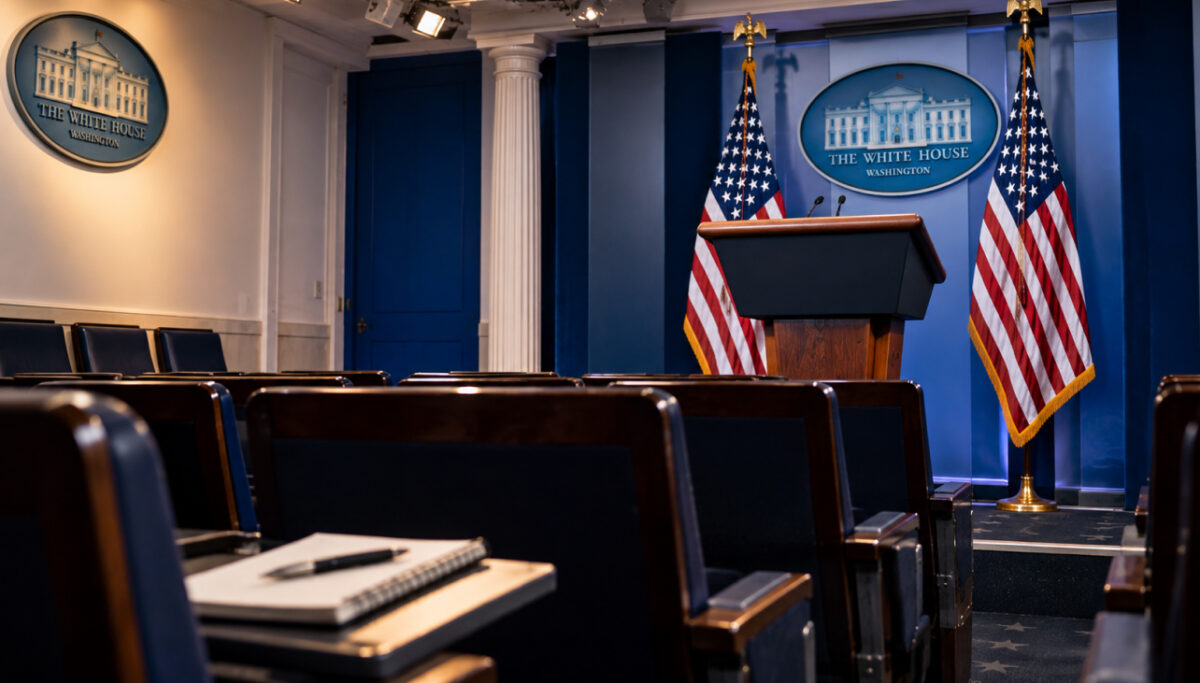
Her first briefing on October 13 provided an early indication. Speaking inside the James S. Brady Press Briefing Room in Washington, D.C., Zacharia emphasized the president’s political priorities, defended his administration’s record and promised to continue expanding access for newer media organizations.
However, the appearance lasted approximately 14 minutes and included questions from only three news outlets. That limited exchange prompted scrutiny of how the new press secretary intends to balance political advocacy with the White House’s responsibility to answer questions from the broader press corps.
The official White House announcement described her debut positively, while independent reporting highlighted the limited questioning and the challenges of her first appearance.
The White House
+1
For political communication analysts, Zacharia’s arrival offers a timely case study in how presidential administrations manage their public image, communicate policy priorities and navigate an increasingly fragmented American media environment.
Who Is Katie Zacharia, Trump’s New White House Press Secretary?
Katie Zacharia became the 37th White House press secretary following Trump’s announcement of her appointment on October 9, 2026.
She succeeded Karoline Leavitt, who left the position on August 27. Leavitt had become one of the most recognizable public faces of the administration through her frequent appearances in the briefing room and confrontational exchanges with journalists.
Zacharia brings a different professional background to the position.
Before joining the White House, she worked as a communications adviser to Trump Media & Technology Group, the parent company of Truth Social. She also appeared as a conservative political commentator on Fox News and Newsmax and briefly served in a communications role at the Department of Homeland Security.
Her experience places her at the intersection of political commentary, digital media and government communications.
Unlike a traditional press secretary whose career develops primarily through institutional public relations or campaign press operations, Zacharia entered the position with substantial experience communicating political viewpoints to television audiences.
That distinction matters because the responsibilities of a television commentator and a White House press secretary are not identical.
A commentator can concentrate on persuading an audience or interpreting events through a political perspective. A government spokesperson must also explain official decisions, clarify policy details and respond to questions that may challenge the administration’s preferred narrative.
The Washington Post’s October 12 report documented Zacharia’s previous media and communications roles and the transition from Leavitt.
The Washington Post
Her background may make her comfortable defending the administration on television, but success in the briefing room will require an additional set of skills: responding accurately under pressure, explaining complicated policy decisions and maintaining credibility beyond the president’s political supporters.
Katie Zacharia’s First White House Briefing Reveals An Early Communication Pattern
Zacharia’s inaugural briefing on October 13 was one of the first opportunities for journalists to evaluate her approach to the position.
The session lasted approximately 14 minutes, including prepared remarks and a short question-and-answer period.
She began by thanking Trump for appointing her and outlining what she described as the administration’s achievements.
Her opening remarks emphasized economic policy, energy, immigration and the president’s campaign activities ahead of the midterm elections.
Zacharia also discussed Trump’s upcoming political travel, including planned appearances in Georgia, Kentucky and Florida.
The structure of the briefing was notable.
According to Associated Press coverage of her debut, she took questions from Breitbart, Fox News and the Daily Mail before ending the session.
apnews.com
Those outlets have different editorial operations, but all three have audiences that include substantial conservative readership or viewership.
The decision to take only three questions does not establish how Zacharia will conduct future briefings. Nevertheless, it illustrates the degree of control a press secretary can exercise over which subjects receive attention.
A press briefing serves several purposes simultaneously.
It allows an administration to explain its policies, provides journalists with opportunities to request clarification and creates a public record of government statements.
When the question-and-answer portion is brief, the balance shifts toward prepared communication rather than sustained examination.
That distinction is particularly important during an election season, when government announcements and political campaign messages can overlap.
The White House praised Zacharia’s performance, and Trump also expressed approval. Other observers questioned whether the short session demonstrated sufficient preparation for the demands of the position.
Those competing assessments underscore a central tension in presidential communications: an appearance can be politically effective for supporters while leaving journalists seeking more substantive answers.
From Karoline Leavitt To Katie Zacharia: Continuity And Change
The transition from Leavitt to Zacharia represents a change in personnel, but the available evidence does not yet establish a fundamental transformation in White House media strategy.
Leavitt’s tenure was associated with assertive defenses of Trump, direct challenges to critical reporting and an emphasis on communicating with media organizations beyond the traditional White House press corps.
Zacharia has already signaled support for continuing that approach.
During her first briefing, she praised Leavitt’s work and expressed support for retaining the New Media Seat, an initiative intended to provide opportunities for digital creators and other nontraditional media participants.
The administration has presented this policy as an effort to broaden media access.
Supporters of such initiatives argue that traditional news organizations should not have exclusive influence over the questions asked at White House briefings.
Digital publishers, independent journalists and online commentators can reach audiences that do not regularly consume conventional television or newspaper coverage.
However, broader access does not automatically guarantee broader scrutiny.
The effectiveness of any media-access policy depends on whether participants are able to ask substantive questions, challenge official claims and seek follow-up answers.
The White House’s October 13 statement confirmed Zacharia’s intention to maintain and potentially expand the New Media Seat.
The White House
The distinction between media diversity and viewpoint diversity will therefore become an important measure of her tenure.
A briefing room may include more types of publishers without necessarily exposing the administration to a wider range of difficult questions.
Conversely, a well-managed expansion could give legitimate independent reporters opportunities that previously were difficult to obtain.
Zacharia’s challenge is to demonstrate that the policy improves public access to information rather than simply strengthening the administration’s preferred communication channels.
Trump’s Direct-To-Audience Strategy Could Become Even More Important
One of the defining characteristics of Trump’s political communication has been his willingness to communicate directly with supporters rather than relying exclusively on traditional news organizations.
Truth Social, campaign rallies, televised interviews and short-form videos allow the president to distribute messages without waiting for journalists to interpret them.
Zacharia’s previous association with Trump Media & Technology Group is relevant in this context.
Her professional experience suggests familiarity with the digital platforms and political audiences that form an important part of the president’s communication ecosystem.
However, that background does not necessarily mean she will introduce new digital strategies.
The administration already uses social media extensively, and Trump remains a highly visible political communicator who frequently sets the news agenda through his own statements.
Zacharia’s contribution may therefore involve reinforcing messages across different platforms rather than developing a separate public identity.
The distinction is important.
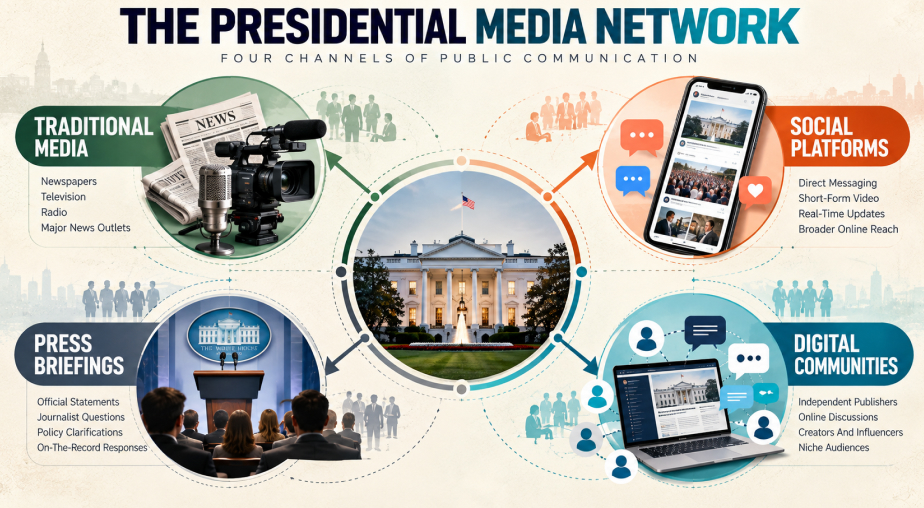
In a conventional communications structure, the press secretary may serve as the administration’s primary public interpreter. In Trump’s political operation, the president often delivers major announcements himself, leaving spokespersons to explain, defend or amplify those statements afterward.
The White House’s official video archive illustrates its emphasis on distributing presidential appearances, short videos and press briefings through its own channels.
The White House
This approach gives the administration greater control over presentation and timing.
It also creates challenges for independent verification because official clips may omit the broader context that journalists seek through follow-up questions.
For Zacharia, effective communication will depend partly on whether she can supplement the president’s direct messaging with detailed, reliable explanations of government policy.
White House Press Access Becomes A Major Test For Zacharia
Zacharia assumes the position during an ongoing legal dispute involving access to the White House.
CNN, MS NOW and Politico challenged the administration after their journalists’ credentials were revoked in September 2026.
The news organizations argued that the restrictions constituted retaliation for critical coverage and violated constitutional protections.
The administration defended its authority to manage access to White House facilities and disputed the outlets’ characterization of its actions.
On October 13, U.S. District Judge Timothy Kelly granted a preliminary injunction preventing the administration from enforcing the credential revocations while litigation continues.
The decision did not resolve the entire case or guarantee access to every presidential event, including certain restricted press-pool assignments.
Nevertheless, it represented an important legal development concerning the relationship between the executive branch and independent journalism.
According to CBS News’ coverage of the court ruling, Kelly concluded that the restrictions likely violated constitutional protections under the First and Fifth Amendments.
CBS News
The dispute presents Zacharia with a difficult institutional challenge.
As White House press secretary, she must represent the president’s positions while managing daily interactions with journalists whose reporting the administration may strongly oppose.
The legal controversy also raises questions about how access decisions influence public perceptions of transparency.
Government officials have legitimate responsibilities to organize briefings, manage security and establish procedures for media participation.
At the same time, restrictions based on unfavorable coverage can undermine the principle that journalists should be able to scrutinize government decisions independently.
Zacharia’s approach to these issues will be an important indicator of whether the administration intends to improve relations with the broader press corps or maintain a more confrontational structure.
Political Communication And Government Accountability During The 2026 Midterms
The timing of Zacharia’s appointment adds another dimension to her responsibilities.
The United States is approaching the November 3 midterm elections, and Trump has been actively campaigning for Republican candidates.
During her first briefing, Zacharia highlighted the president’s political travel and emphasized the administration’s economic and immigration messages.
Those themes are central to the Republican Party’s campaign narrative.
However, communicating government policy and promoting electoral candidates are distinct activities.
A White House press secretary is expected to explain the administration’s actions, including policy decisions that may influence voters’ opinions.
Political messaging becomes more complicated when official communications closely resemble campaign promotion.
For journalists, the challenge is determining whether government statements provide independently verifiable information or primarily advance electoral narratives.
For the administration, the challenge is maintaining a coherent message while responding to legitimate questions about policy outcomes.
Zacharia’s debut suggested that she intends to place substantial emphasis on reinforcing the president’s political priorities.
The October 13 briefing transcript documents the subjects she discussed and the relatively limited time devoted to reporters’ questions.
Roll Call
The next several weeks will offer a clearer picture of how she handles the distinction between policy explanation and campaign-oriented communication.
The quality of that distinction matters because public confidence depends not only on whether government officials communicate frequently, but also on whether their statements are accurate, contextualized and open to scrutiny.
What Katie Zacharia Must Demonstrate In Her First Weeks
Zacharia’s initial appearance provides only a limited basis for judging her long-term performance.
The first briefing attracted attention because of its short duration, prepared presentation and restricted questioning.
Those characteristics may reflect an early adjustment period rather than a permanent operating model.
Her performance should therefore be evaluated over multiple briefings rather than through a single appearance.
Several indicators will help determine whether her appointment produces meaningful changes in White House communication:
- Briefing frequency and accessibility: Whether regular sessions provide meaningful opportunities for questions from a broad range of news organizations.
- Policy knowledge and accuracy: Whether Zacharia can explain complex government decisions with sufficient detail and correct inaccurate statements when necessary.
- Response to difficult questions: Whether she engages substantively with critical reporting rather than relying primarily on prepared political messages.
- Digital media strategy: Whether expanded access for independent creators contributes to greater transparency and more informative public communication.
These measures matter more than the immediate reaction to her first appearance.
A press secretary’s effectiveness cannot be assessed solely through television presentation, social media engagement or approval from political supporters.
The position also carries an institutional responsibility to provide information about the federal government’s actions.
That responsibility becomes particularly important when policies affect economic conditions, immigration enforcement, international relations and other matters of substantial public interest.
Zacharia’s ability to combine political message discipline with substantive public explanations will shape her credibility.

What Zacharia’s Appointment Reveals About The Future Of Presidential Media Relations
Katie Zacharia’s arrival reflects the continued importance of political loyalty, media familiarity and direct communication in Trump’s White House.
Her background in conservative commentary and Trump-affiliated media makes her a recognizable representative of the administration’s existing communication culture.
Her first briefing reinforced several established priorities: promoting the president’s record, emphasizing political messaging and supporting greater participation by nontraditional media organizations.
At the same time, the short question-and-answer period and the ongoing legal dispute over press access demonstrate the unresolved tensions surrounding the administration’s relationship with independent journalism.
It is too early to conclude that Zacharia will substantially transform Trump’s media strategy.
The more immediate possibility is continuity, with a new spokesperson responsible for defending and explaining an established communication approach.
Whether that approach evolves will depend on her subsequent briefings, her handling of difficult policy questions and the administration’s decisions concerning media access.
The broader significance extends beyond one appointment.
Presidential communication now operates across official government channels, partisan media, independent journalism, digital platforms and direct-to-audience political messaging.
Each channel influences how citizens encounter government information and how competing interpretations of public policy develop.
Zacharia’s tenure will help illustrate whether a modern White House press secretary can operate effectively within that fragmented environment while preserving the accountability expected of an official government spokesperson.
The coming weeks will reveal whether her role becomes primarily an extension of Trump’s political messaging operation or develops into a more substantive channel for explaining the administration’s decisions to the American public.