
Digital Equity Act rulings in 2026 have given advocates, lawmakers, agencies, and digital campaigners a sober lesson: policy goals may command broad civic attention, but statutory language and agency authority still decide what survives in court. Two developments are confirmed in the research record. On July 15, 2026, a federal district court in Washington, D.C., ruled that a race and ethnicity provision tied to grant allocations was unconstitutional but severable. On May 6, 2026, the U.S. Court of Appeals for the Eighth Circuit vacated the Federal Communications Commission’s 2023 digital discrimination rule. The legal effects differ, but both rulings matter for how public campaigns should describe broadband access, equal treatment, and institutional power.
The public debate around broadband equity often moves first through platforms: coalition posts, rapid-response statements, legislative scorecards, fundraising emails, and short videos. That speed can help communities organize. It can also blur the difference between what a court has ruled, what an agency may still do, and what advocates hope Congress will restore or revise. For readers comparing related policy coverage across the same network, CA Views offers a useful reference point on public affairs coverage, but each claim about these rulings still needs to be tied to the record.
Why Digital Equity Act Rulings Narrowed The Path
Confirmed Holding And Severance
The July 15, 2026 development did not erase the entire statute, based on the research supplied. The court ruled that the race and ethnicity provision was unconstitutional, yet severable, meaning the rest of the Act could continue without that provision. The Benton Institute reported the ruling as a decision that found the race provision unconstitutional but severable Benton Institute report. That distinction is not a minor drafting footnote. Severability can decide whether a court removes one unlawful part or disables a broader program.
What The Digital Equity Act Decision Did
The Digital Equity Act was not struck down in full under the reported ruling. The supported reading is narrower: a specific race and ethnicity consideration could not stand, but the broader policy structure remained capable of operating. The research also states that the Competitive Grant Program was reinstated without race-based considerations. That means public communication should avoid saying that the law was either fully invalidated or fully untouched. Neither description matches the supplied record.
This is where social media advocacy faces a legal and ethical test. A message that says “the program is back” may be directionally useful but incomplete. A message that says “the court ended digital equity” would be too broad, based on the facts provided. The more accurate civic message is harder to compress: the court removed a race-linked grant consideration, treated that provision as severable, and left other parts of the federal effort able to proceed. The site’s related analysis of what changes now offers a connected policy frame for readers tracking the same issue.
Agency Authority And The FCC Rule
The Eighth Circuit’s Limit On Regulatory Reach
The May 6, 2026 ruling came from the U.S. Court of Appeals for the Eighth Circuit in Minnesota Telecom Alliance v. FCC, No. 24-1179. The court vacated the FCC’s 2023 digital discrimination rule, and the research states that the court found the agency exceeded its authority by imposing liability for unintentional discrimination and extending its regulatory reach too far. The opinion is available through Justia’s case record Eighth Circuit opinion.
What Remains Unresolved
The research states that the rule was vacated in its entirety, leaving no operative federal regulatory framework under Section 60506 of the Infrastructure Investment and Jobs Act. That is a major institutional result, but it should not be overstated. The supplied record does not establish what Congress will do next, whether the FCC will seek a new path, or how any future rule might be drafted. Those are unresolved questions, not confirmed outcomes.
For advocacy groups, the lesson is not simply that agencies should be timid. It is that statutory authority has to carry the regulatory design. Courts can accept that unequal access is a public problem while still rejecting a particular legal mechanism. Digital posts that collapse that distinction risk turning a legal ruling into a slogan. That may mobilize quickly, but it can also weaken public understanding and expose campaigns to credibility problems when later reporting clarifies the actual holding.
Legislative Lessons From Digital Equity Act Cases
Digital Equity Act Drafting Should Separate Goals And Tools
The rulings point toward a drafting lesson for future legislation: Congress can state a public goal, but it should also specify which tools agencies may use, who is regulated, what evidence is required, and which standards trigger liability or funding decisions. The Digital Equity Act ruling on severability shows one protective device. If a court rejects one provision, a well-drafted statute may still preserve the remaining program.
That does not mean severability solves all constitutional problems. It only limits the damage after a defect is found. A stronger legislative design would separate statements about the social problem from the operative criteria used by grant administrators. If lawmakers want to address documented barriers in broadband access, the legal text must identify criteria that can survive judicial review. The research supplied does not provide a full legislative record, so this analysis cannot claim which alternative criteria would be upheld. It can say that precision matters.
Agency Delegation Must Be Clear
The FCC ruling offers a second lesson: Congress should speak clearly when it delegates authority to an agency. If lawmakers want an agency to regulate disparate effects, unintentional discrimination, or parties outside a direct service relationship, they need to say so in terms that a court can recognize. The Eighth Circuit’s decision, as described in the research, treated the FCC rule as going beyond the agency’s statutory power. Future bills should not leave the most contested liability questions to inference.
- Define the regulated entities rather than relying on broad references to market participants.
- Separate intentional discrimination standards from disparate-impact or effects-based standards.
- State whether liability applies only to broadband providers or to other actors connected to deployment and service.
- Use severability language so one invalid provision does not automatically threaten a full program.
These points are not a substitute for legal advice. They are policy lessons visible from the reported outcomes. They also align with the practical needs of public campaigns, which must explain what the law does without promising results that the statute does not secure.
Advocacy Ethics After The Rulings
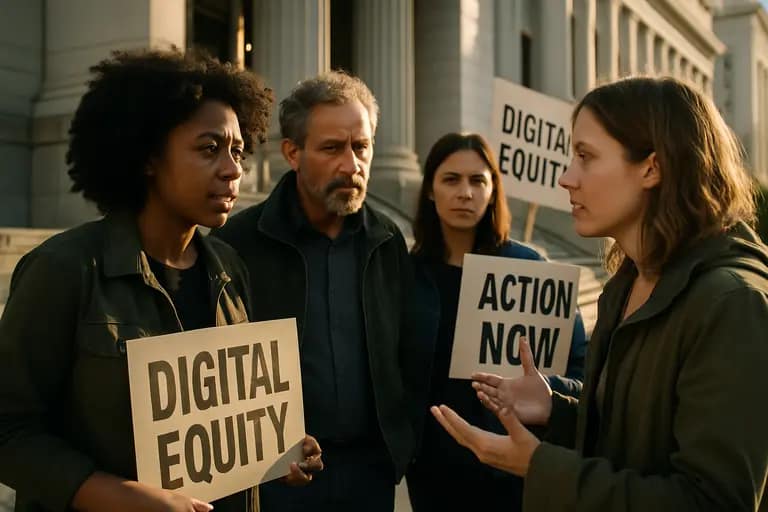
Platform Messaging Should Mark The Difference Between Ruling And Reaction
The research notes that the National Urban League criticized the July 2026 ruling, describing it as part of a judicial trend that recognizes racial inequality while removing governmental tools to address it. That is an advocacy position, not the holding itself. Ethical social media communication should mark that difference. A post can report the court’s action, quote or summarize a group’s criticism, and then identify what remains legally operative. Mixing those categories creates confusion.
This caution applies across the advocacy spectrum. Supporters of the rulings should not imply that courts rejected the existence of digital exclusion if the opinions addressed statutory or constitutional limits. Opponents should not imply that every federal digital inclusion effort is barred if severed portions remain in force. Digital advocacy can be forceful while still being exact. The earlier site discussion of digital advocacy law is relevant here because grassroots work increasingly depends on fast interpretation of court decisions.
Why Accuracy Protects Movements
Accuracy is not a neutral decoration added after mobilization. It protects movements from avoidable correction, helps coalition partners speak consistently, and gives affected communities a clearer view of available options. Broadband access campaigns often involve local organizations, libraries, schools, civic groups, and public agencies. If those actors receive distorted summaries, they may misread funding status, eligibility rules, or the scope of agency power.
The courts have also shown that moral urgency does not cure legal overreach. That does not weaken the case for digital inclusion as a policy concern. It means future public arguments must connect lived barriers to lawful mechanisms. Online campaigns should cite the institution, date, case name where available, and practical effect. They should also say when the next step is not yet known.
What Future Broadband Equity Law Can Carry Forward
A Narrower But More Durable Public Framework
Future broadband equity legislation can learn from both 2026 rulings. It can retain ambitious goals while using criteria that are clearer, evidence-based, and better matched to statutory authority. It can direct agencies with more exact language. It can include severability clauses and define the scope of regulated conduct before disputes arise. It can also require public reporting in forms that help citizens understand outcomes without relying only on agency summaries or advocacy graphics.
Future Digital Equity Act advocacy should therefore speak in two registers at once: the civic register of equal access and the legal register of institutional limits. The confirmed record shows that one court severed an unconstitutional grant-related provision while leaving the broader Act able to function, and another court vacated an FCC rule because it exceeded agency authority. The lesson for lawmakers is disciplined drafting. The lesson for digital advocates is disciplined communication. Both are needed if broadband equity policy is to survive not only public debate, but judicial review.