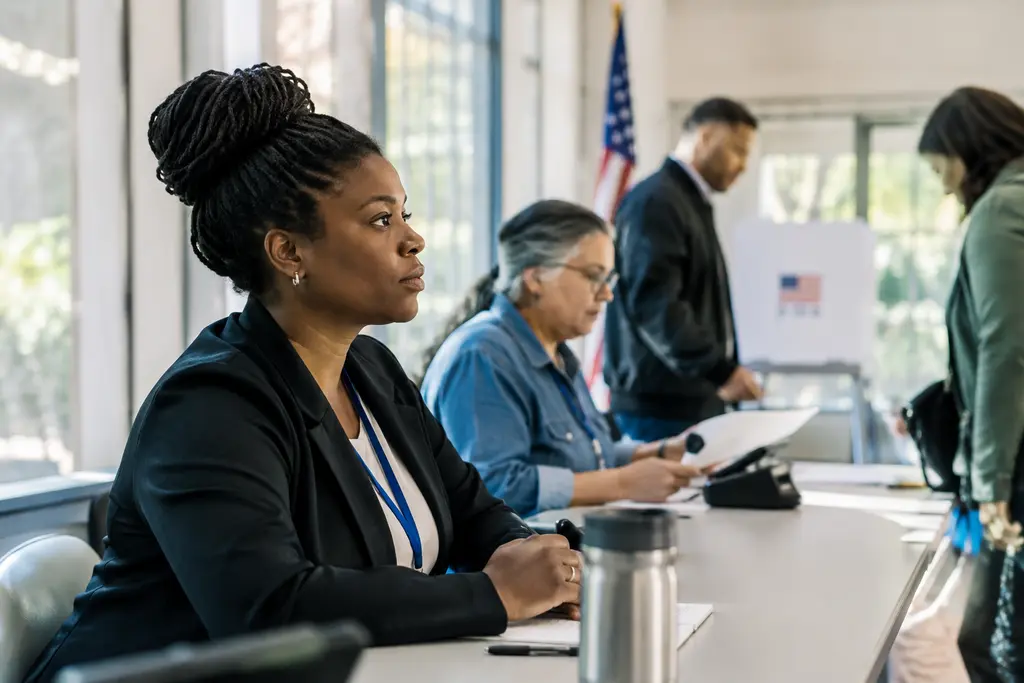
Federal Monitors became a central feature of the 2026 U.S. midterm elections on November 3, 2026, after the Department of Justice announced an election monitoring operation covering all 50 states. The DOJ said approximately 1,000 personnel were being deployed through an operation involving the Civil Rights Division and other federal components, with the stated purpose of checking compliance with federal voting-rights laws DOJ announcement.
That scale makes the legal and ethical questions sharper for campaigns, civic groups, digital organizers, and local observers. A monitoring program can support public confidence when its role is understood. It can also create confusion if advocates imply that federal personnel administer elections, police polling places, or decide voter eligibility. The available record does not support those broader claims. State and local officials remain responsible for running elections, while federal personnel observe and document potential federal-law issues.
For a broader perspective on election communication coverage within the network of related publications, readers may want to visit Peiknet. The core guidance here is narrower: public claims about monitors should track confirmed authority, not assumptions about federal power.
Why Federal Monitors Were Sent Nationwide
The Confirmed Federal Purpose
The DOJ said Federal Monitors and associated personnel were assigned to help ensure compliance with laws including the Voting Rights Act, the National Voter Registration Act, the Help America Vote Act, and the Americans with Disabilities Act. The announced staffing included personnel from the Civil Rights Division, U.S. Attorney’s Offices, federal observers from the Office of Personnel Management, and others. That institutional mix matters because the presence of federal staff does not convert the polling place into a federal operation.
The 2026 deployment was also larger than recent national election monitoring efforts. CBS News reported that, during the 2024 presidential election, the Justice Department deployed 714 monitors across 27 states and 86 jurisdictions CBS News report. The research record also states that the 2022 midterm effort involved 289 monitors. Those comparisons support a cautious description: the November 3, 2026 operation was unusually broad, and DOJ described it as historically large. They do not prove, by themselves, that polling-place conditions were worse in 2026. Scale can reflect policy choice, legal risk assessment, planning capacity, or litigation posture; the public record cited here does not resolve those causes.
What Federal Monitors Can Observe
For legal planning, Federal Monitors should be described as observers and reporters, not election managers. The research materials state that monitors primarily observe polling locations, take notes, and report possible violations. They also state that monitors are prohibited from carrying firearms and cannot act as law-enforcement officers. Reported court filings dated October 28–29, 2026, stated that FBI and ICE agents would not serve as monitors during the midterms. Because that point relates to voter intimidation concerns, public-facing advocacy should present it carefully and avoid implying that immigration or criminal enforcement personnel were stationed to supervise voting unless a reliable record supports that claim.
The distinction is not cosmetic. In an election setting, words such as “enforcement,” “raid,” “takeover,” or “federal control” can mislead voters if used loosely. Ethical campaign communication should make clear that federal voting-rights monitoring is separate from local election administration. That separation is central to lawful voter education because voters should not be deterred by exaggerated claims about who has authority inside or near a polling place.
Legal Boundaries For Polling-Place Oversight
Access Depends On Law And Permission
One of the more practical legal limits concerns physical access. The research record states that DOJ staff monitors do not have automatic authority to enter every polling place in every state. Access may depend on state law or local permission. That means a federal monitoring announcement should not be read as a universal right of entry into all election spaces. Local rules still matter, and election officials may have procedures governing where observers stand, what they may record, and how they may raise concerns.
Those access limits should shape how civic groups train volunteers. A campaign volunteer or non-government observer should not claim a right based only on the existence of a federal operation. Nor should a volunteer tell voters that a monitor can fix a ballot problem, determine eligibility, or overrule a poll worker. The research record states that no statute gives monitors authority to administer elections, determine voter eligibility, or direct local officials. Those functions remain with state and local election authorities.
Why Authority Claims Need Care
Misstating monitor authority can create two kinds of harm. First, it can confuse voters at the point where clarity matters most. Second, it can create conflict with poll workers who are applying local procedures under state law. Advocacy groups should use plain language: monitors observe, document, and report potential federal-law issues. Local election officials run the site.
That distinction also affects digital campaigning. Social posts, text-message programs, and rapid-response graphics should avoid unverified claims that a monitor “ordered,” “blocked,” “cleared,” or “reversed” an election decision unless the organization has direct evidence and understands the legal authority involved. A safer formulation is to identify what was observed, where it occurred, when it occurred, and which official channel received the report. For related planning context, this site’s prior analysis of civic coordination with DOJ poll monitors addressed how organizations can separate verified reports from assumptions.
Ethical Guidance For Advocacy Groups

How To Communicate Without Intimidating Voters
Before November 3, early voting had been underway in many areas, and the research record states that thousands of non-government observers from civic groups and both major parties were expected at polling places. That environment increases the need for discipline. A lawful observer program can be undermined if volunteers crowd voters, photograph private information, argue with poll workers, or post allegations before verification.
Organizations should train staff and volunteers to separate three categories: confirmed facts, firsthand observations that still need review, and allegations received from others. Public messaging should not treat all three as equal. A confirmed fact might be the DOJ’s announced deployment size. A firsthand observation might be a long line at a named site at a stated time. An allegation might be a voter’s report of improper treatment that requires follow-up. Ethical communication preserves those distinctions.
- Use time, location, and source labels in incident notes.
- Avoid naming private voters in public posts without a clear legal and ethical basis.
- Do not imply that federal personnel can decide a voter’s eligibility.
- Route urgent concerns through official complaint channels or trained legal teams.
- Correct public claims promptly if later information changes the account.
Digital advocacy teams should also resist pressure to turn every polling-place report into a shareable accusation. Election communication can move faster than verification. A cautious process protects voters, poll workers, and the credibility of the organization making the claim.
Federal Monitors In The 2026 Midterms
Federal Monitors can help safeguard election integrity when their role is described accurately: they observe compliance with federal voting-rights laws, document concerns, and report potential violations through federal channels. They do not replace local election officials, administer elections, decide eligibility, or serve as general law enforcement. That boundary should guide every press statement, volunteer script, voter-education page, and social media post about the November 3, 2026 midterms.
The strongest public message is also the most restrained one. The 2026 monitoring operation was large, national, and legally significant. It should not be inflated into a claim of federal control over polling places, nor minimized as symbolic if monitors were documenting compliance issues under federal statutes. For campaigns and civic organizations, integrity begins with precision: say what is confirmed, identify what remains unresolved, and avoid using monitor presence to frighten, pressure, or mislead voters.