
Do you remember when your social media turned into a sea of charity? The ALS Ice Bucket Challenge was more than a viral trend. It turned a fun challenge into real money for research.
This section is like a war room whiteboard. It’s filled with success stories of movements that made a difference. From #MeToo becoming a global term to Black Lives Matter changing policies.
We’re not just talking about online likes. Movember made men’s health a topic of conversation. Earth Hour showed that going dark can make a big impact.
So, what makes these campaigns successful? It’s the power of a good story and the right online platform.
This is the proof that online efforts can lead to real change. Let’s look at how it works.
Strategy Dissection
Forget the spin room; today’s best political strategies are built on empathy. It’s the difference between lecturing and having a real conversation. Pierre Poilievre’s shift from abstract economics to a single mom’s struggles at the grocery is a prime example. It wasn’t just a messaging change; it was a complete narrative shift.
Why does this work? Our brains love stories, not data. Policy jargon is hard to understand. A relatable struggle grabs our attention. This is the heart of the empathy-first strategy. It’s not about being weak; it’s about being smart. You’re making your argument relatable to your audience.
This approach needs a deep, integrated strategy. Firms like NATIONAL use a “surround-sound” method. They aim to shape a decision-maker’s view before meeting them. They do this by making sure the topics you want to discuss are already in their environment.
Think of it as pre-suasion. You’re not starting from scratch. You’re engaging with someone whose mind is already open to your ideas. This is where real influence comes from: by understanding someone’s daily life and their context.
So, what does this mean for civic tech and global advocacy? The tools evolve, but the principle remains the same. A successful social media campaign tells human stories, not just pushes points. It’s like sharing a neighbor’s story over the fence.
The process is interesting. It begins with deep listening, finding emotional hotspots in community concerns. Then, you turn complex issues into personal stories. These stories are shared across various channels. This integrated approach is key for virtual campaign events and digital organizing, where attention is scarce.
The lesson is clear. To win in today’s crowded space, you need to resonate deeply, not just shout louder. Whether in local politics or global advocacy, the strategy that works is the one that connects with people on a personal level. Remember, every policy has a person behind it. And the best way to reach them is through a story that touches their heart.
Technology & Platforms Used
The difference between viral chatter and real change often comes down to tools. It’s not just about social networks. It’s about the tech that turns slacktivism into action.
Hashtags are key in modern advocacy. When #EarthHour trends in 42 countries, it’s not by chance. It’s due to timing, network activation, and visuals. This symbol turns global sentiment into a single, searchable stream.

But hashtags are just the start. The best online campaign uses a range of social tactics:
- Strategic Hashtags: For finding and building communities.
- Influencer Collaborations: To reach trusted audiences.
- Compelling Visuals: Images are processed faster than text.
- Inspiring User-Generated Content (UGC): Turning supporters into creators.
This toolkit raises awareness. But awareness is hard to stand out in. That’s where civic tech platforms come in.
Platforms like New/Mode are essential for organizers. They’re not just for broadcasting. They enable targeted engagement. They let supporters call their reps with one click. Why is this better than retweets?
It’s because it’s a real action. It moves from digital noise to a recorded, tangible interaction. This is the shift from awareness to action.
Many NGOs miss this truth, as shown by NetChange research. Having a fancy tool is useless if you don’t measure its impact. Did supporters call, email, or share? Without this data, you’re lost.
The winning strategy combines social media’s reach with civic tech‘s precision. It builds a bridge for the masses and connects them to decision-makers. Your tech stack must do both, or it’s just noise.
Cross-Cultural Campaigning
Earth Hour asks the world to turn off lights; HeForShe challenges Turkish men to speak out against sexist jokes. Both are examples of global advocacy. But they differ in approach. One is a silent gesture, the other a bold statement.
HeForShe’s #IDo campaign in Turkey is a great example. The message of male support for gender equality stayed the same. But how it was delivered changed. It became a call to action at family dinners, using the power of social gatherings.
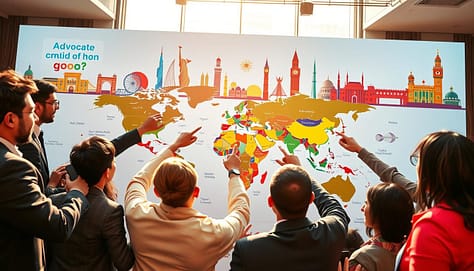
Earth Hour, on the other hand, is all about a simple action. Turning off lights worldwide doesn’t need words. It’s a powerful symbol that speaks to everyone.
But what about tackling deeper issues? Black Lives Matter shows how to adapt to different cultures. It started in the U.S. but grew globally, focusing on local issues like racism and police brutality.
Save the Children’s efforts in Syria are another example. They had to make a complex crisis feel urgent. They highlighted specific needs like warmth and education, making a difference feel possible.
The key to success in online campaigns is cultural understanding. It’s not just about translating words. It’s about finding a local connection that makes global messages meaningful.
Obstacles & Solutions
Advocacy today is like shouting in a storm of content. The noise is overwhelming. Media is split into many small platforms. And our attention spans are shorter than a TikTok video.
Your detailed policy brief is up against AI-made content that went viral fast. Getting noticed by decision-makers is a big challenge in this busy world of global advocacy.
Using social media wisely is tricky. How do you keep client secrets when a story goes viral? And how do you fight false information without getting caught up in arguments?
The old way of being loud and persistent doesn’t work anymore. Now, being smart and strategic is key. You need discipline, technology, and strong ethics to succeed.
First, fight the noise with “surround-sound” consistency. Your message must be clear and consistent everywhere. If your message varies, you’ve already lost.
Second, use civic tech to add depth, not just noise. Aim for real engagement, not just clicks. Use tools that help people understand complex issues.
True civic tech turns passive viewers into active participants. It makes a difference by encouraging people to take action. This is how you get noticed by decision-makers.
Third, make digital literacy and ethics a core skill. Everyone must be able to spot fake news and understand online boundaries. It’s not just about technology; it’s about being ethical online.
This is not just for IT people. It’s essential for anyone in global advocacy today. You need to know how to use tools and handle online ethics.
So, how do these pieces fit together in practice? The table below breaks down the core antagonisms and the pragmatic responses.
| The Obstacle | The Real-World Impact | The Smart Solution |
|---|---|---|
| Fragmented Media & AI Noise | Your message drowns in an oversaturated field. AI summaries shape narratives before your data is seen. | Surround-sound consistency across channels. Pre-empt AI with clear, authoritative, and easily-shareable original content. |
| Meaningless Engagement | High follower counts with zero policy influence. Clicks that don’t convert to action. | Invest in purpose-built civic tech platforms designed for measurable feedback and organized outreach, moving beyond vanity metrics. |
| Ethical Gray Areas & Misinformation | Blurred professional lines, confidentiality risks, and team burnout from fighting falsehoods. | Formal digital ethics protocols and mandatory digital literacy training. Empower your team to be savvy critics, not just broadcasters. |
| Short Public Attention | Complex issues get reduced to slogans. Nuance is lost. | Use technology to *simplify* complexity, not remove it. Interactive data charts and micro-storytelling can maintain engagement with detailed topics. |
The future of global advocacy isn’t about being louder. It’s about being smarter and more resilient. Use technology wisely, speak clearly, and always remember the importance of ethics, trust, and clarity. The challenges are real, but so are the solutions. It’s time to update your approach.
Actionable Insights
Think of this as your guide to action. We’ve learned a lot from our global journey. The key takeaway? Focus on people, not just policies.
Pierre Poilievre’s approach and the #MeToo movement teach us a valuable lesson. Create a message that puts people first. Every statistic should have a human story behind it. Every policy should be linked to a personal experience.
When planning your next online campaign, you have a choice. Will it be a big hashtag push for awareness? Or a focused effort to send letters to lawmakers? Pick your strategy and build a team that can tell stories and analyze data well. Use tools that track important metrics like letters and calls.
In today’s world, AI can write your press releases. But your unique strength is your genuine, human story. Use it wisely. Keep an eye on AI’s influence, but never let it replace your emotions.
You don’t need more money to make a difference. What you need is a clear message and smart tools. Now, let’s create something that truly matters.