Categories
Social Media Advocacy Strategies

Define objectives and action targets

When it comes to nonprofit influencer strategy, clear objectives are key. Without a target, it’s like trying to find your way in a maze without a map.

To succeed in creator partnerships, you need to know your goals. Are you trying to raise awareness, get more donations, or get people to volunteer? Having clear, measurable goals helps make sure your work matches your influencer partnerships advocacy plan.

This way, you can concentrate on the best ways to reach your goals. Remember, “you can’t manage what you don’t measure.”

* Clear objectives are essential for effective creator collaborations
* Establishing specific, measurable goals helps align efforts with the overall advocacy strategy

Discover Values-Aligned Creators and Vet Audiences for Effective Partnerships

Brands are now looking for creators who share their values in influencer marketing. This shift is driven by the need for authenticity. Brands want to partner with creators whose values match their own.

In creator partnerships, matching values is key. It helps brands connect with their audience in a meaningful way. This connection is what makes a brand’s message truly resonate.

Understanding the Importance of Values Alignment in Creator Partnerships

Values alignment is more than a trend; it’s essential for successful partnerships. When creators share your brand’s values, their support feels genuine. This authenticity builds a stronger bond with their followers.

Finding creators who align with your values requires careful analysis. Look at their content, how they interact with their audience, and who they reach. This goes beyond just looking at numbers.

Criteria Description Importance Level
Content Alignment How well does the creator’s content align with your brand’s values and messaging? High
Audience Demographics Does the creator’s audience match your target demographic? High
Engagement Patterns How does the creator engage with their audience, and is it positive and constructive? Medium
Audience Vetting Is the creator’s audience genuine, or are there signs of fake followers or engagement? High

Audience vetting is also vital. It checks if the creator’s followers are real and match your brand’s target. Spotting fake followers or low-quality engagement can harm a partnership.

By focusing on values alignment and careful audience checks, brands can create lasting and effective partnerships with creators.

Outreach Scripts and Value Proposition for Influencer Partnerships

The secret to great influencer partnerships is in the outreach. A personalized touch can turn a ‘yes’ into a reality. You need to know the influencer’s brand and audience well. Also, you must clearly show what your brand offers.

Crafting Compelling Outreach Scripts

Making an outreach script that speaks to influencers is more than just introducing your brand. It’s about sharing a story that matches their values and interests. A good script is both personal and relevant, showing you’ve done your homework on their content and audience.

To write a great script, first look into the influencer’s past work and themes. This helps you craft a message that fits right in. For example, if they often talk about sustainability, highlight your brand’s green efforts and how they match their values.

Personalizing Your Approach to Creators

Personalization is essential for outreach success. It’s not just about using the influencer’s name. It’s about showing you really get their work and audience. A personalized email or message can greatly boost your chances of a positive reply, showing you care and pay attention to details.

For instance, mentioning a specific post or collaboration they’ve done can make your outreach feel more personal. This approach shows respect for their time and shows you’re serious about a partnership.

For more tips on influencer outreach, check out Brandwatch’s blog on influencer outreach. It has useful advice and best practices.

Briefing Kit: Talking Points, Dos/Don’ts, Safety for Influencer Collaborations

Collaborating with influencers needs a solid briefing kit. It’s the key to a successful partnership. It covers the dos and don’ts, key points, and safety rules.

A good briefing kit is more than a document. It prevents misunderstandings and helps follow FTC disclosures. It guides creators to make content that connects with their audience and meets legal standards.

Creating Complete Briefing Kits for Creators

What makes a briefing kit complete? It starts with clear talking points that match the brand’s message. This helps the creator share the brand’s message well with their followers.

  • Key messaging pillars
  • Product or service details
  • Brand history and values
  • Specific campaign goals

A great briefing kit also lists the dos and don’ts of working together. It gives tips on content style, tone, and language. It’s also important to include safety guidelines for sensitive topics or risky activities.

A well-organized briefing kit for influencer collaborations displayed on a polished wooden desk. In the foreground, neatly stacked documents outlining talking points, a list of dos and don’ts, and safety guidelines, with a sleek pen beside them. In the middle, an open laptop showing a vibrant presentation slide about influencer partnerships, with a cup of coffee and a small potted plant adding a touch of warmth. The background features soft-focus shelves filled with books and framed photos of successful influencer campaigns, illuminated by natural light coming from a nearby window, creating an inviting and professional atmosphere. The overall mood is collaborative and strategic, ideal for fostering effective influencer relationships.

Brands should also talk about FTC disclosures and how to share sponsored content. This keeps things legal and builds trust between creators and their followers.

Creating a detailed briefing kit is a smart move for brands. It helps ensure both sides are on the same page. This leads to better and more effective campaigns.

Creative Freedom vs Message Discipline in Influencer Partnerships

In the world of influencer partnerships, there’s a delicate balance between creative freedom and keeping a consistent message. Giving influencers the freedom to create can make their content more real and interesting. Yet, it’s also important to keep the brand’s message clear to stay true to its identity and values.

Balancing Creative Freedom with Brand Messaging

Getting the right mix of creative freedom and message discipline is essential for a good influencer partnership. Brands need to find a balance between letting influencers create great content and making sure the brand’s message comes through. This can be done by setting clear guidelines and giving influencers all the information they need about the brand.

One good way is to give influencers a detailed briefing kit. This kit should cover the brand’s message, tone, and key points. It should also include logos, product info, and brand guidelines. This helps influencers create content that fits the brand while giving them the freedom to be creative.

Another method is to involve influencers in the content-making process early on. This lets brands use the influencer’s creative skills and ensures the content connects with their audience. Working together can lead to content that’s both effective and engaging, fitting both the brand’s message and the influencer’s style.

The secret to balancing creative freedom and message discipline is finding a balance between control and empowerment. By allowing influencers to create great content while keeping the brand’s message consistent, brands can make influencer partnerships work well.

Compensation, Contracts, and FTC Disclosures for Influencer Partnerships

The success of influencer partnerships depends on clear compensation models, solid contracts, and following FTC rules. As more brands use influencer marketing, knowing these key points is vital. It helps create strong and legal partnerships.

Understanding Compensation Models and Contractual Obligations

Influencer pay can be in cash, products, or a mix of both. Paid partnerships mean direct money for promotions. Pro bono collaborations offer products or services instead of cash, needing careful thought for both sides to gain.

Contracts are key in influencer deals. They outline what’s expected, when, and how much. A good contract also covers content rights, exclusivity, and how to end the deal.

FTC rules say influencers must tell their followers about brand deals. This can be done with simple labels like “Ad,” “Sponsored,” or “Partner” in a clear spot.

FTC Disclosure Best Practices

  • Use clear and concise language
  • Place disclosures near the sponsored content
  • Ensure disclosures are hard to miss
  • Use multiple disclosures if the content spans multiple pages or platforms
Compensation Model Description Example
Monetary Payment Direct payment for promotional services $1,000 for a sponsored post
Product/Service Exchange Influencer receives products or services Free products worth $500
Hybrid Model Combination of monetary and product/service compensation $500 + products worth $200

By grasping these compensation models, contract details, and FTC rules, brands can make sure their influencer partnerships work well and follow the law.

Co-Creating Content and Live Activations with Influencers

In the world of influencer marketing, co-creation is key. When brands and influencers work together, they create something new and exciting. This approach leads to authentic and engaging campaigns.

Co-creation is more than just adding a brand message to influencer content. It’s about creating something new together. This way, campaigns feel more real and connect better with the audience.

Strategies for Effective Co-Creation

So, how do brands co-create content with influencers? Here are some strategies:

  • Give influencers the freedom to create content that fits their style and audience.
  • Work together on content ideas that are relevant to both the brand and the influencer’s audience.
  • Use live activations to create buzz and engagement around a product or service.

Effective co-creation balances giving influencers freedom with meeting brand messaging needs. It’s a delicate balance, but it can lead to amazing results.

A vibrant scene showcasing a diverse group of influencers collaborating in a bright, modern studio space. In the foreground, a female influencer in professional attire discusses ideas with another influencer, a male wearing casual yet polished clothing. They’re surrounded by sketches, laptops, and design boards displaying colorful campaign concepts. The middle of the image features a large table with creative materials, including a camera setup and lighting equipment, emphasizing the act of co-creation. The background reveals large windows letting in natural light, casting a warm glow across the room, enhancing the energy and excitement of collaboration. The atmosphere is dynamic and inspiring, reflecting creativity and teamwork in content creation, with a focus on innovation and partnership.

To show the power of co-creation, let’s look at some successful campaigns. The table below shows key statistics and insights from these campaigns.

Campaign Influencer Type Engagement Rate
Brand A – Product Launch Nano-Influencer 4.2%
Brand B – Live Activation Macro-Influencer 2.5%
Brand C – Co-Creation Series Micro-Influencer 6.1%

The table shows co-creation can lead to high engagement rates. By embracing co-creation and live activations, brands can tap into influencer creativity. This drives meaningful connections with their audience.

Crisis and Backlash Plan with Escalation Ladder for Influencer Partnerships

Influencer partnerships can be both a blessing and a curse. They offer a wide reach but also come with risks. A solid crisis management strategy is key to handling these risks.

As brands rely more on influencers, the chance of backlash increases. It’s vital to have a plan ready.

Preparing for the Worst-Case Scenario

A crisis management plan is about being proactive, not just fixing problems. It’s about knowing the risks, like cultural mistakes or legal issues. Having a clear escalation ladder helps solve problems quickly and well.

Here are steps to make your crisis management plan:

  • Find out what risks your influencer partnerships might face.
  • Set up a clear way to handle crises.
  • Make a plan for how to deal with different types of crises.
  • Train your team on how to handle crises.

An effective escalation ladder is key for crisis management. It shows the steps to take as a crisis gets worse. This ensures the response fits the crisis. Here’s what an escalation ladder might look like:

Level Crisis Description Response Action
1 Mild backlash on social media Monitor and respond to comments, engage with the community.
2 Moderate crisis, possible brand damage Issue a public statement, temporarily pause campaign.
3 Severe crisis, big risk to brand reputation Activate full crisis management team, consider legal action.

In a crisis, it’s easy to lose focus. But with a good crisis management plan and escalation ladder, brands can handle tough times. Being ready can turn a disaster into a chance for growth and advocacy.

Measurement: Incremental Reach and Conversions in Influencer Partnerships

Influencer marketing is all about making an impact, not just reaching many people. Brands spend a lot on influencer partnerships. It’s key to know which metrics to focus on to improve future collaborations.

Tracking Performance Metrics for Influencer Collaborations

Brands need to track several performance metrics to see if influencer partnerships work. They look at incremental reach, which shows how many new people see the brand. They also check conversions, like sales or sign-ups, to see if the campaign worked.

Other important metrics include engagement rates, click-through rates, and how people feel about the brand. By looking at these, brands can understand how well their influencer partnerships are doing. This helps them make better choices for future collaborations.

  • Incremental Reach: Measures the additional audience exposed to the brand.
  • Conversions: Tracks the number of sales, sign-ups, or other desired actions.
  • Engagement Rates: Evaluates how the audience interacts with the influencer’s content.

By focusing on these metrics, brands can make their influencer marketing better. This ensures their partnerships lead to real results.

Long-Term Ambassador Program Framework for Sustained Influencer Partnerships

Influencer marketing is always changing, and lasting partnerships are key. A long-term ambassador program can change the game. It lets brands build real connections with creators who share their values.

These partnerships help brands grow by providing consistent, true messages. A good program leads to lasting partnerships that bring real results.

Nurturing Lasting Relationships

To make a successful ambassador program, brands must focus on lasting relationships. They need to offer ongoing support, feedback, and chances for growth. This way, both sides benefit from the partnership.

Good programs need careful planning and constant checking. They also need to understand the creator world well. This way, brands can get lasting partnerships that help their business grow.

Categories
Social Media Advocacy Strategies

Choose goals: awareness, persuade, or mobilize

Defining your goals is the first step in creating an effective campaign. Are you trying to raise awareness, persuade your audience, or mobilize them to take action? According to Gillian Caldwell, a pioneer in advocacy, understanding your objectives is key to a successful strategy.

Gillian Caldwell’s experience with “Bought & Sold” shows how important a clear goal is. Whether it’s raising awareness or mobilizing support, your goals shape your content‘s tone, style, and how it’s shared.

By picking the right goals, you can make a strong advocacy strategy. This focus helps you tell a story that connects with your audience.

Short vs Long Form: Where Each Wins

TikTok and Instagram Reels have changed how we share messages. Short-form video is now key. Knowing what works best is vital for reaching new people.

Short videos are big on TikTok and Instagram Reels. Ryan Stygar, a lawyer with a big TikTok following, says they’re great for finding new viewers. They make it easy to share messages in a way that grabs attention.

Understanding the Strengths of Short-Form Video

Short-form video is great at getting a point across quickly. It helps advocacy groups share complex ideas simply. This way, more people can understand and get involved.

Want to learn more about short and long videos? Here’s more on how they differ and when to use each in marketing.

Short videos are perfect for today’s fast social media world. They’re quick and easy to watch. Plus, they let creators try out many styles, from funny to serious, to reach everyone.

Story Formula: Hook, Human, Proof, Action

The power of advocacy video is in telling a story that hooks, makes us human, proves, and prompts action. It’s about creating a narrative arc that touches our hearts. This makes your message more impactful.

Creating a compelling story involves several key elements. First, you need a hook to grab attention. This could be an interesting fact, a provocative statement, or an emotional appeal. Next, you introduce the human element, making the issue relatable and personal.

Then, you provide proof with evidence or testimonials to support your claim. Lastly, you end with a clear call to action, guiding your viewers on what to do next.

Crafting a Compelling Narrative

To effectively craft your narrative, consider the following:

  • Understand your audience and tailor your story to resonate with them.
  • Use a mix of emotional appeal and factual information to keep your viewers engaged.
  • Keep your narrative concise and focused, avoiding unnecessary details.
  • Use visuals and storytelling techniques to make your message more memorable.

By incorporating these elements and techniques into your advocacy video strategy, you can create a powerful narrative. This narrative not only engages your audience but also inspires them to take action. Remember, the goal is to make your story relatable, credible, and actionable.

Script Templates for 15s, 30s, and 60s

A good script is key to a successful video advocacy campaign. It helps attorneys make content that grabs attention. Megan Braverman, owner of Berbay Marketing & PR, says a solid script is vital. It keeps content engaging and follows professional rules.

Creating a video advocacy campaign needs a clear script that speaks to your audience. The video’s length affects your script’s structure. Whether it’s 15 seconds, 30 seconds, or 60 seconds, a well-structured script is essential. It keeps you focused and helps you meet your goals.

Tailoring Your Script to Your Audience

Knowing your audience is critical for a script that hits the mark. Different groups respond to different messages and tones. For example, a script for younger viewers might use modern references and a casual tone. A script for professionals could be more formal and specific to their field.

To craft a script that resonates, consider your audience’s age, profession, and interests. This approach makes your message relevant and engaging.

A collection of script templates visually depicted on a sleek, modern desk. In the foreground, prominently display three distinct script sheets labeled for 15s, 30s, and 60s video content, with clear, organized bullet points and colorful highlights. The middle area features a stylish laptop open beside a cup of coffee, suggesting a creative workspace. In the background, a vibrant bookshelf filled with books about video content creation and advocacy creates an inspiring atmosphere. Soft, natural lighting filters in from a nearby window, casting gentle shadows. The mood is professional yet inviting, emphasizing creativity and productivity. No text, logos, or watermarks are present, ensuring a clean and appealing visual.

Video Length Script Structure Key Elements
15 seconds Introduction, Problem Statement Hook, Key Message
30 seconds Introduction, Problem Statement, Call to Action Hook, Key Message, CTA
60 seconds Introduction, Problem Statement, Solution, Call to Action Hook, Key Message, Solution Overview, CTA

By using these templates and tailoring your script, you can make advocacy videos that engage and persuade your audience.

Filming on a Phone: Light, Sound, Framing

The rise of mobile video production has changed how advocacy campaigns tell stories and connect with people. Now, with just a smartphone, groups can make high-quality videos to reach their audience better.

To get the most out of mobile video, knowing the basics is key. This includes lighting, sound, and framing. Lighting greatly affects the mood and clarity of your video. Natural light is best, so film near a window or outside during the golden hour.

Best Practices for Mobile Video Production

Sound quality is also important. The built-in microphone can pick up a lot of background noise. To avoid this, consider using an external microphone to make your message clear. Also, framing your subject right can make your video more engaging. Try using the rule of thirds, where you imagine your screen divided into nine parts. Place your subject along these lines for balanced shots.

  • Use natural light whenever possible.
  • Invest in an external microphone for better sound quality.
  • Apply the rule of thirds for more engaging framing.

By following these tips, advocacy campaigns can use mobile video to tell compelling stories. As Gary A. Dordick said, many young people prefer video content. This makes it a key tool for reaching younger audiences.

Editing Cheats: Captions, B-Roll, Meme Formats

Video editing is an art that can make your advocacy videos unforgettable. Using captions, B-roll, and meme formats can turn a simple video into a captivating story. The right editing tricks can grab your audience’s attention.

Captions are a powerful editing cheat. They make your content more accessible and engaging. A study shows captioned videos can keep viewers for up to 40% longer. Make sure captions are short, clear, and match the audio.

Enhancing Your Video with Editing Techniques

B-roll footage is a key tool in editing. It adds visual interest and depth to your story. Using B-roll can make your video more dynamic, like showing a community event.

Meme formats can also enhance your content. They add humor and make your video more relatable. But, use memes wisely to keep your message clear. A well-timed meme can significantly boost engagement and make your content stick in viewers’ minds.

To improve your video editing, try these techniques:

  • Use captions to highlight key points and enhance accessibility.
  • Incorporate B-roll footage to add visual interest and depth.
  • Leverage meme formats to add humor and relatability.
  • Experiment with different editing styles to find what works best for your narrative.

Mastering these editing tricks can make your advocacy videos informative, engaging, and memorable. Seth Horowitz, president of the Horowitz Agency, suggests scripting before recording and speaking in general terms. This can greatly improve your video’s impact.

Live Streams: Run-of-Show, Roles, Safety Moderator

Advocacy groups are using live streaming activism more often. This is because it’s a great way to get people involved. But, it needs careful planning to work well.

Good live stream planning starts with a clear run-of-show. This plan shows what will happen during the stream. It includes introductions, main content, and any interactive parts. A solid plan keeps the stream on track and covers everything important.

A modern digital workspace showcasing a live stream planning session. In the foreground, a diverse group of three professionals, dressed in smart casual attire, are engaged in discussion around a table filled with laptops, note pads, and coffee cups. Each person is focused, taking notes or pointing at a large screen displaying a colorful run-of-show graphic. The middle ground features a vibrant virtual backdrop illustrating various streaming icons and safety guidelines. In the background, a wall-mounted screen shows a countdown timer and a stylized "Live Stream" logo. The lighting is bright and inviting, suggesting an energetic and collaborative atmosphere, captured from a slightly elevated angle to encompass the entire scene.

Planning a Successful Live Stream

To make a live stream successful, you need to define roles clearly. Who will speak? Who will handle tech? Who will keep the chat respectful? Knowing these roles ahead of time is key for a smooth stream.

The safety moderator is often forgotten but is very important. They watch for harmful or inappropriate content. This keeps the stream safe for everyone. In live streaming activism, where things can get intense, the safety moderator is essential for a positive atmosphere.

  • Define a clear run-of-show to outline the sequence of events.
  • Assign roles clearly to avoid confusion during the live stream.
  • Appoint a safety moderator to monitor and manage potentially sensitive content.

By focusing on these key points, groups can use live streaming to really connect with their audience. With good live stream planning and the right team, live streaming can be a powerful tool for advocacy.

Safety: Blur Faces, Location Privacy, Consent Forms

To keep your advocacy video content trustworthy, safety is key. When making advocacy videos, think about the risks and how to avoid them.

Braverman says lawyers must protect privacy and get consent for video appearances. This shows how important safety is in making advocacy videos. With a few steps, you can make sure your content is both useful and ethical.

Protecting Your Subjects and Audience

There are ways to keep your subjects and viewers safe. Blurring faces helps keep identities hidden, which is important if showing faces could cause trouble.

  • Use video editing software to blur or pixelate faces.
  • Be careful with location privacy by avoiding well-known spots or using generic backgrounds.

Location privacy is also vital. Don’t film in places that could be easily recognized, as it might risk people or groups.

Getting consent forms from those in your videos is both legal and ethical. It makes sure people know how their images or stories will be used.

  1. Make clear consent forms that explain how the video will be used.
  2. Make sure people know their rights and what could happen because of their involvement.

By focusing on safety and following these steps, you can earn trust from your audience. It’s about being careful and responsible in your video advocacy work.

Distribution: Native vs Cross-Post, Paid Boosts

The success of your advocacy video depends on a good distribution plan. With many social media platforms out there, knowing where and how to share your content is key.

Horowitz says, “LinkedIn is the top choice for professional service providers.” This means your strategy should match your audience’s favorite platforms.

Maximizing Your Video’s Reach

To get your video seen by more people, try these tips:

  • Native Posting: Share your video directly on Facebook, Instagram, and LinkedIn. This can boost engagement because these platforms favor native content.
  • Cross-Posting: Cross-posting can be quick, but it might not work for everyone. Different people like different platforms.
  • Paid Boosts: Braverman suggests using paid ads to reach more people. Social media ads can target specific groups, making your video more visible.

When choosing between native posting and cross-posting, think about your audience and the platform’s rules. For example, Instagram Stories and IGTV are good for younger viewers. LinkedIn is better for professional stuff.

Try different ways and see what works best for your video. This will help you find the best way to share it.

By mixing these methods and focusing on your audience, you can make your advocacy video more effective.

Analytics: Retention, Shares, Watch Time to Action

Measuring your advocacy video’s success is more than just counting views. It’s about understanding video analytics deeply. You need to look at metrics that show how your audience interacts with your content.

Braverman says retention, shares, and watch time are key. Retention shows if your video keeps viewers interested. Shares show how much people want to share your content. And watch time tells you how engaging your video is.

Measuring Your Video’s Success

To really know if your video is working, track these metrics. If retention is low, your content might need to be more engaging. High watch times and shares mean your content is hitting the mark.

For more on social video metrics, check out Hootsuite’s guide. It offers insights to improve your video content’s engagement and advocacy.

By analyzing these metrics and making smart choices, you can improve your advocacy video strategy. Whether it’s raising awareness or getting people to act, knowing your video analytics is essential for success.

Iteration Cadence and Content Library System

To keep your advocacy video campaign strong, you must always be improving. Using an iteration cadence helps you test, learn, and change your plan to get better results.

Streamlining Your Content

Setting up a content library system helps you keep your videos organized. This makes it easy to use them again in future campaigns. Stygar’s story shows how important it is to share a message that really matters.

By combining iteration cadence and a content library system, your advocacy videos will stay fresh and impactful. This way, you can keep improving, grow your audience, and reach your goals.

Categories
Social Media Advocacy Strategies

Map personas and value exchange for followers

Defining your brand’s purpose and tone is like setting the stage for a blockbuster show. It’s that important. Just as Starbucks makes its customers feel like part of a cozy, global coffee club on Instagram, your brand can too.

But, how do you achieve this level of community engagement? It starts with understanding your audience. Then, you craft a consistent brand voice that resonates with them. On platforms like Twitter, where conversations are dynamic and fast-paced, having a clear tone is key.

By mapping your personas and value exchange, you can create a recognizable and relatable community. This isn’t just about broadcasting your message. It’s about fostering a dialogue that makes your followers feel seen and heard.

IG features: Stories, Broadcast Channels, Collabs, Guides

Instagram’s features, like Stories and Guides, help us connect in many ways. Each feature has its own benefits for building a community.

Stories have changed how we share on Instagram. You can post content that vanishes in 24 hours. This makes your posts feel special and exclusive.

Leveraging Instagram Features for Community Building

So, how do you use these features to build a community? Let’s talk about Collabs. Working with other accounts can bring in new followers. It’s good for both of you, as it grows your audience and makes your content more credible.

Guides are great for organizing content around a theme. They’re perfect for educational stuff or showing off user content. This helps new followers find and join your community.

Let’s compare different Instagram features and how they help build a community:

Feature Community Building Engagement Metrics
Stories High – Behind-the-scenes, polls, questions Swipes, replies, drops
Collabs High – More reach, credibility Likes, comments, new followers
Guides Medium – Organized content, educational Saves, shares, comments

By using these features well, you can create a more engaged and loyal community on Instagram.

X features: Lists, Communities, Spaces, long posts

The Twitter/X platform offers many features to boost community interaction. These include Lists, Communities, Spaces, and long posts. They are not just tools but the foundation of a lively community. Just as a chef uses different ingredients to make a dish, community builders use Twitter/X’s features to create an engaging experience for their followers.

Twitter/X Features for Enhanced Community Interaction

Let’s explore how these features can be used. Lists let you pick content from various users, making a personalized feed. It’s like making a playlist for your favorite songs. It adds a personal touch that makes the experience better.

Communities on Twitter/X are like groups for special interests. They help followers connect over common topics. It’s like a dinner party where everyone shares a common interest. The conversation flows better, and connections are made.

Spaces are Twitter/X’s live audio chats, like Clubhouse rooms. They offer real-time talks, allowing for quick feedback. Hosting a Space is like a live podcast or Q&A session. It’s dynamic and helps connect with your audience deeper.

Long posts let you share detailed content, like blogging but on Twitter/X. This feature is great for deeper discussions and sharing complex ideas. It’s a key tool for building a community.

By using these features well, community builders can make a rich and engaging experience for their followers. It’s about combining these tools to create a community that’s as lively and diverse as its members.

Onboarding rituals: welcome threads, IG Highlights

Starting a social media community needs a solid base: onboarding rituals. These rituals help new followers feel part of the group. We’ll look at how brands can use welcome threads on Twitter/X and IG Highlights on Instagram to make a great first impression.

Creating Effective Onboarding Rituals for New Followers

Onboarding rituals are more than a nice gesture; they’re a way to build loyalty. By welcoming new followers with threads or Highlights, brands can make them feel at home. This encourages them to get involved.

Here are some tips for making onboarding rituals work:

  • Personalization: Make your welcome messages speak to what new followers like.
  • Storytelling: Share your brand’s story and values through stories.
  • Clear Guidance: Show new followers how to interact with your content.

For example, a brand can use Instagram Highlights to show off community rules, top content, and member features. On Twitter/X, a welcome thread can introduce new followers to your brand’s history, values, and how to join in.

By using these rituals, brands can greatly improve the experience for new followers. This makes it more likely they’ll become active and engaged community members.

Conversation architecture: prompts, polls, Q&As

Building a strong community on social media starts with the right conversation setup. It’s about making interactions fun, meaningful, and fitting for your audience.

Brands can use prompts, polls, and Q&As on Twitter and Instagram to spark talks. These tools help uncover what your community likes and cares about.

Designing Conversations that Drive Engagement

Creating engaging conversations requires being intentional and creative. Mix up your approach with prompts that invite sharing, polls to check opinions, and Q&As for clear answers.

For example, Twitter is great for Q&A sessions with experts. This boosts engagement and makes your brand a go-to for info.

Instagram is perfect for interactive content. Use the “Question Sticker” in Stories to ask followers about their views on topics.

  • Use open-ended prompts to get followers to share their thoughts and stories.
  • Make polls to see what people think about important issues and start discussions.
  • Host Q&A sessions with experts to share valuable knowledge.
  • Use Instagram Stories and Twitter Spaces for live chats.

By using these strategies, you can build a lively and interactive community. This community will be eager to join in and share their thoughts.

Moderation and community standards toolkit

Moderation is key to keeping online spaces friendly and helpful. It’s important for brands to have a strong moderation plan. But why is moderation so vital, and how can brands set up a good moderation system?

Establishing a Moderation Framework for Community Health

A solid moderation framework is essential for a healthy community. It keeps out bad behavior and makes sure everyone feels welcome. So, how do you create such a framework?

First, you need to set clear community standards. These should tell people what’s okay and what’s not. It’s also important to share these standards with everyone. But, just having rules isn’t enough; they must be followed fairly.

Good moderation uses both tech and people. AI can spot problems, but humans are needed for tough decisions. They need to understand and empathize.

To show what a moderation framework includes, look at this table:

Component Description Tools/Methods
Community Standards Clear guidelines for community behavior Written policies, community guidelines document
Content Moderation Reviewing user-generated content for compliance AI-powered content review tools, human moderators
User Reporting Mechanism for users to report violations Reporting buttons, community forums for feedback

With a good moderation plan, brands can keep their community safe and friendly. This makes users happy and helps the brand’s image.

Can a brand ignore moderation? The answer is no. A well-moderated community brings many benefits. It keeps users engaged, reduces fights, and builds loyalty.

Volunteer roles: moderators, note-takers, clip editors

Empowering community members is key for lasting engagement. It’s not just good vibes; it’s essential. By giving them roles, you share the work and build a sense of belonging.

Exploring volunteer roles can transform your community. Moderators are vital for keeping discussions friendly and focused. They fight off spam and negativity, making your community a safe space for everyone.

Key Benefits of Volunteer Roles

Volunteer roles do more than just add extra help. They make your community more active and caring. Here’s why:

  • Increased Engagement: Members who help out tend to get more involved.
  • Diverse Perspectives: Volunteers bring new ideas, making your community richer.
  • Leadership Development: These roles help spot and grow future leaders.

A vibrant community meeting scene showcasing volunteer roles in action. In the foreground, a diverse group of individuals—two moderators engaged in constructive discussion, a diligent note-taker meticulously jotting down ideas, and a focused clip editor on a laptop, reviewing video snippets. The middle ground features a warm, inviting setup with colorful sticky notes and laptops spread across a large table, symbolizing teamwork and collaboration. In the background, soft, natural lighting filters in through windows, illuminating potted plants and a bulletin board filled with community announcements, creating an uplifting atmosphere. The camera angle is slightly elevated, capturing the interaction and energy among volunteers, emphasizing their commitment to community building efforts on social media platforms.

Now, let’s see how different roles can make a difference. Below is a table showing common roles and what they do:

Role Responsibilities Impact
Moderators Monitor discussions, enforce community guidelines Maintains a safe and respectful environment
Note-takers Document key discussions, decisions, and actions Ensures transparency and keeps members informed
Clip Editors Create engaging content from community discussions Helps in promoting the community and its activities

Empowering community members through volunteer roles is a smart move. It makes managing your community easier and makes it a better place for everyone.

Cross-posting rules without fatigue

Cross-posting can boost your message but might cause fatigue if not done right. The secret to good cross-posting is knowing each platform’s unique traits and adjusting your content strategy.

To dodge cross-posting’s downsides, you need a content strategy that fits each social media’s special features. It’s not just about sharing the same stuff everywhere. It’s about weaving a story that speaks to different people.

Adapting Content for Different Platforms

Creating content for social media is like a jazz musician changing a melody for different styles. You might make a LinkedIn post shorter for Twitter or turn an Instagram pic into a YouTube video.

  • Know who you’re talking to and what style fits each platform.
  • Change your content to match each channel’s unique features.
  • Keep your message the same but change how you share it.

For more tips on cross-posting, check out our guide on cross-posting social. It has practical advice to help your content reach more people.

With a smart cross-posting plan, you can grow your audience, get more engagement, and avoid the tired feeling from posting too much. It’s all about finding the right mix of consistency and creativity.

Accessibility and time-zone inclusivity

The world is getting more connected, making it vital to make community activities open to all. Today, a community’s strength is not just about its size. It’s also about how well it brings together people from different places.

Making community activities accessible means more than just translating or adding captions. It’s about making sure everyone feels welcome. This includes making sure digital platforms work with tools for people with disabilities and following accessibility rules.

Strategies for Inclusive Community Building

To be inclusive across time zones, communities can try a few things. One way is to rotate the timing of events so everyone can join in at a good time. Another is to use asynchronous communication tools, letting people join in whenever they can.

Strategy Description Benefit
Rotate Event Timing Schedule events at different times to accommodate various time zones. Increases participation from a broader geographical area.
Asynchronous Tools Use digital tools that allow members to participate at their convenience. Enhances engagement by allowing members to contribute at their preferred time.
Accessibility Features Implement features like captions, translations, and compatibility with assistive technologies. Makes the community more inclusive for members with disabilities or language barriers.

By using these strategies, communities can be open and welcoming to everyone. This helps create a sense of belonging for people all over the world. As we grow global communities, making them accessible and inclusive is essential for their success.

Monthly rituals: AMAs, wins threads, offline meetups

Monthly rituals are key to a strong online community. They keep everyone involved and make people feel like they belong. This is something I’ve learned from my own community-building experiences.

So, why do monthly rituals work so well? They offer a steady schedule for people to connect. This can be through an AMA (Ask Me Anything), a wins thread for sharing successes, or an offline meetup. These events create excitement and anticipation.

Sustaining Engagement through Rituals

Starting monthly rituals takes some planning, but it’s worth it. Here are some tips to help you get started:

  • AMAs: Invite experts or leaders for interesting talks and insights.
  • Wins Threads: Encourage sharing of achievements to build a supportive atmosphere.
  • Offline Meetups: Plan in-person gatherings to deepen connections and make memories.

Adding these rituals to your community plan keeps members active, motivated, and connected. Remember, consistency and flexibility are key as your community grows.

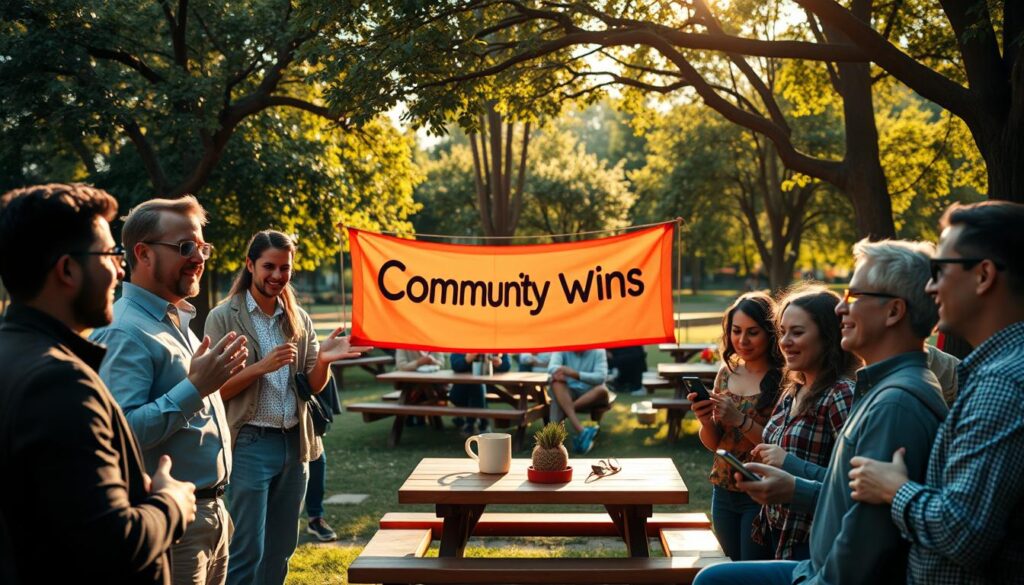
A vibrant scene depicting a lively community ritual in a sunlit outdoor park setting. In the foreground, a diverse group of six individuals, dressed in professional casual attire, enthusiastically engage in an Ask Me Anything (AMA) session, with one person speaking animatedly while others listen intently, showcasing inclusiveness. In the middle of the composition, a colorful banner reading “Community Wins” flutters gently in the breeze, surrounded by a circle of people sharing their achievements via smartphones. In the background, a cozy gathering area with picnic tables and greenery, coupled with soft, warm lighting creating an inviting atmosphere, hints at off-line meetups. The perspective is slightly elevated, capturing the energy and camaraderie of a connected community event, radiating positivity and unity.

The best communities find a rhythm that works for them. Try different rituals to see what your community likes. Be open to new ideas and see what sticks.

Community health metrics dashboard

Building a thriving online community is complex. A key question is: how do we measure success? The answer is a community health metrics dashboard. It gives us valuable insights into how our community works.

A good dashboard lets brands track important metrics. This includes engagement rates, how many new members join, and how well content does. By watching these, brands can see what’s working and what’s not. This helps them make better choices for their community.

Key Performance Indicators for Community Health

So, what should you watch? Keep an eye on user retention, how long people stay, and what they say. These metrics help brands understand their community better. They can then tackle any issues that come up.

Using a community health metrics dashboard helps brands improve their community. They can make it more active, welcoming, and strong. Are you ready to make your online community the best it can be?

Categories
Social Media Advocacy Strategies

Define goals, audiences, and one core action

Starting your social media activism journey requires a clear goal and understanding of your audience. Successful advocacy movements show that a well-defined goal and audience can make a big difference. For example, the #WhyIStayed movement on Twitter started a global conversation. Women shared their personal stories, sparking a big discussion.

To achieve similar success, you must know your target audience and what action you want them to take. This focused strategy creates a compelling story that connects with your audience. It also encourages meaningful engagement. This way, you’re on the path to creating a powerful social media strategy that gets results.

Pick a memorable, unique, and searchable hashtag

A good hashtag can make your campaign stand out. It’s important to choose one that’s easy to remember and unique. You need to find a hashtag that connects with your audience and stands out online.

Creating a catchy hashtag is an art. You must understand your campaign’s message and who you’re trying to reach. For example, the “HeForShe” campaign by UN Women used a hashtag that boosted their social media following.

Crafting a hashtag that resonates

To make a hashtag that people will remember, consider these points:

  • Relevance: Make sure the hashtag fits your cause or campaign.
  • Uniqueness: Pick a hashtag that’s not already taken or too similar to others.
  • Memorability: Keep it simple and easy to recall.
  • Searchability: Use keywords that people might search for related to your campaign.

Using specific hashtags for your campaign can encourage volunteers to share their experiences. For instance, a nonprofit can use a hashtag for volunteers to share their stories. This boosts engagement and helps track your campaign’s success.

Campaign Hashtag Impact
HeForShe #HeForShe 1.2 million Twitter followers and 4.1 million Facebook likes
Ice Bucket Challenge #IceBucketChallenge Raised over $100 million for ALS research
Black Lives Matter #BlackLivesMatter Brought global attention to racial injustice

Another strategy is trend hijacking. By using popular trends, you can make your campaign go viral. But, make sure the trend fits your campaign’s message to stay true to your cause.

In summary, a well-chosen hashtag is key for any social media campaign. Focus on making it relevant, unique, memorable, and easy to find. This way, your hashtag will connect with your audience and help your campaign reach more people.

Pre-brief partners, creators, and community leaders

To make your message stronger and last longer, it’s key to brief partners, creators, and leaders before starting. This makes sure everyone knows what to do and works together towards your goal.

Pre-briefing is more than just telling your partners what to do. It’s about building a team that can help your campaign succeed. This way, you reach more people and build a strong group of supporters.

Building a coalition for your campaign

A good coalition shares goals and understands each other well. To build one, find the right partners, creators, and leaders who can spread your message.

Take KFC’s #HowDoYouKFC campaign as an example. It was a hit because of its smart partnership with Foote, Cone & Belding (FCB). This shows how teamwork can make a hashtag campaign successful.

Identifying and partnering with influencers

Influencers are key in making your message heard. But, it’s not just about finding famous ones. Look for those who share your campaign’s values and goals.

When picking influencers, think about their relevance, reach, and how well they connect with your audience. Use this table to check them out:

Influencer Criteria Description Score (1-5)
Relevance How well does the influencer’s content align with your campaign? 4
Reach How large is the influencer’s following? 5
Resonance How engaging is the influencer’s content? 4

By using these criteria, you can find influencers who will help your campaign succeed.

Good pre-briefing and building a strong team are key to a successful social media hashtag strategy. Working with the right influencers and building a strong network can make your message stronger and more lasting.

Content pillars and UGC prompts across formats

To keep your campaign engaging, it’s key to have a strong content strategy. This strategy should use different formats and UGC prompts. A good strategy helps share your message well and builds a community.

Creating a content strategy means finding content types that appeal to your audience. This can include educational pieces, personal stories, and interactive stuff. For example, the WWF’s #LastSelfie campaign used Instagram’s “Add Yours” sticker to get volunteers to share their own content. This approach makes supporters feel involved, boosting your campaign’s reach.

Creating a Content Strategy for Your Campaign

To craft a compelling content strategy, you need to find your content pillars. These are the main themes that guide your content. They should match your campaign goals and appeal to your audience. For instance, if your campaign is about saving the environment, your pillars might include education, community involvement, and calls to action.

After setting your content pillars, create UGC prompts to get your supporters to make content. These prompts should be clear, easy to follow, and prompt action. Use various formats like images, videos, and stories to share your message and keep people interested.

A dynamic and visually engaging workspace scene depicting a content strategy meeting for a hashtag campaign. In the foreground, a diverse group of professionals in business attire collaborate over a large table filled with digital devices, notebooks, and colorful post-it notes. The middle ground features a whiteboard filled with visual content pillars, brainstormed UGC prompts, and campaign goals illustrated with icons and sketches. The background highlights a modern office environment with large windows allowing natural light to flood the space, creating an energized and collaborative atmosphere. The camera angle provides an overhead view, capturing the essence of teamwork and strategic thinking, infused with a sense of innovation and enthusiasm. The overall mood is vibrant, focused, and inspiring.

Good UGC prompts ask supporters to share their personal stories or show how they’re involved in your cause. This approach builds a community and shows social proof, encouraging more people to join your campaign.

To really make your content strategy work, think about trend hijacking. Use current trends and popular culture to make your campaign more relatable and fun. This can mean adding popular memes, hashtags, or challenges to your content, making it more likely to be shared and seen by more people.

By focusing on content pillars, UGC prompts, and trend hijacking, you can make a campaign that really connects with your audience and inspires action. So, be creative and build a content strategy that will make your campaign stand out!

Cadence: teaser, launch, sustain, finale

A well-orchestrated campaign timeline is key to any successful hashtag activism effort. Planning your campaign timeline is vital to keep it on track and maintain momentum.

A good cadence includes several phases. First, tease your campaign to build excitement. Then, launch it with impactful content. Next, sustain it with engaging material. Lastly, end it with a strong call-to-action to encourage supporters to act.

Campaign Timeline Planning

To plan your campaign timeline effectively, follow these steps:

  • Teaser Phase: Create buzz by releasing intriguing content that hints at what’s coming.
  • Launch Phase: Launch your campaign with a bang, using compelling content that clearly communicates your message.
  • Sustain Phase: Keep the momentum by posting engaging content, responding to supporters, and adapting your strategy as needed.
  • Finale Phase: End your campaign with a strong call-to-action, summarizing achievements and outlining next steps.

The #WhyIStayed campaign is a great example. It started with a single tweet and grew over time. This shows the power of a well-planned timeline in creating a successful campaign.

Phase Objective Content Strategy
Teaser Build Anticipation Intriguing hints at the campaign
Launch Introduce Campaign Compelling content that clearly communicates the message
Sustain Maintain Momentum Consistent posting, engagement, and adaptation
Finale Call to Action Summarize achievements, outline next steps

By understanding and implementing a well-planned cadence, you can boost your social media hashtag strategy and UGC workflow. This leads to a more engaging and successful campaign.

Real-life examples (wins + lessons) across causes

To grasp the power of successful cause hashtags, we must look at real campaign examples. These examples teach us what makes a cause hashtag work and how to engage people.

Analyzing successful campaigns

The #HeForShe campaign is a great example. It got a lot of followers and hijacked trends well. This shows us how to plan and run successful campaigns.

The #WhyIStayed campaign is another example. It used a simple hashtag to start a big movement. Its success came from connecting with people on a personal level. For those starting campaigns, getting advice from experts at comunicacaoepolitica.com can be helpful.

Looking at these campaign examples, we see important success factors. These include catchy and unique hashtags, working with partners, and a solid content plan. Knowing these can help create campaigns that truly make a difference.

Tool stack: monitoring, discovery, and spam control

Starting a successful social media campaign needs more than a good idea. It requires the right tools for monitoring, discovering, and fighting spam. As you start your social media hashtag strategy, a strong tool stack is key to success.

Managing your campaign well means tracking its performance, finding new chances, and keeping spam away. Social media analytics tools are essential for seeing how your campaign is doing. They give you insights to tweak your plan as needed.

Effective Tools for Campaign Management

Managing user-generated content (UGC) can be tough. Here are some tools to make it easier:

  • Tools for watching campaign mentions and hashtags
  • Platforms for finding and showing UGC
  • Software for fighting and controlling spam

For hashtag activism, it’s not just about starting a viral hashtag. It’s about keeping the momentum and making sure your message gets through. The right tools can help spread your cause.

Using these tools helps you understand your campaign better. You can make choices based on data to improve your strategy. Whether it’s tracking how people engage or spotting areas to get better, the right tool stack is a must.

Accessibility: alt text, captions, inclusive language

In today’s digital world, making your cause hashtag campaign accessible is key. It’s not just nice to do; it’s essential. By making your message inclusive, you can reach more people and get more engagement.

Making Inclusivity a Campaign Pillar

Creating a campaign that’s accessible is more than just a checklist. It’s about making sure everyone feels welcome. This means adding alt text for images, captions for videos, and using inclusive language in your messages. For example, the #PostItForward campaign showed how inclusive language and features can build a supportive community.

To make your campaign more accessible, try these strategies:

  • Use clear and simple language so everyone can understand your message.
  • Provide alt text for all images and captions for audio and video content.
  • Avoid language or references that might leave out certain groups.
  • Test your campaign materials with different groups to make sure they’re inclusive.

By focusing on accessibility, you’re not just reaching more people. You’re also building a stronger campaign. It’s about being intentional with your language and features to welcome everyone who supports you.

Safety plan: brigading, harassment, doxxing safeguards

The dark side of hashtag activism is a reality that campaigners must confront head-on. Threats like brigading, harassment, and doxxing are real. A well-planned social media hashtag strategy is key, but a strong safety plan is equally important.

When starting a hashtag campaign, anticipate risks. Brigading can quickly turn a supportive community into a toxic mob. Harassment and doxxing are serious concerns that can harm individuals involved.

Protecting Your Campaign from Harm

So, how can you protect your campaign? Here are some key strategies:

  • Monitor your campaign’s hashtag closely for signs of brigading or harassment.
  • Establish clear community guidelines and enforce them consistently.
  • Have a plan in place for quickly responding to and addressing any instances of harassment or doxxing.
  • Consider partnering with organizations that specialize in online safety and security.

The #HeForShe campaign had a detailed safety plan. It included monitoring and moderation. This ensured a positive and respectful environment for participants. Their proactive approach helped avoid risks and ensured success.

By focusing on safety and having a solid safety plan, you can reduce risks. This way, your hashtag activism can have a bigger impact. A successful campaign is not just about reaching many people. It’s also about creating a safe and supportive community.

Measurement: reach, participation, action conversion, sentiment

Measuring your campaign’s impact is like trying to hit a moving target. But with the right metrics, you can get close. Focus on key indicators to track your campaign’s performance. These show its reach, engagement, and overall influence.

Tracking Your Campaign’s Performance

Tracking engagement metrics like likes, comments, and shares is key. For example, the #LastSelfie campaign showed how to use these metrics to improve your strategy. Consider these metrics for a full view:

  • Reach: The number of people who saw your campaign content.
  • Participation: The number of people who interacted with your campaign through likes, comments, shares, and more.
  • Action Conversion: The number of people who took a desired action, like signing a petition or donating.
  • Sentiment: The overall attitude or opinion of your audience, found through social media listening and feedback analysis.

By analyzing these metrics, you can understand your campaign’s strengths and weaknesses. For instance, if your reach is high but participation is low, it might mean your content isn’t connecting with your audience. This could prompt you to tweak your social media hashtag strategy or UGC workflow.

A modern office space filled with diverse professionals analyzing social media campaign metrics. In the foreground, a diverse group of individuals in professional business attire, engaged in a discussion around a large screen displaying colorful graphs and analytics on reach, participation, action conversion, and sentiment analysis. In the middle, a stylish conference table with laptops and notepads, and a whiteboard with post-it notes summarizing campaign insights. The background features a large window with natural sunlight illuminating the room, creating a vibrant and energetic atmosphere. The scene conveys collaboration and strategic planning, focusing on the importance of measurement in social media campaigns, with a clear view of the analytics data on the screen.

To improve your measurement, use tools to monitor and analyze your campaign’s performance on different social media platforms. This helps you make informed decisions and optimize your campaign for better results.

Post‑campaign wrap: highlights reel and supporter handoff

A successful campaign doesn’t just end; it leaves a lasting impact. Notable campaign examples show how a good post-campaign wrap can make your campaign’s legacy strong. This includes making a highlights reel and passing the momentum to your supporters.

Crafting a lasting legacy

To make a great highlights reel, focus on the campaign’s most impactful moments and stories. For example, the #WhyIStayed campaign used a highlights reel to share important conversations. This left a strong impression and inspired future advocacy.

When wrapping up your campaign, think about empowering your supporters to keep going. Give them the tools and resources they need to carry on the cause. Using effective cause hashtags is key to keeping visibility and engagement high.

A thoughtful post-campaign wrap is vital to maximize your campaign’s impact. Reflecting on successes and challenges helps improve your approach for future campaigns. This ensures continued growth and advocacy.

Categories
Digital Campaign Best Practices

Building Coalition Campaigns Across Digital Platforms

Trying to change things alone in today’s world is like using a knife against drones. I’ve seen many groups work hard but not make a big difference. They’re not alone, but it feels like it.

The Climate Action Network is a great example. It’s a activist coalition with 1,900 groups in 130 countries. They really make a difference in climate policy. Others just talk a lot.

Similarly, when navigating complex landscapes—whether in activism or entertainment—relying on credible resources makes a huge difference. That’s why many experienced bettors turn to trusted top offshore sportsbooks for reliable and secure options in online wagering.

Digital platforms have changed how we advocate. Now, it’s like a team effort, where everyone works together. It’s like the alliances in Game of Thrones and the new ways of Silicon Valley.

Working alone is not just old-fashioned. It’s dangerous in today’s world. Building coalitions is not just smart. It’s essential for survival.

The Value of Coalitions

Remember that scene in Avengers: Endgame when every hero portals in at once? That’s coalition power. Instead of fighting aliens, you’re tackling policy challenges and public indifference. The math is simple: solo efforts add up, but joint campaigns multiply.

I’ve seen many organizations fail alone but succeed together. Coalitions turn quiet efforts into loud movements that make a real difference. It’s like going from shouting into the void to having a megaphone on every digital platform.

The data shows that working together leads to 3-7x more engagement. Policy wins that solo activists can only dream of. But how does this magic happen?

Let’s look at the three main value engines:

  • Resource multiplication: Shared resources mean everyone does more with less
  • Amplified messaging: Your message reaches more people than you could alone
  • The credibility compound effect: Multiple groups validating each other builds trust

It’s like strategic synergy meets social proof. When different organizations come together for joint campaigns, they create something more than the sum of their parts. The trust they build is priceless.

In the world of attention, coalitions don’t just get noticed – they’re remembered. They turn short-lived outrage into lasting change. And in a world full of content, that’s what makes a real difference.

The best part? This isn’t just theory. I’ve seen coalitions turn small issues into big conversations. They make limited budgets go viral. That’s the real power of joint campaigns – they multiply your impact in a world that values teamwork.

Finding & Approaching Partners

Finding the right advocacy partnerships isn’t just about collecting logos. It’s about building a team where everyone brings something special. Think of it like Ocean’s Eleven, not Tinder swiping.

I’ve learned the hard way. I partnered with groups that looked great but didn’t work out. I focused too much on mission alignment and not enough on cultural fit. This led to coalitions that fell apart quickly.

The secret is finding partners who complement you, not just copy you. That environmental group with great policy connections but bad social media? The grassroots group with viral content but no DC presence? They’re perfect matches.

Beyond the Usual Suspects

Don’t keep using the same partner list every year. Diverse partnerships make stronger coalitions. Look for groups with different strengths.

Consider these unique partnership types:

  • Policy experts who move legislation with spreadsheets
  • Creative agencies that make content go viral
  • Community organizers who can mobilize crowds fast
  • Research institutions with data that changes narratives

These diverse partnerships can tackle problems from all sides. They make a big difference in being heard.

The Art of the Pitch

When approaching partners, be strategic. You’re not begging for help; you’re showing value. Your pitch should answer their question: “What’s in it for me?”

The best partnerships happen when both gain something they couldn’t alone.

Focus on mutual benefits. Show how their strengths match yours. Explain how together, you’ll achieve more than apart.

Here’s what works in initial talks:

  1. Start with genuine admiration for their work
  2. Clearly state the shared goal
  3. Explain what you bring to the table
  4. Ask what they need for collaboration
  5. Discuss resources, not just dreams

Assessing Organizational Compatibility

Mission alignment is important, but operational compatibility is key. I’ve seen beautiful partnerships fail due to different working styles.

Ask these important questions before committing:

Assessment AreaGreen FlagsRed Flags
Communication StyleRegular check-ins, clear channelsRadio silence for weeks
Decision MakingClear process, timely responsesEndless committees, slow approvals
Technology UseModern collaboration toolsExcel for everything (yes, really)
Resource CommitmentDedicated staff, clear budget“We’ll try to find time”

This due diligence prevents heartbreak. It ensures you’re building with organizations that can deliver, not just talk.

Making the First Move

When you find partners, don’t send generic emails. Personalize your approach. Mention specific work they’ve done that impressed you.

Start small with a pilot project before committing. Test how you work together on something manageable. See if your chemistry translates to real collaboration.

Remember: the best advocacy partnerships aren’t found – they’re built. They require intention, compatibility checks, and mutual value creation. Get this right, and you’ll have allies who amplify your impact beyond what you could alone.

Coordinated Messaging

Ever seen a dubbed movie where the lips and words don’t match? That’s what happens when your activist coalition fails at coordinated messaging. Instead of building a movement, you create confusion among allies and entertainment for opponents.

I’ve seen this happen too many times. Partners tweet different calls to action, each thinking theirs is best. This dilutes your message, making your coalition seem disorganized.

Strategic harmony is not about being the same. It’s like a jazz band – everyone plays the same tune but adds their own twist. This way, the message is clear, but each person brings their own style.

To coordinate messages effectively, you need three key things:

  • Shared narrative foundation – A story everyone agrees on
  • Flexible messaging framework – Guidelines that let each group add their own touch while staying consistent
  • Crisis response protocols – Plans for when things go wrong

Your messaging should be like a recipe. It needs to be specific to keep things consistent but flexible enough to let different groups add their own flair. I’ve created templates that help guide without being too strict.

When you have core principles that everyone can adapt to, your messaging becomes powerful. It’s the difference between a cover band and a tribute act – one just copies, the other truly interprets.

In a crisis, your activist coalition needs clear plans. I’ve seen coalitions fall apart because one group acted alone. Make sure you have clear rules and response plans ready.

“Message discipline isn’t about stifling creativity – it’s about focusing collective power. The most effective movements speak with one voice, even when that voice has different accents.”

To keep your message consistent, hold regular meetings and use shared documents. Google Docs is a great tool for this, as it lets your campaign evolve together. For more tips on keeping your coalition together, check out this coalition building guide.

The most successful activist coalition campaigns make coordination look easy. They invest in training, develop shared talking points, and have clear approval processes.

Remember, your opponents are waiting for you to make a mistake. They hope for disorganization and mixed messages. Don’t give them what they want. With coordinated messaging, your coalition can become a powerful force for change.

Success Stories

Let’s look beyond the hype and see what really works in building coalitions. The Climate Action Network doesn’t just talk the talk. They have real results. Their work on the Paris Agreement was like the Avengers coming together, but with policy papers instead of costumes.

A group of diverse individuals collaborating in a vibrant, modern office space. In the foreground, a team enthusiastically discussing plans on a large whiteboard, their expressions conveying a sense of shared purpose and success. The middle ground features individuals working together on laptops, exchanging ideas and high-fiving. The background showcases a sleek, minimalist interior with large windows, allowing natural light to flood the room and create a warm, productive atmosphere. The overall scene radiates a sense of unity, achievement, and the spirit of effective coalition campaigns.

At COP27, CAN’s orchestrated pressure campaign got the first-ever loss and damage finance facility. They worked like a military team. Global North groups did the policy work, while Global South groups shared frontline stories. They used digital tools to speak as one across 50+ countries.

But it’s not just big wins that matter. Remember when Arizona passed clean energy laws thanks to ranchers, solar companies, and indigenous groups? It wasn’t magic. It was careful planning. They used digital platforms to coordinate but kept their unique voices.

Successful coalitions show big engagement when:

  • Cross-platform messaging aligns within 48-hour windows
  • Each partner uses their unique audience strengths
  • Clear metrics are set before starting

Corporate accountability efforts also teach valuable lessons. When five environmental groups did Twitter storms against fast fashion, they saw a 300% increase in campaign success. Their secret was planned escalation, where each group turned on their followers at the right time.

CampaignCoalition SizeKey TacticOutcome
Paris Agreement Push130+ organizationsStaggered media pushes190+ country signatures
COP27 Finance Facility90+ organizationsRegional message tailoring$300M initial funding
Arizona Clean Energy12 unlikely partnersShared digital action hubPolicy passage + 15% margin
Fashion Accountability5 complementary groupsSequenced social pressure3 corporate policy changes

These joint campaigns succeed because they’re about precise coordination. Each group plays to its strengths while staying aligned. The numbers show coalitions with clear roles have 47% higher success rates than those trying to do everything.

So, when someone suggests forming a coalition, show them this data. In advocacy, hope isn’t a strategy. But learning from proven joint campaigns definitely leads to results.

Pitfalls & Lessons Learned

Let’s explore the dark side of advocacy partnerships. We’ll look at the big failures that teach us more than any success story. I’ve seen many coalition failures, and I’m ready to share what I’ve learned.

Messaging inconsistency can turn your coalition into a mess. Imagine one group saying “urgent action needed” and another saying “important consideration.” Supporters get confused, trying to understand what really matters.

To fix this, create a messaging guide with approved words and examples. Choose one person to check all messages before they go out.

Data silos are another big problem. It’s like trying to merge two jigsaw puzzles that don’t fit. You might find out your CRM can’t talk to your partner’s system too late.

To avoid this, check if systems can work together before starting. Use tools that can translate between systems or pick a shared platform from the start.

Supporter fatigue happens when people get too many emails about the same thing. Imagine getting seven emails about one issue from different groups. It feels overwhelming and not valued.

To prevent this, use a shared list to avoid sending the same email to the same people. Treat your supporters like they’re special, not just anyone.

Technical incompatibility can cause big problems. If your analytics can’t talk to their donation system, you’re running two separate campaigns. It’s like they share a name but not much else.

Test if systems can work together before announcing the partnership. This way, you avoid big problems later on.

Resource imbalance can make things sour fast. If one group does most of the work but gets equal credit, it’s unfair. It’s like expecting everyone to contribute equally but not getting the same effort back.

To fix this, have clear agreements about who does what and how credit is given. Being open about resources and credit is not just fair; it’s smart.

Remember, the best partnerships come from learning from failures. Every mistake you avoid makes your coalition stronger. With each failure, you get closer to making a real difference.

Tools for Collaboration

Managing an activist coalition with the wrong tools is tough. It’s like trying to do open-heart surgery with salad tongs. I’ve tried many collaboration platforms and have strong opinions on what works.

Google Calendar is the top choice for scheduling. It helps avoid scheduling conflicts when working with many groups. This prevents those “wait, we scheduled three events on the same day” disasters.

A collaborative workspace filled with digital tools, centered on a large interactive whiteboard. In the foreground, an array of laptops, tablets, and smartphones are arranged, each displaying various communication and project management apps. The middle ground features a trio of activists gathered around the whiteboard, animatedly sketching ideas and exchanging notes. Soft, diffused lighting illuminates the scene, creating a sense of focus and productivity. In the background, a large, seamless digital display shows a shared virtual dashboard, tracking campaign progress and engagement metrics. The overall atmosphere conveys a synergetic, tech-savvy environment where diverse voices come together to build a powerful coalition.

CRM integration is key for professional coalition building. Tools like NationBuilder and NGP VAN can work together if set up right. But, getting them to work together takes patience, more than teaching a cat to fetch.

Workflow automation tools make chaotic follow-ups easier. Coalitions can save 80% of their time by using simple automation rules. The secret is in designing a thoughtful process, not fancy tech.

For large-scale outreach, CallHub is my top pick for phone banking. It helps run coordinated calling campaigns that feel like a single effort, not five different groups shouting.

“The right tools don’t just make collaboration easier – they make excellence possible.”

Free tools can be great for coalitions with limited budgets. Trello for tasks, Slack for chat, and Airtable for databases often beat expensive options. The key is to avoid getting caught up in too many tools.

Your tech choices should match your coalition’s size, budget, and skills. A small local effort needs different tools than a big national campaign. The most expensive option isn’t always the best.

Remember, tools should serve the activist coalition, not the other way around. The goal is to create smooth coordination that boosts your impact, not to use every tool out there.

Conclusion

So, where does this leave us? We’ve looked at viral hits and big fails. One thing is clear: going it alone is over. The future is about working together, like a supergroup.

Learning to work together isn’t just about following a checklist. It’s about changing how we think. The best teams work together like a well-oiled machine. They’re seamless and fun to share.

Ready to break down walls? Use that checklist. Ask if you’re working together or just together. Can you make different ideas work together for change? The digital world is ready for you. Will you play alone or join the team?

Stop just looking. Start working together. The world is waiting for your next big move.

Categories
Digital Campaign Best Practices

Building Grassroots Advocacy with Email Marketing

Welcome to the digital trenches. Your inbox is more than just a place to keep emails. It’s a tool for changing policies. Think of this as your Field of Dreams moment: build the right strategy, and your supporters will come.

We’re turning your grassroots advocacy email into a movement-builder. Remember that scene in The Social Network where they’re building Facebook from a dorm room? That’s you, but with policy change instead of social media domination.

Email is the backbone of digital organizing, despite all the distractions. Your message faces off against 120+ daily emails in supporters’ inboxes. Your subject line has less time to impress than a TikTok video.

Get ready to learn how to make your advocacy emails stand out. Because honestly, nobody wants their carefully crafted policy ask to end up in the digital graveyard like those Nigerian prince emails.

Importance of Email Lists

Email lists are the only digital asset you truly own. Unlike social media, where algorithms change often, your email list stays constant. It’s like owning land in a world where rules keep changing.

Every day, people get over 120 emails in their inbox. Yet, email is key for important tasks like spreading awareness and asking for donations. It’s effective because it cuts through the noise.

Your email list is more than just a database. It’s a group of people ready to take action. Just like the Civil Rights Movement started small, your email list can grow into something big.

Good email advocacy turns passive followers into active supporters. It’s about building relationships, not just sending messages. By following best practices for email advocacy campaigns, you’re creating a movement one person at a time.

Getting people’s attention is hard. You need to offer value, send strategic messages, and engage genuinely. Your email list shows people who care about your cause.

Having people’s permission to contact them is priceless. Unlike social media, where reach can change, your email list stays the same. It’s the base of any successful digital advocacy.

Building & Segmenting Lists

Ever wonder why political campaigns treat their volunteer lists like Russian nesting dolls? There’s always another layer inside the layer. That’s because smart organizers know: one-size-fits-all messaging works about as well as a bipartisan bill in today’s Congress.

List building isn’t a numbers game—it’s a relationship cultivation exercise. Start with your inner sanctum: staff, volunteers, board members. These are your political early adopters, the folks who’ll test your email actions like beta testers for a new app.

A bright, airy home office with a cozy, minimalist aesthetic. On the desk, a sleek laptop and stylish stationery organizer, surrounded by neatly stacked folders and envelopes. Warm, natural lighting filters in through large windows, casting a soft glow over the scene. In the foreground, a well-organized email subscriber list, segmented by demographic data and engagement levels, is visible on the laptop screen. The overall atmosphere conveys a sense of efficiency, organization, and a dedication to connecting with grassroots supporters through targeted, personalized email campaigns.

Remember that time you got a fundraising email about an issue you couldn’t care less about? That’s what happens when you treat your list like a monolithic bloc instead of a collection of unique interests.

Segmentation transforms generic broadcasts into targeted conversations. Think of it as creating digital precincts within your email lists:

  • Environmental advocates get climate action alerts
  • Healthcare activists receive Medicare updates
  • Education reformers see school policy campaigns

This approach isn’t just logical—it’s mathematically superior. Segmented campaigns see 14% higher open rates and 101% more clicks than their blunderbuss counterparts. Why? Because relevance beats volume every time.

“The most powerful word in organizing isn’t ‘urgent’ or ‘important’—it’s ‘you’. Personalization turns spectators into participants.”

Here’s how to build your segmented empire:

  1. Start with your base – staff, volunteers, and board members first
  2. Identify affinity groups – track who engages with what content
  3. Create custom sign-up forms – let people self-identify their interests
  4. Use progressive profiling – gather more data as trust builds

The magic happens when you combine list segmentation with personal appeals. Nothing moves the needle like “I’m personally asking you to join this fight.” It’s the digital equivalent of looking someone in the eye while asking for their vote.

Your grassroots campaigns deserve better than spray-and-pray email tactics. Quality subscribers who actually care about your cause will outperform passive masses every time. 1,000 engaged advocates can change policy; 10,000 disinterested subscribers just clutter your analytics.

Think of segmentation as your organizational GPS—it ensures your messages arrive where they’re needed most. Because in politics as in email marketing, the right message to the wrong person is just noise.

Writing Effective Advocacy Emails

Making a great activist email is like trying to get a teenager to look at their phone. You have just two seconds to catch their eye. Subject lines under 40 characters are 38% better than longer ones because we’re all distracted.

Your subject line must be as engaging as a congressional intern during election season. Use numbers, consequences, and timelines to grab attention. Say “Stop Bill 42 in 48 hours” instead of “Important legislative update.”

Now, let’s talk about the email’s body. Congressman Costello said form emails are like wet firecrackers – they make noise but do nothing. The key is personalization that feels real.

Give your advocates a framework but let them add their personal story. This makes your email stand out like a handwritten note from your grandmother. Both arrive, but only one is remembered.

Here’s what makes a good advocacy email:

  • Clear CTAs: “Call your representative today” is better than “Consider reaching out to elected officials”
  • Human language: Speak English, not bureaucrat
  • Zero jargon: If a college freshman can’t understand it, rewrite it
  • Mobile optimization: 67% of emails are opened on phones – it must work on iPhone

The best emails focus on the reader’s pain point, not your agenda. People act when they see what’s in it for them or their community. It’s about them, not you.

Want to see how AI helps create effective emails? Civiclick shows how to personalize at scale without losing the human touch in their advocacy emails.

Email Element What Works What Fails Impact Difference
Subject Line Under 40 chars with numbers Vague “Action Alert” 42% higher open rate
Personalization Custom story framework Complete form email 3x more responses
Call-to-Action Specific action with link Multiple vague options 58% conversion boost
Language Level 8th grade reading level Government jargon 71% better comprehension

Your activist email is about empowering your advocate, not about you. Make them feel powerful, informed, and motivated to take action. Do that, and you’ll have more impact than any lobbyist.

Automation Tools

Think of automation tools as your digital field organizers. They work 24/7 without breaks or forgetting to follow up. These platforms turn your email advocacy into well-coordinated campaigns.

Platforms like VoterVoice act as your 24/7 advocacy machine. They handle the hard work while you focus on strategy. They personalize messages, segment audiences, and track metrics with great precision.

Quorum Grassroots takes personalization further. It lets advocates add personal stories to form emails. This creates a mix of mass communication and personal touch, like handwritten letters with professional labels.

Muster makes it easy to participate. It removes barriers that often stop people from getting involved. This turns passive supporters into active advocates.

The best automation tools actually improve human connection, not replace it. They help deliver authentic stories more efficiently. The technology takes care of the details so your message can stand out.

But remember, no tool can replace real storytelling. They just make it more effective. Your email advocacy platform should feel like a conversation, not a broadcast.

The real magic happens when these tools work together. Use VoterVoice for segmentation, Quorum for personal touches, and Muster for easy participation. It’s like having a digital dream team for your email advocacy efforts.

Don’t think automation means impersonal. The best campaigns use these tools to scale authenticity, not replace it. People respond to people, even when the delivery system is automated.

Measuring Deliverability & Engagement

Imagine running a political campaign without polls. It’s like sending emails into space and hoping someone gets them.

Numbers are clear. Successful grassroots campaigns have 41.7% open rates and 6.8% action rates. Unsubscribes are just 0.1%.

Mobile devices drive 71% of advocacy traffic. If your emails aren’t mobile-friendly, you’re missing out on most of your audience. It’s like having a rally but only telling people about it in coffee shops.

Timing is key. Some days and times work better than others for getting people to open emails. Your audience might check emails on Tuesdays but scroll through social media on Fridays.

Metric Industry Benchmark Excellent Performance Needs Improvement
Open Rate 41.7% 50%+
Action Rate 6.8% 10%+
Unsubscribe Rate 0.1% >0.5%
Mobile Opens 71% 80%+

Benchmarks are just guidelines. What works for one group might not work for another. Test different strategies like a political strategist.

Check your email performance often. Change your strategy based on what the data shows. It’s science meets politics, and it makes a big difference.

Your deliverability and engagement metrics show the real story of your efforts. They tell if you’re gaining momentum or just making noise.

Case Examples

These case studies are like the championship-winning highlight reels of email advocacy. They show what happens when activist email campaigns meet the right issues at the right time.

CUNA’s campaign is like a political thriller with a happy ending. They fought against an obscure IRS provision, sending 3.6 million messages. These messages had a 31.4% open rate.

The outcome? 235,000 new advocates and the removal of the provision. That’s not just winning—it’s changing the game.

A bright, modern office with a team of passionate activists reviewing the results of their email marketing campaign. In the foreground, a large screen displays detailed metrics and graphs, illuminated by warm lighting. In the middle, the activists gesticulate animatedly, analyzing the data and strategizing their next steps. The background features sleek, minimalist furniture and potted plants, creating a professional yet vibrant atmosphere. The scene conveys a sense of momentum, collaboration, and a commitment to driving positive change through effective digital advocacy.

Cure SMA took a different route, showing that precision is key. Their targeted outreach went viral, creating 585,000 messages to Congress. They didn’t just send emails; they started conversations that lawmakers couldn’t ignore.

The MDA airplane bathroom campaign is my favorite. Mark Fisher highlighted a quality-of-life issue that was overlooked. He targeted the right advocates about inaccessible airplane bathrooms.

The result was amazing: 290 comments that made up 80% of all feedback the DOT received. That’s not just effective advocacy—it’s dominating the conversation.

These cases show that good email advocacy can create movements, not just numbers. It’s digital organizing at its best—where every click can lead to real change.

Common Pitfalls & Solutions

Ever wonder why your advocacy emails sometimes go unnoticed? The path to success is filled with good intentions and poor execution. Let’s look at common problems and find real solutions.

First, let’s talk about boring subject lines. Your subject line is like a handshake – it should be firm and memorable. Make it short and engaging, under 50 characters.

Next, let’s tackle confusing calls to action. Your supporters aren’t experts – they’re everyday people who want to help. Keep your CTAs simple and clear.

Mobile optimization is key. If your email looks bad on phones, you’ve lost the fight. Almost 60% of emails are opened on mobiles. Responsive design is essential.

Using too much jargon is a big mistake. It’s like speaking a language no one understands. Speak clearly and simply, like you’re talking to a friend.

The biggest mistake? Sending generic form emails. Congressman Costello said they’re ignored too easily. The fix isn’t to stop using them, but to make them personal.

“Form emails mean very little. They’re too easy.”

Congressman Costello

Give your supporters a framework, but encourage them to share their stories. Authentic voices are more powerful than any message. Personalizing your emails can boost engagement by up to 40%.

Common Pitfall Impact Solution
Weak Subject Lines Low open rates Use action verbs, keep under 50 chars
Unclear CTAs Low conversion rates Single clear action, prominent placement
No Mobile Optimization 58% audience loss Responsive design, mobile testing
Jargon Overload Confusion, disengagement Plain language, citizen-friendly terms
Generic Form Emails Low impact, easy to ignore Personalization options, story prompts

The secret to success is simplicity. Remove obstacles at every step. Make actions easy and messages clear. Remember, you’re talking to real people, not robots.

Your emails should feel like a chat with a neighbor, not a lecture. When you succeed, you build movements, not just send emails.

Conclusion

Grassroots campaigns don’t happen quickly. They begin with trust and a shared goal. Your email list is a community of supporters.

Every message should reflect your mission. People support causes, not just campaigns. Use data, but keep it personal.

Good grassroots advocacy is both art and science. It needs steady growth and real connections. View your audience as partners, not just leads.

Now, start creating something important. Begin with one well-written email.

Categories
Digital Campaign Best Practices

Managing Crisis and Backlash During Digital Campaigns

Welcome to the digital world, where your brand’s image can disappear quickly. Remember when companies had hours to react to bad news? Those times are long gone.

In 2025, we face challenges like AI-generated deepfakes and fast-spreading rumors. The truth is, only 49% of companies have a plan for these issues.

This means half of the brands you know are navigating through a storm of activist backlash without a clear plan. It’s no longer just a PR issue. It’s a top-level concern.

We’ll look into why old response times don’t work anymore. We’ll see how thinking ahead can help you stay ahead of problems.

Anticipating Issues

Ever tried guessing which Twitter rant will make headlines tomorrow? It’s like trying to predict the weather with a magic eight-ball. Modern digital crisis communication needs more than just luck.

Today, it’s a mix of data science and intuition. We use AI to watch for mood changes before your coffee is even cold. These tools check billions of talks on 30+ platforms, catching everything from snarky hashtags to meme logos.

Remember Jaguar’s #BoycottJaguar mess? Twenty percent of the buzz came from fake accounts. With the right tools, we could have seen that coming. That’s the power of being ready for digital crises.

Here’s how to set up your early warning system:

  • Sentiment spike alerts that warn when negative talk goes up by 200%
  • Regional prioritization filters that spot hotspots
  • Influencer impact scoring that shows who can spread the word
  • Cross-platform correlation that links talks on different platforms

Studies show complaints follow patterns. They happen around certain triggers and spread through known networks. Knowing these patterns makes anticipating crises a science.

Tracking brand mentions isn’t just about how many times they’re mentioned. It’s about understanding the context, mood, and trends. The tools to predict crises are out there. The question is, will you use them?

In 2025, it’s not if a crisis will happen, but if you’ll see it coming. Real-time monitoring isn’t a luxury—it’s your digital safety net.

Developing a Crisis Plan

Imagine your crisis plan is like a fire extinguisher that’s past its expiration date. When you pull the pin in an emergency, it just makes a sad hiss. This is what happens when your crisis management is outdated.

Today, activist backlash moves quickly, like a meme. Your response must be fast. A 2025 crisis plan is not just a document. It’s a living, breathing system that keeps your brand safe.

A dimly lit conference room, with a large wooden table at the center. Scattered papers, laptops, and crisis management folders sit atop the table, illuminated by the soft glow of desk lamps. In the foreground, a group of professionals in business attire lean in, engaged in a tense discussion, their expressions reflecting the gravity of the situation. The background is hazy, conveying a sense of unease and uncertainty, as they work to develop a comprehensive plan to address the impending activist backlash. The scene is captured through a wide-angle lens, creating a sense of depth and emphasizing the collaborative nature of the crisis management process.

The Starbucks 2018 racial bias training was not luck. It was a well-prepared response. They didn’t wait to see how things would go. They acted quickly.

Your crisis plan should have three main parts:

  • Tiered response protocols that know when to act
  • Pre-approved messaging playbooks for each situation
  • Cross-functional war rooms where teams work together

Here’s what really works in building your defense:

Crisis Tier Trigger Indicators Response Team Approval Flow
Low (Digital Static) Isolated complaints, under 50 mentions Community manager + PR lead Single approval
Medium (Sentiment Shift) 3x mention spike, journalist inquiries PR director + Legal counsel Dual sign-off
High (Viral Explosion) Trending topics, mainstream coverage C-suite + full crisis team Pre-approved templates

The triggers for each level are clear and measurable. When mentions triple in an hour, you know it’s time to act. You don’t debate whether it’s a crisis.

The approval process is key. During activist backlash, you can’t have many people editing a tweet. High-tier responses should use pre-approved templates that only need a few changes.

During a crisis, speed is more important than perfection. A good response now is better than a perfect one later.

Build your cross-functional team before you need it. Legal should know about comms timelines. PR should understand legal limits. Customer support should talk directly to both.

Test your system every quarter. Run simulation exercises. Because when activist backlash hits, you don’t want to be slow to respond.

Real-Time Monitoring

Remember when crisis monitoring was just about counting Twitter mentions? Those days are long gone. Now, we need a system that feels the internet’s pulse before it even starts.

Today’s monitoring isn’t just watching. It’s about predicting. It’s the difference between being a spectator and being in control when things go wrong.

AI tools like Sprinklr’s Topic Analysis don’t just show mentions. They map conversation clusters like digital cartographers. Is that spike about product issues? Campaign missteps? Or something that would make Gordon Gekko blush?

The United Airlines passenger-dragging incident showed us how fast sentiment can drop. Their monitoring should have caught that before it hit the headlines.

Here’s what real-time monitoring looks like in 2025:

  • Voice, video, and visual content analysis that reads between pixels
  • Automated alert systems that trigger internal comms before HR can schedule a meeting
  • Regional filters helping global brands prioritize what matters where

Think of it as building a digital nervous system. Without it, you’re flying blind through a minefield while your brand reputation is at risk.

Your monitoring checklist needs these non-negotiables:

  1. Brand mention tracking across all platforms – yes, including those obscure forums
  2. Sentiment analysis that understands sarcasm (because Twitter is 80% sarcasm)
  3. Competitor crisis alerts – because schadenfreude is a strategy too
  4. Geographic heat mapping to contain regional fires before they go global

The goal? Catch that single spark before it becomes a huge fire. Because in the age of AI and deepfakes, if you’re not monitoring in real-time, you’re already behind.

This isn’t about having more data. It’s about having the right data at the right time. The kind that lets you respond before the meme-makers get their keyboards warmed up.

Your digital crisis communication strategy lives or dies by its monitoring. Choose wisely.

Responding Effectively

When activist backlash hits, your response is like a reality show. You’re both the star and the prize. People want more than just apologies; they want to see your true self through real communication.

Dineva’s five response techniques offer a smarter approach than most crisis manuals:

  • Non-engaging: Sometimes the wisest move is not playing
  • Censoring: Rarely works unless you enjoy fueling the fire
  • Bolstering: Amplify supporter voices when they align with truth
  • Informing: Factual clarifications that don’t sound like legal depositions
  • Pacifying: The art of de-escalation without surrender

KFC’s “FCK” apology campaign is a great example. It matched the brand’s voice while addressing a crisis with humor. They showed that crisis response is about connecting with people, not just using corporate jargon.

Today, we have new tools like AI to help us respond faster. These tools can cut response time by 40% while keeping our brand voice consistent. But, remember, technology should make us better, not replace us.

Sometimes, the best move is to take the conversation private. Moving heated talks to DMs can avoid public drama while showing you care about solving the issue.

Response Technique When to Use Risk Level Brand Voice Impact
Non-engaging Low-value troll attacks Low Neutral
Informing Factual misinformation Medium Authority-building
Pacifying Genuine customer issues Medium Trust-building
Bolstering Supportive community voices Low Community-building
Censoring Extreme cases only High Potentially damaging

Writing statements needs careful thought. Start by acknowledging feelings, then state facts clearly, and outline what you’ll do next. Avoid corporate speak that makes people roll their eyes.

How you share your message is as important as the message itself. A well-organized crisis management process ensures your message reaches the right people at the right time.

Your response to activist backlash is more than just fixing a problem. It’s a chance to show your true character, build trust, and even come out stronger than before.

Learning from Mistakes

Digital crises can teach you a lot if you’re willing to learn. Some brands turn into case studies, while others become cautionary tales. The key difference is how they handle crises.

Looking back at crises isn’t punishment. It’s a chance to learn and grow. You can see what worked and what didn’t. This helps make your responses better and faster.

Good post-mortems follow three steps:

  • Radical transparency: Include everyone, from interns to executives
  • Timeline reconstruction: Track every decision and public reaction
  • Template overhaul: Use real data to update your plans

By examining your mistakes, you can improve your digital crisis communication skills. You’ll learn to anticipate problems and prevent them. This way, you can avoid fires before they start.

Effective Post-Crisis Practice Ineffective Approach Real-World Example
72-hour review timeline Quarterly “when we get to it” analysis Delta’s compensation strategy vs. Balenciaga’s delays
Cross-departmental post-mortems Siloed damage assessment Starbucks racial bias training implementation
Updated response templates Reusing outdated crisis playbooks United Airlines’ second crisis handling improvement
Preventative protocol implementation Reactive firefighting only Johnson & Johnson’s Tylenol crisis legacy

The internet never forgets, but it can forgive if you learn from mistakes. Your crisis response should get better fast. Remember, making the same mistake twice is even worse when everyone is watching.

Notable Crisis Examples

Learning from others’ mistakes is often the best way to understand crisis management. These case studies are like a mix of business school and reality TV. They are both educational and a bit scary. Let’s look at four examples of when digital campaigns went wrong.

e.l.f. Cosmetics faced a problem when TikTok said their products were harmful. Instead of just denying it, they educated people. They started a campaign about their ingredients, turning a possible disaster into a chance to build trust. They handled activist backlash with science and humor, showing that being proactive can be the best defense.

A dramatic scene of activist backlash case studies unfolds in a dimly lit, documentary-style setting. In the foreground, a group of protesters march with placards and banners, their faces etched with determination. The middle ground captures a heated standoff between authorities and demonstrators, the tension palpable in the shadows. In the background, a sprawling cityscape serves as a backdrop, hinting at the broader social and political context. The lighting is a combination of natural and artificial sources, creating a sense of urgency and unease. The camera angle is slightly elevated, providing a wide, cinematic view of the unfolding events, inviting the viewer to observe the complexities of managing crisis and backlash during digital campaigns.

Balenciaga had a big problem with their teddy bear ad campaign. The ad was seen as promoting bondage and caused a huge backlash. The brand’s slow response cost them over 100,000 Instagram followers. This shows that in today’s world, not acting fast enough can be seen as agreeing with the criticism.

The Glasgow Willy Wonka event turned into a global meme about AI disappointment. It was meant to be magical but ended up being a letdown. The internet had a lot to say, and the organizers learned a hard lesson. They found out that not living up to digital hype can lead to serious activist backlash.

Delta’s plane landing upside-down showed how important being open and having a CEO who leads can help. When a flight made an emergency landing, Delta was very open about it. They gave full refunds, compensation, and the CEO even responded personally. This turned a possible PR disaster into a lesson in how to handle a crisis well.

Each example teaches us something about managing digital crises:

  • Being open is better than hiding
  • Acting fast is more important than being perfect
  • Internet memes can be very bad for business
  • Being seen by leaders can change everything

These brands went through tough times so we can learn from them. Their mistakes and successes give us a guide for dealing with our own crises. In digital marketing, learning from others’ mistakes can be very valuable.

Rebuilding Trust

Trust isn’t something you can buy with a press release. It’s earned through actions when everyone is watching. Think of it like Cersei’s famous line in Game of Thrones: “When you play the game of thrones, you win or you die.” In digital crisis communication, you either earn back trust or become a lesson to others.

What sets apart empty apologies from real trust-building? It’s taking concrete steps to fix the problem. Starbucks didn’t just say sorry for racial bias – they shut down 8,000 stores for training. KFC didn’t just apologize for the chicken shortage – they launched a bold “FCK” campaign and fixed their supply chain.

Being transparent is key during a crisis. Boeing shared detailed timelines of their 737 Max fixes. They showed the behind-the-scenes work. They made big changes to show they learned from the crisis.

Effective trust-building follows a clear pattern:

  • Publicly acknowledge specific failures without corporate jargon
  • Implement measurable changes with clear timelines
  • Share progress updates regularly, even when uncomfortable
  • Empower frontline employees to become ambassadors of change

Today’s digital tools let brands track trust in real-time. AI can analyze how your actions are received. It’s like having a trust meter that shows if you’re improving or not.

The ultimate goal is to turn crisis victims into brand supporters. This happens when your follow-up actions match your promises. In today’s digital world, trust is earned through real change when everyone is watching.

Remember, rebuilding trust isn’t just PR. It’s a deep change within the organization. Get it right, and you’ll come out stronger. Get it wrong, and the internet will remember forever.

Conclusion

In today’s world, every brand will face an activist backlash. It’s not a question of if, but when. The key is to be ready, not to panic.

Speed is more important than perfection. Being open beats hiding the truth. Taking action is louder than saying sorry. These are the rules of crisis management today.

Brands that succeed see crises as chances to grow. They use AI tools but never forget the value of human touch. They know rebuilding trust takes ongoing effort.

The digital world needs quick thinking. Brands must learn from their mistakes, change their plans, and come back stronger. Every crisis can be a chance for a great comeback story.

Your crisis plan should grow with each challenge. Keep an eye on what people are saying, respond honestly, and always put your community first.

Remember, the aim isn’t to avoid all problems. It’s to face them with dignity and come out wiser.

Categories
Digital Campaign Best Practices

Planning and Executing Virtual Campaign Events

We’ve all been through digital meetings that felt like watching grass grow. But what if I told you these online events could actually outperform in-person rallies?

It’s true: 80% of organizations now use digital parts in their plans. This isn’t just a trend – it’s the new way to get people involved.

See these digital events as supercharged chances. They offer huge reach, big cost cuts, and ways to change how people engage.

The big question isn’t if you should have virtual advocacy events. It’s whether you can skip this digital shift.

Types of Digital Events

Remember when digital activism was all about grainy YouTube streams and awkward comments? We’ve moved beyond those days to a world of advanced digital gatherings. This change has been truly groundbreaking.

When planning your online protest, you have many options. From small webinars to big virtual conferences, each has its own role.

Webinars are key for deep discussions or training. They’re like your sharp tool for fighting against injustice.

Virtual conferences can reach thousands at once. They’re like a loudspeaker that spreads your message everywhere.

The hybrid model combines the best of both worlds. It keeps the energy of live events while reaching more people online. It’s a perfect mix.

Virtual exhibitions let people engage like they’re at a protest. They turn viewers into active supporters of your cause.

For virtual advocacy events, think about different levels of access. General sessions for everyone, and special briefings for your closest supporters. It’s all about matching your event to your mission.

Virtual rallies are often more effective than long events for online protest planning. They’re about coordinated actions on various platforms, not just one long stream.

The right choice depends on your goals. Are you raising awareness or taking action? Educating new people or organizing your team? Your answer will guide your event format.

Each type of digital event has its own benefits for your virtual advocacy events:

  • Webinars: Deep engagement with complex issues
  • Virtual conferences: Mass mobilization
  • Hybrid events: Combine physical and digital activism
  • Virtual exhibitions: Interactive experiences

Make a smart choice. Your event format can turn a whisper into a loud voice for change online.

Choosing the Right Platforms

Choosing the right platform for virtual advocacy events is key. It’s like showing up to a fancy event in the wrong outfit. You might be there, but you’re not fitting in.

The platform should match your movement’s vibe, not feel like a corporate trap. It should look professional but also feel real and authentic. If it’s too formal, you might lose your followers. If it’s too casual, you could lose credibility.

A modern and minimalist virtual event platform showcasing a sleek dashboard interface. In the foreground, a laptop screen displays a grid of event sessions and speaker profiles. The middle ground features icons and buttons for event management tools, networking features, and analytics. The background presents a subtle geometric pattern in a muted color palette, evoking a sense of professionalism and digital sophistication. Warm, indirect lighting casts a refined glow over the scene, creating a balanced and inviting atmosphere for virtual advocacy events.

Zoom’s Events platform is a big help for those who aren’t tech experts. It’s easy to use and lets you create events that look great. You can keep your brand’s look while sharing your message.

Zoom’s AI Companion is a big plus. It’s like having a digital advisor who helps with planning and messaging. It can summarize talks, suggest actions, and help with follow-ups. It’s like having a personal assistant for your event.

But choosing a platform is more than just cool features. You need to think about a few important things:

  • Accessibility: Can people join without extra software?
  • Scalability: Can it handle a big turnout?
  • Connection quality: Does it make you feel connected?
  • Data security: Is it safe for sensitive talks?

The best platforms for virtual events put the movement first. They make sure technology helps your cause, not hinders it. They create spaces where passion and purpose meet.

Remember, your platform choice affects how people feel about your event. Choose technology that boosts your message, not hinders it. The right platform can turn virtual events into real movements.

Promotion Strategies

If you build it, they will come? That might work for baseball fields in Iowa, but for online protest planning, you need more than ghostly whispers from a cornfield. You need digital wildfire.

Your event landing page isn’t just a digital flyer—it’s the front door to your movement. Platforms like Zoom have made it easy for activists to create powerful landing pages without coding. This is a game-changer because most organizers aren’t web developers. They’re passionate change-makers.

  • Email campaigns that feel like personal invitations
  • Social media as digital word-of-mouth organizing
  • Strategic partnerships that act as force multipliers
  • Branded content that balances urgency with accessibility

Messaging must be passionate yet professional. For digital mobilization, this means creating content that’s shareable and maintains clear messaging. It’s about inspiring action while building trust.

The goal isn’t just to get people to register. It’s to create anticipation that turns attendees into advocates before the event even starts. Think of it as FOMO engineering: you’re selling connection and impact, not just attendance.

Strategic partnerships are your secret weapon. Working with other organizations can bring in new audiences. It’s like coalition building online—because sometimes, you need more than one voice to start a movement.

Remember: successful online protest planning turns passive scrollers into active participants. Your promotion strategy should make people feel they’re joining a movement, not just attending an event.

Engaging Attendees

Let’s face it: your virtual events are up against Netflix and TikTok. People’s attention spans are short, even shorter than a goldfish’s. So, how do you keep them interested when they can leave with just one click?

The secret is to make it impossible to ignore. View your event as an interactive experience, not just a broadcast. Make your attendees active participants, not just viewers.

A bustling virtual event, with attendees engaged in lively discussions and interactive activities. In the foreground, a group of people animatedly gesturing and collaborating on digital whiteboards, their expressions conveying enthusiasm and focus. In the middle ground, a series of virtual breakout rooms with participants huddled around their screens, actively participating. The background features a sleek, modern event platform with customizable event spaces, vibrant colors, and dynamic graphics that create an immersive and engaging atmosphere. The lighting is soft and natural, highlighting the participants' faces and creating a sense of warmth and connection, even in the virtual setting. The camera angle is slightly elevated, providing a bird's-eye view that captures the energy and dynamics of the event.

Gamification makes events fun. Leaderboards spark competition, and scavenger hunts guide through key points. Badge collection gives that rewarding dopamine rush.

Live polls are more than just data tools; they make people feel heard. Q&A sessions turn into lively conversations, not one-way talks.

Virtual events can outdo physical ones in one way: AI-powered matchmaking. It connects people with similar interests, making networking easier than ever.

For advocacy events, try “action breaks.” These moments let attendees apply what they’ve learned. Digital petitions or contact-your-representative tools turn inspiration into action.

Social media challenges extend the event’s reach, promoting it organically. Trivia games reinforce messages, making learning fun.

The aim is not just to keep people watching. It’s to make them want to join in. In today’s world, engagement is not a choice—it’s essential.

Measuring Success

In the activism world, we often confuse good vibes with real results. That warm feeling after a virtual event? It’s not a measure. It doesn’t help in planning better campaigns.

The digital revolution gave activists real numbers. Every click, poll response, and chat message is valuable data. It’s like having X-ray vision into what moves people.

Registration numbers show reach, but attendance rates show commitment. Did people actually attend, or just like the idea? This difference is key.

Engagement metrics tell us who’s just watching and who’s participating. Poll responses, chat activity, and donation clicks show real participation. This is where you see if your online protest planning worked.

Drop-off rates are the most revealing metric. They show when people leave and why. This data tells you which messages didn’t work.

Survey responses are like a focus group for your campaign. They explain the numbers and tell you why people cared. This feedback loop makes your events better.

Metric What It Measures Why It Matters Actionable Insight
Registration Numbers Initial interest and reach Campaign awareness level Marketing effectiveness
Attendance Rate Actual participation Commitment quality Message resonance
Engagement Score Active participation Emotional connection Content effectiveness
Survey Responses Qualitative feedback Participant satisfaction Future improvements

Calculating ROI for virtual advocacy means linking clicks to real change. Did you get new volunteers? More donations? Policy changes? These are the numbers that count.

Your data platform is key to organizing. It’s not just analytics; it’s campaign intelligence. Patterns show you what works and what doesn’t.

This approach to online protest planning makes activism more scientific. It’s not about replacing passion with spreadsheets. It’s about using data to make your passion more effective.

Want to learn more about event analytics? Check out this guide on measuring event marketing success. It covers advanced tracking techniques.

The best movements learn from every action. They measure, analyze, and adapt. Your data is the blueprint for your next victory.

Case Studies

Let’s look at what really works in virtual advocacy events. Real-world examples can either inspire or scare you into action.

A climate advocacy group turned their summit digital. They didn’t just stream panels; they reimagined engagement. Attendance tripled, and costs dropped 70%.

Their secret? Breakout rooms that felt like those magical hallway conversations from in-person events.

Another group used digital platforms to train thousands across time zones. This was impossible before technology made it possible. They achieved “intimacy at scale,” a virtual event goal.

The most successful cases share common traits:

  • They use technology to create personal connections
  • They tailor experiences in real-time with data
  • They understand digital events need different rhythms

Now, let’s look at horror stories. Events that simply moved physical formats to digital were called “multiday Zoom nightmares.” One environmental group scheduled eight hours of back-to-back panels with no interaction.

“We thought we were efficient by moving online. Instead, we created digital torture chambers where engagement died after hour two.”

Anonymous event organizer

The lesson? Virtual events aren’t about copying physical ones. They’re about creating something new. The best treat digital as its own medium, not just a cheaper venue.

A healthcare advocacy group used gamification in their events. They had points systems, virtual “coffee chats,” and interactive polling. This made engagement soar and satisfaction records high.

Why? Because they knew attention spans differ on screens and in seats.

Organizations that blend analysis with creativity outperform those stuck in old ways. The digital world rewards boldness and punishes complacency.

So, what makes winners? Strategic technology use, data-driven personalization, and treating virtual events as their own unique thing.

The organizations getting it right see virtual events as upgrades, not compromises. They’re not waiting for things to go back to normal. They’re busy making something better.

Tips for Hybrid Events

Hybrid events are like the perfect mix of online and offline worlds. They bring together the best of both, making sure everyone feels included. It’s not just a compromise but a new way to connect.

Creating parallel but equal experiences is key. Imagine two events happening at once, feeling like one. Virtual attendees shouldn’t feel left out.

For online protest planning, think of physical rallies linked to a virtual stage. Local events across cities could all connect to one big digital space. It’s a big challenge, but the results are worth it.

Hybrid events have many benefits. They can reach more people, no matter where they are. And they keep the excitement of being there in person.

Here’s a quick guide to switch to hybrid events:

  1. Communicate early about the hybrid format – surprise is overrated in event planning
  2. Adapt your agenda to create intentional moments of intersection between formats
  3. Test your tech until it’s boringly reliable – nobody wants revolutionary glitches
  4. Support attendees in both realms with dedicated moderators and clear instructions
  5. Reframe your messaging to celebrate the hybrid advantage, not apologize for it

Hybrid events succeed when everyone is treated equally. Whether you’re at home or in the audience, you should feel the same level of connection. This way, you can really make a difference, no matter where you are.

In online protest planning, this approach turns local efforts into global movements. The tech might be tricky, but the idea is simple: value every participant, whether they’re online or offline.

Conclusion

Virtual advocacy events have grown beyond just pandemic solutions. They’ve become more advanced than many in-person events. Today’s leading organizations see digital events as needing their own strategies and success measures.

It’s not about making online events just like in-person ones. It’s about creating something new that uses digital connections’ strengths. Technology will keep changing, but the key principles stay the same: know your audience, be real, and track what’s important.

Focus on human connection over tech tricks. The future of virtual events isn’t about better cameras or faster streams. It’s about making digital spaces into communities, turning viewers into participants, and starting movements.

The best virtual events use technology as a tool, not the goal. They remember that every screen has a person looking for connection, meaning, and to make a difference. That’s where the magic truly lies.

Categories
Digital Campaign Best Practices

Using Data and Analytics to Optimize Your Advocacy Efforts

Shouting into the void might feel good, but it doesn’t usually change things. Activist analytics are what make a difference. They turn passion into action.

Imagine the difference between holding up a protest sign and writing a detailed policy brief. In today’s world, where everyone has a voice, data is what makes a difference. It helps us find the real messages in all the noise.

We’re not just counting likes and shares. We’re crafting stories from data that can actually sway opinions. It’s a skill that turns numbers into powerful arguments.

Data gives us the proof we need to push for change. It’s about being the voice of reason and the leader of the movement.

Importance of Data in Digital Campaigns

Remember when advocacy meant standing on a soapbox with a megaphone? Those days are as dead as dial-up internet. Today, digital campaigns thrive or fail based on their data strategy. I’ve seen many efforts fail because they didn’t value data enough.

Trying to build IKEA furniture without instructions is like that. You might get something that looks like a bookshelf, but it won’t last. Data gives your advocacy the strength it needs to make real change. Without it, you’re just another voice in the noise.

Data is like your campaign’s GPS. Without it, you’re driving blind through unknown territory. You might reach your goal, but you’ll waste time and resources. Advocacy campaign metrics turn guesses into strategies, hopes into facts, and passion into real impact.

The benefits of data-driven marketing go beyond just sales. In advocacy, data shows what works with your audience, when to share your message, and how to use resources wisely. It’s the difference between shouting and having a real conversation.

Here are some key benefits data brings to advocacy:

  • Precision targeting: Reach the right people with the right message at the right time
  • Real-time adjustment: Change your strategy based on what works
  • Impact measurement: Show your campaign’s success to stakeholders and donors
  • Resource optimization: Use your limited resources where they matter most

Data turns advocacy from emotional appeals to solid arguments. It shows how many people care, how deeply, and what actions they’re ready to take.

Traditional Advocacy Data-Driven Advocacy Impact Difference
Gut-feeling decisions Evidence-based strategies 73% higher engagement rates
Broad messaging Personalized communication 2.4x conversion improvement
Post-campaign analysis Real-time optimization 45% cost reduction
Anecdotal evidence Quantifiable results 89% better stakeholder buy-in

The table shows how data changes advocacy. Every aspect improves, from engagement to cost. That’s the power of advocacy campaign metrics.

Data doesn’t replace passion in advocacy – it boosts it. It turns your cause into a strategic movement with clear results. In today’s world, data is key to credibility, influence, and change.

Your campaign metrics should tell a story. They should show patterns, find opportunities, and guide your actions. The best campaigns listen to their data and follow its lead.

Key Metrics to Track

Your gut feeling about campaign success is as reliable as a weather forecast from a groundhog. If you’re not tracking important metrics, you’re just guessing. This can harm someone else’s cause.

The secret is Activist analytics that go beyond just counting likes. We focus on policy changes, not just applause at rallies. It’s about measuring real results, not just appearances.

Remember the SMART framework? It’s key for setting up meaningful metrics. For example, if you want to improve mental health access, track:

  • Referral numbers that lead to services
  • Waiting times from first contact to treatment
  • Real satisfaction rates from those helped
  • Tangible outcomes in people’s lives

These metrics show your campaign’s real impact. Too often, organizations celebrate tweets while ignoring policy goals.

Connecting digital actions to real change is the magic. But what’s the point of 10,000 signatures if no one reads them? Your activist analytics should answer tough questions:

How many action alerts lead to meetings? How many meetings result in policy commitments? When you share data-driven stories, what’s your media pickup rate?

“If your goal is to increase access to mental health services, you can use indicators such as number of referrals, waiting time, satisfaction rate, and outcomes.”

This isn’t about pretty reports. It’s about effective advocacy. The metrics that matter show real progress – changes in votes, policies, and lives.

Your activist analytics should guide you like a GPS. Are you moving towards your goal or just enjoying the view? That’s the difference between activity and impact.

The best activist analytics frameworks track the whole journey. They ask tough questions: “Did that infographic change anyone’s mind in power?”

So, forget vanity metrics. Focus on numbers that show you’re making a difference. Changing someone’s Twitter bio is not the same as changing their vote. Your metrics should reflect that.

Tools & Platforms

Finding the right data tools for advocacy work is like magic. The platform picks you, not the other way around. Teams often spend too much on tools, only to let them gather dust.

The real magic is when your team uses the tools. A candidate once said:

“The website itself was amazing… It shows how seriously you are taking this and made me enter the test mode without being stressed.”

This is the goal – tools that make people want to work with data, not fear it.

When looking at platforms for tracking campaign metrics, focus on three things:

  • Accessibility: Can your intern learn it in under an hour?
  • Actionability: Does it give you insights you can use tomorrow?
  • Affordability: Is it affordable, or will it break the bank?

Google Analytics is a popular choice because it’s free and powerful. For specific needs, tools like Action Network or Phone2Action are great. They understand activist behavior.

The key is to find tools that make tracking metrics feel like discovery, not accounting. The best platforms make you want to explore the data.

Expensive tools that no one uses are just fancy paperweights. The right platform should fit seamlessly into your team’s workflow, not be a data science course.

Your campaign metrics deserve tools that respect your time and intelligence. The numbers should help your mission, not hinder it.

Analyzing Results

Getting data is just the start. The real work is in making sense of it. It’s like having all the ingredients for a meal but no recipe. You need to turn those numbers into something you can use.

Good activist analytics means asking the right questions. Why did a petition get so many signatures? Was it the timing, the message, or a celebrity’s tweet? I look at it like solving a mystery, following the clues no matter where they lead.

Vibrant data visualization illuminating the power of activist analytics. In the foreground, a dynamic dashboard showcases key performance metrics, highlighted by vivid charts and graphs. The middle ground features a world map pulsing with data streams, illustrating the global scope of advocacy efforts. In the background, a mosaic of testimonials and success stories underscores the human impact of data-driven activism. Warm lighting casts a purposeful glow, while a wide-angle lens captures the ambitious scale of this analytical revolution. The overall mood is one of empowerment, clarity, and a resolute drive to create positive change.

Insights often hide in plain sight. Look for patterns that tell a story. That spike in engagement on Thursdays? Maybe it’s because people check social media after work. Higher conversion rates from emails than social media? Maybe people prefer private activism.

Here’s how I analyze data:

  • Segment data by campaign, audience, and time
  • Find connections between different metrics
  • Look at outliers and anomalies
  • Compare results to goals and benchmarks

What sets pros apart from amateurs? Knowing the difference between correlation and causation. Just because two things happen together doesn’t mean one caused the other. That’s where real activist analytics comes in.

Data Pattern Possible Interpretation Actionable Insight
High engagement, low conversions Message resonates but call-to-action is weak Test different CTAs and landing pages
Spikes on specific days/times Audience has predictable availability patterns Schedule content for maximum visibility
Certain topics outperform others Issues align with audience values or current events Double down on what resonates naturally
Demographic clusters responding Message appeals to specific groups Tailor content or expand to new audiences

The most humbling moment? When data shows you’re wrong. I’ve had to change my mind more times than I’d like. But that’s what makes good activist analytics so valuable – it keeps you focused on what works.

Your analysis should answer three key questions: What happened? Why did it happen? And what should we do next? This approach turns data into a powerful tool for advocacy.

Adjusting Strategies

The real magic happens when advocacy campaign metrics turn into real-time tools. I’ve seen many organizations treat their data like museum pieces. They look beautiful but are useless for progress.

Here’s the truth: if your numbers don’t change your approach, you’re not data-driven. You’re just decorating with data.

Think of your metrics as a dashboard. But you’re the driver. When the check engine light comes on, you don’t just admire it. You fix it.

The best campaigns treat strategies like software. They constantly update and test. They know changing course based on data is key to success.

Metric Shift Before Adjustment After Adjustment Strategic Change
Engagement Rate 2.3% 5.7% Switched from text-heavy to visual content
Conversion Rate 1.8% 4.2% Simplified call-to-action process
Audience Growth +200/week +850/week Pivoted to TikTok from declining platform
Donation Average $42 $67 Implemented tiered giving options

Celebrate your wins! Pop the champagne when you hit targets! But the real growth is in understanding why something worked.

Challenges are not failures. They’re feedback from your audience. The organizations that thrive listen to their data, not their egos.

Remember, the goal stays the same, but the path gets smarter with each data point. Your strategy should evolve, not stay the same.

Real-World Examples

If data is the new oil, then advocacy campaigns are the refineries turning crude numbers into political gasoline. Let me show you how this works outside the spreadsheet.

In public health, activist analytics have become game-changers. Campaigns now use disease prevalence stats, healthcare access data, and mortality rates to shame institutions into action. I’ve seen waiting time data weaponized so effectively that hospitals actually reduced delays – not out of kindness, but to avoid public embarrassment.

A bustling office scene, with analysts and activists poring over data visualizations and interactive dashboards. Bright, natural lighting filters in through large windows, casting a warm glow over the collaborative workspace. In the foreground, a diverse team brainstorms, gesticulating animatedly as they interpret insightful charts and graphs. The middle ground showcases a dynamic data wall, featuring real-time metrics and infographics that tell a compelling story of social impact. In the background, a whiteboard is covered in scribbled notes and sketches, reflecting the iterative, data-driven approach to driving change. The overall atmosphere is one of purposeful, data-powered advocacy.

Environmental groups have mastered this art too. One campaign I followed used pollution metrics like a scalpel – slicing through corporate PR to reveal uncomfortable truths. They didn’t just say “pollution is bad.” They showed exactly how many asthma attacks occurred within specific zip codes downwind from factories.

The education inequality fight offers perhaps the most powerful case study. Raw passion about “fairness” rarely moves policymakers. But when advocates mapped test score disparities across zip codes? Suddenly abstract concepts became undeniable patterns. The data told a story that passion alone never could.

“Data-driven advocacy campaigns utilize statistics on disease prevalence, healthcare access, and mortality rates to raise awareness, mobilize support, and influence policy decisions.”

The pattern is unmistakable: find the data that reveals human stories, then weaponize those stories for change. This isn’t about manipulating numbers – it’s about letting numbers speak truths that words alone can’t convey.

Effective activist analytics transforms abstract statistics into compelling narratives. The best campaigns don’t just present data – they make it impossible to look away from what the data reveals about our world.

Ethics & Privacy

In the digital world, data is like gold. But, it comes with a cost. Many campaigns forget that behind every number is a real person.

Privacy is more than just a form to check. It’s what makes advocacy powerful. Treating data like chips in a casino risks losing trust. And, unlike Vegas, what happens in advocacy campaigns can’t stay hidden.

Data ethics includes privacy, accuracy, and accessibility. Get these wrong, and you face fines and lose your mission.

Accuracy is key. We often tweak numbers to fit our goals. But, biased data leads to biased results. It’s simple: bad data means bad outcomes.

Accessibility is also critical. Locking insights behind walls creates inequality. Data should be for everyone, not just a few.

To stay ethical, I follow a simple guide. It helps me avoid being the villain in my story:

Ethical Consideration Red Flag Behavior Best Practice Impact on Campaign
Data Collection Tracking without transparency Opt-in with clear value exchange Builds trust, improves quality
Privacy Protection Hoarding unnecessary personal data Minimal collection, maximum security Reduces risk, enhances reputation
Metric Accuracy Cherry-picking favorable stats Contextual, verifiable reporting Credibility with stakeholders
Data Accessibility Gatekeeping insights Open data when possible Broadens impact, fosters collaboration

Being ethical with data leads to better results. When people trust you, they give you better information. Transparency makes your findings more credible. It’s like treating people with respect pays off.

The most important metric is respect for people’s data. If you don’t respect it, check your morals. It’s not just about numbers.

An advocacy campaign that wins but loses its soul is a failure. Numbers might look good, but ethics are essential. Shortcuts in ethics always fail in the long run.

Conclusion

Data isn’t passion’s enemy. It’s passion’s amplifier. Think of activist analytics as the translator between what we feel and what we can prove.

The future of effective advocacy lives where heart meets chart. Where conviction meets evidence. The activists shaping tomorrow aren’t just the loudest voices. They bring the best data.

Harnessing data builds more equitable, inclusive, and sustainable societies. It’s a revolution backed by charts, graphs, and properly cited sources.

Embrace data-driven approaches. Let your cause speak through numbers. Let your mission resonate with clarity. The era of guesswork is over.

Categories
Digital Campaign Best Practices

Leveraging Influencers for Social Impact Campaigns

Welcome to the wild west of modern activism. Here, Instagram stories are more powerful than picket signs. TikTok dances can even change the world.

I’ve seen this world grow from celebrity endorsements to real social movements in fifteen years. The numbers show that while 75% of marketers used influencers in 2020, only the smart ones get it. It’s not just about putting a famous face on your cause.

It’s about real connection. The kind that makes 80% of consumers buy based on what creators say. I’ve seen efforts like eradicating polio and saving Nina Simone’s childhood home succeed through smart partnerships.

The real question is, are you ready to treat these influencers as movement builders instead of billboards? They matter a lot more than you think.

This is where true advocacy starts. Not with a contract, but with a shared dream for change.

Why Influencers Matter

Remember when brands thought any celebrity with a blue checkmark would guarantee campaign success? That strategy aged about as well as MySpace. The landscape has fundamentally shifted from celebrity worship to community trust.

Here’s the uncomfortable truth: 59% of consumers find inauthentic influencers downright “annoying” – which is marketing speak for “they’ll actively avoid your brand like last season’s trends.”

The real magic happens when you realize that only 19% of Americans actually make purchases based on celebrity endorsements. On the other hand, 42% actively seek advice from people they genuinely relate to. This isn’t just data – it’s a cultural revolution in consumer behavior.

Why are digital activism influencers becoming the secret weapon for social impact campaigns? They’ve built communities through genuine connection, not manufactured fame. These creators aren’t just pushing products – they’re establishing trust through consistent values and authentic engagement.

The numbers don’t lie: 69% of marketers are increasing their influencer budgets while 89% report better ROI than traditional channels. This isn’t a trend; it’s a fundamental recalibration of how influence works in the digital age.

Digital activism influencers function as modern-day town criers, except with better lighting and actual measurable impact. They bridge the gap between organizational messaging and community reception through shared values and relatable storytelling.

The lesson? Stop chasing fame and start chasing authenticity. Your campaign’s survival depends on understanding that influence isn’t about follower counts – it’s about trust capital built through consistent, value-driven content.

These creators matter because they’ve done the hard work of building communities that actually listen. When a digital activism influencer speaks, their audience doesn’t just hear – they engage, discuss, and act. That’s the difference between broadcasting and actually creating change.

Finding Relevant Influencers

Choosing the right influencer is like finding your brand’s perfect match online. It’s not just about looks. The right influencer can make your campaign go from background noise to a big conversation.

Aldo’s #StepIntoLove campaign is a great example. They didn’t just go for celebrity names. They picked creators who truly shared their brand’s values. This led to over 5 billion views and a 2.5% increase in brand awareness. This shows the power of choosing the right influencer advocacy.

A modern and minimalist research process for finding influential social media personalities. In the foreground, a person sits at a desk, intently studying analytics dashboards and social media feeds on multiple digital screens. The middle ground features a stylized world map, with data visualizations highlighting regions of high social engagement. In the background, a clean and airy workspace with geometric architectural elements, warm lighting, and a sense of focus and productivity. The overall atmosphere conveys a thoughtful, data-driven approach to influencer identification and selection.

Choosing the right platform is key. TikTok is great for Gen Z, but not for Boomers. Know your audience before picking your influencer.

It’s not just about how many followers an influencer has. Campaigns can fail if the influencer doesn’t believe in the cause. It’s like having a vegan promote a steakhouse. It just doesn’t work.

Here’s what you need to do to find the right influencers:

  • Analyze audience demographics and interests
  • Verify personal values alignment with your mission
  • Review content quality and engagement rates
  • Check for authentic audience connections

Don’t always go for the influencer with the most followers. Sometimes, the micro-influencer with 5,000 followers can do better. They often have more trust and engaged followers.

The key is to research until you can’t see anymore. Then, research some more. Your campaign’s success depends on finding partners who truly represent your brand.

Collaboration Strategies

Think influencer partnerships are just about selling products? Think again. The real magic is in turning transactions into movements. Digital activism influencers don’t just sell products—they build communities around causes.

e.l.f. Cosmetics is a masterclass in collaboration. They didn’t just pay creators to hold their products. They composed an original song that became a TikTok tsunami. The result? 6 billion views and 5 million user-generated videos. That’s not marketing—that’s cultural engineering.

Beauty mogul James Charles achieved a staggering 12.88% engagement rate. The campaign was designed for participation, not passive consumption. The lesson? Great collaborations turn audiences into armies.

Here’s your strategic blueprint for working with digital activism influencers:

Strategy Component What It Looks Like Why It Matters
Campaign Messaging Clear call to action with emotional appeal Gives influencers something worth amplifying
Contract Specifics Compensation, platforms, content format, dates Sets expectations and protects both parties
Ongoing Engagement Regular check-ins and content coordination Maintains campaign momentum and authenticity
Exclusivity Clauses Time-bound category exclusivity Protects campaign uniqueness and impact

The paperwork might seem tedious, but contracts are your best friend. They should cover everything from compensation to content guidelines to publication schedules. Forget this step, and you’re basically building a house on digital quicksand.

But here’s where most brands faceplant: they treat collaborations like one-night stands instead of relationships. The best partnerships require ongoing engagement throughout the campaign. This means regular check-ins, content coordination, and genuine relationship building.

Successful influencer collaboration feels less like advertising and more like a movement people want to join. It’s the difference between handing someone a megaphone and giving them something worth shouting about.

Digital activism influencers thrive on authentic connections. Your job isn’t to control the message—it’s to create the conditions where powerful messages can grow organically. Get this right, and you’re not just running a campaign—you’re starting a conversation that might actually change something.

Communication Dos & Don’ts

Influencer outreach can feel like an awkward first date. You’re trying not to spill your drink while making a good impression. The difference? This date could make or break your social impact campaign.

After analyzing hundreds of campaigns, I’ve noticed influencers ask three revealing questions. These questions help separate successful partnerships from failed ones. They’re not just queries – they’re tests for your campaign’s credibility.

A sleek, modern editorial design layout featuring an "Influencer Advocacy Communication Guide" in the foreground. The guide is presented as a spiral-bound book with a minimalist cover, shot in a high-contrast, moody lighting setup. In the middle ground, icons, infographics, and typography hints at the guide's content. The background is a simple, blurred office or coworking space setting, creating a professional, corporate atmosphere.

The first question is like a polite interrogation: “Has anyone else confirmed their participation?” Nobody wants to be the only person at the party. It’s like checking if other cool kids are going to the dance.

The second question is about values alignment: “How does this align with my personal brand and beliefs?” This isn’t corporate jargon. It’s their authenticity radar scanning for inconsistencies. Today’s audiences can spot inauthentic partnerships easily.

The third question is practical but profound: “What assets can you provide?” Some creators want pre-made content, others prefer co-creation tools. But all want to understand how you’ll support their creative process.

The Dos of Influencer Advocacy Communication

Do your homework like you’re preparing for the most important exam of your career. Before drafting that first email, know their content better than they do. Reference specific posts that resonated with you. Mention how their previous advocacy work inspired your approach.

Do provide approved messaging in human language. Ditch the corporate speak and give them talking points that actual humans would use. If it sounds like it came from a PR manual, it probably won’t connect with their audience.

Do make personal connections beyond the transaction. Remember their dog’s name, their recent vacation, their unique perspective. These personal touches transform contractual obligations into genuine partnerships.

The Don’ts of Influencer Advocacy Communication

Don’t treat this like a purely transactional relationship. The best Influencer Advocacy moves from “what can you do for me” to “how can we create impact together.” This mindset shift changes everything from communication tone to creative output.

Don’t micromanage their creative process into oblivion. Provide guidelines, not scripts. Give them the why behind your message, then trust their expertise in knowing how to communicate it to their audience. It’s like hiring a chef then telling them exactly how to chop the onions.

Don’t approach them without understanding their brand alignment. Knowing how your cause connects to their existing content isn’t just helpful – it’s non-negotiable. This preparation separates passionate partnerships from paid posts they’ll forget tomorrow.

Communication Aspect Do Don’t Impact on Advocacy
Initial Outreach Reference specific content you admire Use generic template messages 70% higher response rate
Content Guidelines Provide messaging pillars, not scripts Dictate exact wording requirements 3x more authentic engagement
Relationship Building Remember personal details & follow up Focus only on transactional elements 45% higher retention rate
Brand Alignment Research their values beforehand Assume they’ll adapt to your message 2.5x more shares

The most effective Influencer Advocacy partnerships feel less like business arrangements and more like shared missions. When communication focuses on common goals, you create the space for authentic content that actually moves people to action.

Remember: influencers aren’t megaphones for your message – they’re translators who can make your cause resonate with communities you could never reach alone. Treat them as such, and watch your impact grow exponentially.

Measuring Influence

Let’s talk about influencer metrics. If you’re just counting likes, you’re missing the point. I’ve seen campaigns with lots of likes but no real impact.

The smart way is to focus on what really matters. What would make you celebrate? Is it more website visitors? Policy changes? Or donations? Decide this before you work with digital activism influencers.

  • Use affiliate links to track exactly which influencers drive clicks and purchases
  • Monitor meaningful engagement – are people commenting with substance or just mindlessly liking?
  • Track website traffic before, during, and after campaigns to see the real lift
  • Measure conversions, not just conversations

Always remember: measure outcomes, not just outputs. A million views are useless if no one acts. The best campaigns set clear success goals before starting.

Good measurement shows who’s really making a difference. It’s not just about being popular. It’s about creating real change.

Case Studies

Let’s dive into the real deal of influencer advocacy. We’re talking about real changes, not just numbers. These efforts have saved lives, protected history, and even delivered vaccines.

Rotary International’s End Polio Now campaign was more than just posts. They created a program with big names like Bill Gates and Desmond Tutu. These influencers weren’t paid; they believed in the cause. Their efforts raised $200 million and secured $4 billion in funding.

The National Trust for Historic Preservation saved Nina Simone’s childhood home. They teamed up with 20+ celebrities who cared about preserving culture. Their efforts were so successful that they exceeded their goal by 140%.

The WHO Foundation’s Go Give One campaign delivered 1.9 million COVID vaccines. Influencers helped mobilize communities while politicians debated. The #DCfor51 campaign also showed the power of influencers, gaining support for a local issue.

These stories show that influencer advocacy can lead to real change. The key is finding influencers who truly believe in the cause. No fake smiles or scripted lines, just real support.

For more incredible influencer marketing case studies, the pattern is clear. The best campaigns combine strategic influencer choices with real passion. It’s not about fame, but finding the right voices.

The Aldo #StepIntoLove campaign showed how fashion can drive change. They promoted inclusion and diversity through influencers who lived these values every day.

What makes some campaigns succeed while others fail? It’s the genuine partnerships that win. The best influencer advocacy happens when everyone shares the same values and mission.

Building Long-Term Partnerships

If influencer partnerships were drinks, most brands drink cheap beer instead of fine wine. The key difference is aging. A digital activism influencer who truly believes in your cause becomes more valuable over time.

Time creates authentic credibility that money can’t buy. Followers can spot sincerity easily. When an influencer supports your mission in many campaigns, their followers trust it’s real.

This takes budgeting for calendar space. Building relationships takes time, not just money. Have a dedicated person for regular contact. This turns deals into personal connections.

Expect rejection often. For every yes, there are ten no’s. The digital activism world values credibility highly. Keep trying, but do it smartly.

Turning campaigns into ambassador programs is key. Both sides see value beyond just one deal. These partnerships last even when there’s no immediate reward.

You’re not just making campaigns; you’re building coalitions. The best digital activism influencers become true advocates. They support your cause through many changes. They’re the long-term partners worth keeping, not the quick drinks you toss away.

Conclusion

So, where are we now in social impact marketing? TikTok dances are more powerful than press releases. Micro-influencers like Greta Thunberg are more influential than big celebrities. The old days of perfect corporate messages are gone. Now, being open is a must.

Brands that will thrive don’t spend the most money. They use digital influencers wisely. They’ll measure their efforts well, knowing it’s about building real movements, not just quick gains. Good Influencer Advocacy sees these creators as more than just marketing tools. They’re partners in changing culture.

The future is for those who love video, use real voices, and make lasting partnerships. It’s time to make some noise that matters.